
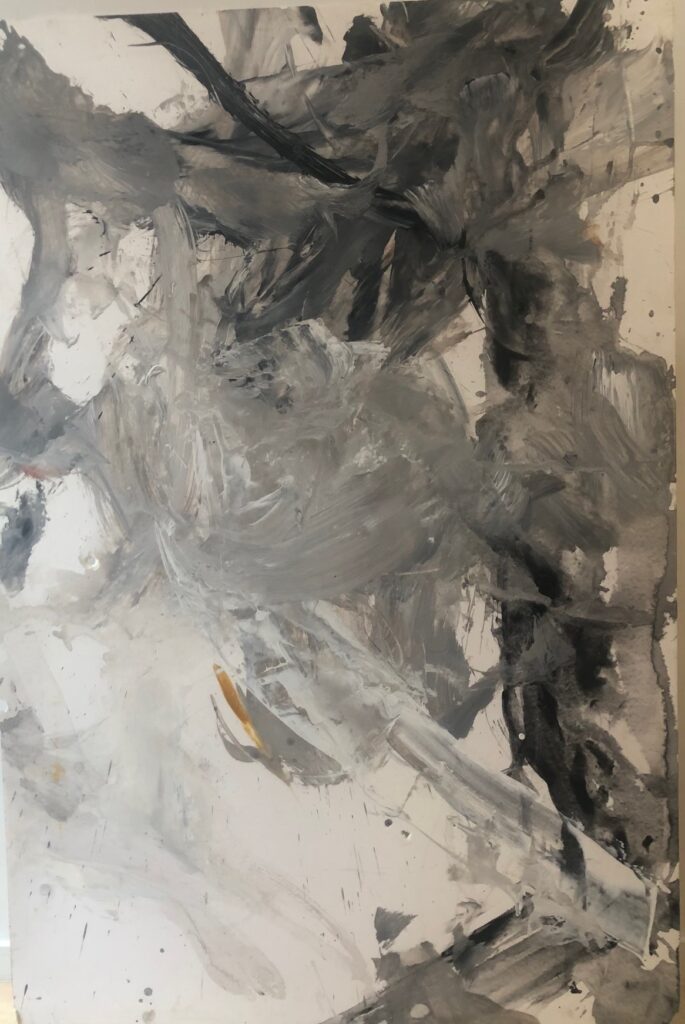
With Jackson Pollock’s huge historic work “7A” from 1948, which seems like the fairy tale cow to leap up in paint up and over the sky and back down again, obtaining a headline grabbing $181 million at Christie’s this season, action painting has surged back into the mass consciousness of contemporary culture. While many artists tip their backwards baseball hats here and there to the mid-twentieth century season of splurge canvases, one painter continues the tradition with an at a moment’s notice zero-to-sixty velocity: Barnaby Ruhe. Meanwhile, simultaneously as a trans-literal artist he transfers his quick-witted dynamism into his handling of paint.
Ruhe’s fabled former loft (after a ruinous recent flood he has a new one in the same building) at the Westbeth artist’s housing complex for years overlooked Roy Lichtenstein’s compound, and from his front windows one could glimpse one of the pop master’s bold cartoonish, yet serious sculptures—works whose exclamatory “ZAP,” “BAM,” “BOOM,” and “WHOOP” energy robustly hint at the forces Ruhe unleashes onto canvases in paint and on notebook pages in pen and ink.
As a practitioner of the ancient aboriginal art and sport of the boomerang, shaman, constant art-world presence, agent of art and literary world co-mingling, and peripatetic whirling dervish tornado cyclone, Ruhe’s practice in both West Village and Lehigh Valley of Pennsylvania is one of motion within commotion. His paintings move with the spirit of the spontaneous vitality that defined Pollock, but also with furtive strokes of DeKooning and carry an ever-changing current and charge like an electric blue eel waiting to sizzle up an underwater picture.
The artist’s Dutch New Amsterdam/New York lineage even links him as a distant cousin to Theodore Roosevelt—who joyfully charged into any environment, consequences be damned. Like his myth-making relative, Ruhe attacks life and art with fearless momentum. Whether sizing up a scene or diving into the “exquisite corpse” of collaborative surrealist games, Ruhe consistently delivers the surprising, missing piece that brings the whole to completion as if he had planned the serendipity all along.
Though indeed sometimes it seems like Ruhe makes paintings the way he makes home fries—fast, sliced, slap-dash, but enhanced with a bunch of seasoning with joy, that joyful intensity finds new expression in the works as they rumble towards being declared done.
So as the art world revels in Pollock’s record-smashing return to the spotlight, Barnaby Ruhe is a thriving reminder that action painting is not a relic of the past but can be a vital, ongoing practice.

true story. Ruhe