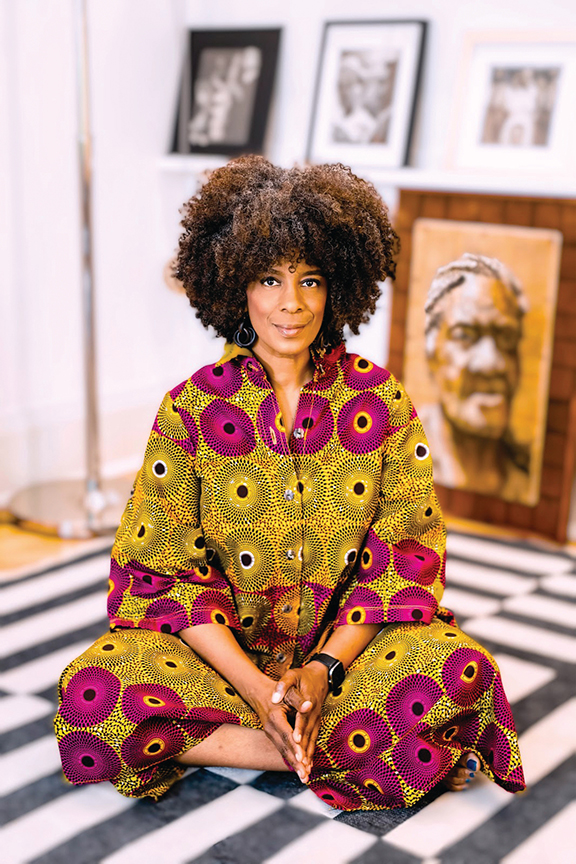
The first time I met Oneika Mays was in the sanctuary of the historic Abyssinian Baptist Church in Harlem. A quartet of musicians from the New York Philharmonic was playing a Mozart sonata, and between movements Oneika spoke about how metta—the Hindu and Buddhist practice of offering loving kindness to all beings—is like sharing a favorite piece of music with others. The setting couldn’t have been farther from the desolation of the Rikers Island Correctional Facility, where Oneika spent over 10 years as a yoga instructor and mindfulness coach helping incarcerated women recover a sense of self-worth and even joy in the bleak surroundings.
Her book Sit with Me (HarperOne) recounts her experiences at Rikers and offers us all a glimmer of hope that sometimes the light of compassion can pierce the darkness of despair. The following week, we met at Tibet House in Manhattan, where she’ll be doing a workshop next winter. We sat in the gallery surrounded by tapestries portraying great Buddhist masters like Shatideva, who dedicated all the good karma he’d gained from his teachings to the beings imprisoned in the hell realms. That seemed like an appropriate place to begin our conversation.
In your book, you describe Rikers as hell. What did you see there that made you feel that way?
It’s hell for real, but not the way I imagined. I had this image in my head that Rikers would be dark and feel like the walls were closing in. But in fact, newer sections of the women’s jail look like high school: cinder-block walls painted bright yellow, blue, or purple; there’s a mural painted by some of the women in one of the hallways. It’s a tricky hell because while the place may be attempting to look cheerful, the psychological, physical, spiritual, and emotional violence that happens there against this bright, cheerful backdrop is awful. Everyone is suffering.
Everyone? The guards, too?
The people incarcerated there the officers, everyone. I can say confidently after working at Rikers for 10 years, everybody is going down there; everybody is suffering. Rikers is a culture of misery.
You described your office as a kind of a refuge for the women who came to see you. What was it like?
My office was in a trailer. It was very small. It was an old exam room. They’d taken out the exam table, but it still had a cuff bar where people used to be chained during examinations. I had a desk, a chair, and a big, six-foot purple yoga mat that took up most of the floor. There were tapestries of lavender fields on the walls, and I’d spray the room with sage or other essential oils.
You wrote that it had a window.
Yes, a little two-by-three-foot window that opened a crack and you could see a patch of grass outside. The rec yard at Rikers is blacktop; there’s no grass anywhere, so the sound of a lawn mower and the smell of fresh cut grass through my window could be a moment of connection to the outside for some of the women. It was a place where they could breathe. I get emotional when I remember one woman who compared being in my office to sitting on a porch in a rocking chair. It’s so simple and beautiful to enable people to have that kind of experience. And not as a way of dissociating. They knew where they were. But I was able to help them find a safe space within themselves in a place where there are no safe spaces.
Mayor Mamdani said he’d do his best to close Rikers by next year. Do you think he will?
I’m hopeful. But I guess we’ll see.
You wrote that you wouldn’t mind seeing Rikers burned to the ground.
Oh, yes. That would be lovely, and I’d sit on the other side of the river and watch it burn—with some popcorn.
Were you ever hopeful that conditions there could change?
In the beginning, maybe. When the Wellness Program opened it was disruptive in a good way, a positive change. But then, like anything that’s part of an enormous system, it got swallowed up and became part of the routine. I wasn’t bitter. I knew we weren’t going to change the institution in any fundamental way, but I was passionate about the work I was doing and thought it was making a real difference in the lives of the women incarcerated there.
You’ve emphasized that Rikers is a jail, not a prison. What’s the difference?
A prison like Bedford Hills Correctional Facility upstate is where people go to serve their sentences. In a jail like Rikers most of the people incarcerated there are waiting to go to trial, sometimes for months or even years. The delays got worse during and after Covid. I knew people who were there four years or more. If you can’t afford bail, you’re stuck.
What kinds of crimes were they accused of?
Everything from shoplifting to murder. I treated them all the same. I wanted them to feel better. Not everybody who’s murdered someone is unjustified, like in a lot of cases where intimate partner violence is involved. But there were officers who didn’t think incarcerated people deserved a yoga and wellness program, or just to be treated with kindness for that matter. They saw the place as a punitive institution, even if the women hadn’t been convicted of anything yet.
You write that when people left your office, they’d sometimes say, “I love you,” and that you didn’t know how to respond at first. Why?
Partly, it had to do with how the officers would perceive it. Simple acts of kindness could be misinterpreted. I’d been screamed at for hugging an inmate because they think you’re passing them something. But it also had to do with my own hangups. It felt awkward because I didn’t feel worthy of their gratitude and love. After a while I relaxed and came to feel if someone is expressing love to me, I should say “I love you” back. That felt good. It felt like a real fuck-you to the system, too.
One of the most disturbing sections in your book is your description of trying to do mindfulness training with women in solitary.
It was ridiculous. The women would be let out of their cells, but they’d have to be shackled to a table. How are you supposed to talk about self-love and agency to someone with a shackle on their leg?! One time, they’d been a fight and the women were locked down in their cells. Someone was screaming “Fuck you! Fuck you! Fuck you!” This piercing screaming, while I’m trying to talk to someone about being mindful through the little slot of a window on their cell door. The inmate thought it was ridiculous, too. Because it was ridiculous.
What’s it like thinking about that now?
That was the hardest chapter for me to write because I’d suppressed the experience and as I was writing I was right back there: the smell or urine, the screaming, and the pain on people’s faces. It’s still very alive inside me. And I don’t know if I ever want it to go away.
Why not?
Because it helps me remember that none of us are free as long as a place like that exists.
Wasn’t solitary confinement banned a few years ago?
If it was, they’re not enforcing it. There’s still solitary confinement, where people are only allowed outside of their cells for an hour a day, only they’re calling it “punitive segregated housing.” There’s another unit called CAPS (Clinical Alternative to Punitive Segregation) for people with mental illnesses who’ve acted out violently. Regardless of what it’s called, it’s solitary.
Near the end of your time at Rikers, you write about feeling compassion fatigue. What you mean by that?
It’s a way of describing job burnout for healthcare providers and people who provide frontline service in conditions that don’t sustain them. Like Dr. Robbie in this season of The Pitt. Your ability to offer compassion gets exhausted and your feelings of frustration and anger start to leak out inappropriately. Most of the time, mine didn’t leak out at Rikers, but they were leaking out in my personal life. I was snappy. I thought that everybody’s problems, including my own, were bullshit compared to what I was witnessing at work every day.
When you decided to quit, you wrote that you thought you might be doing more harm than good, that you might only be helping people relax so they could feel better about being in a cage? Do you still feel that way?
I do feel that way. People used to hear about what I did, and they’d say, “Oh, that must be so good for people.” And it was. But it let Rikers off the hook, and I don’t want anything to let Rikers off the hook. Anything that’s a justification for keeping that place open—no matter how well intentioned—is doing more harm than good.
Photo by Keith Bratcher