What can white musicians say in jazz? That’s no small question, particularly today. The goal of the Trump regime and American conservatism in general is to restore segregation (a form of apartheid) to society so there is no challenge to the political, economic, and social status of the white majority. You’d think that being the majority, these people would feel safe from challenges. But racism is inextricable from fear and stupidity, and if you ever hear conservatives talk about culture, it’s clear they know that American culture is glorious because of African Americans, while they, the conservatives, have nothing to contribute except barbarism.
So what a white musician can say in jazz is something like, in spite of the unimaginable hardships and depredations, Black musicians created this incredible music, one of the triumphs of American possibilities, and I hear it and I love it and what they’ve done, and their America is also our America, I want to live in it and honor and celebrate and perpetuate what they’ve given this country.
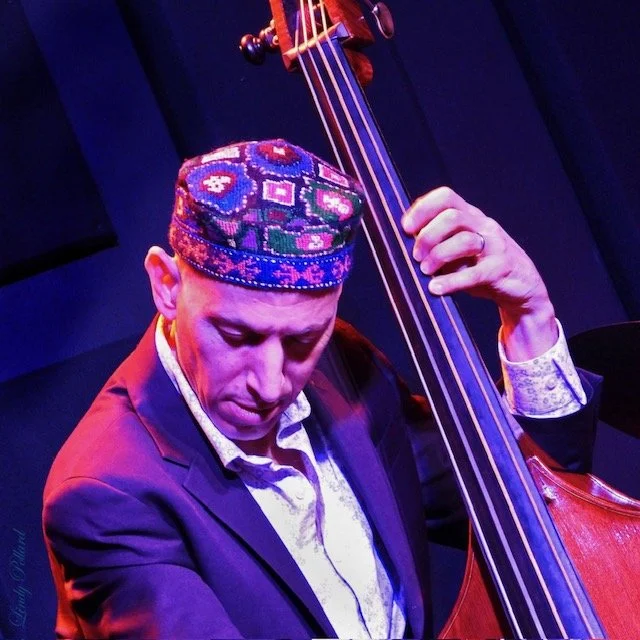
That’s what bassist David Ambrosio aims for with his new album, Civil Disobedience (Blue Frog Records), a quintet (saxophonist Donny McCaslin, trumpeter Ingrid Jensen, pianist Bruce Barth, and drummer Victor Louis) date deliberately crafted to not only emulate the classic Blue Note albums of the 1960s, but with material from that era. Some of the key tracks on the album—James Spaulding’s “A Time to Go” (a tribute to Martin Luther King, Jr.), Harold Land’s “Poor People’s March,” and Joe Chambers’ “Ankara”—are straight from some of the great albums of the era.
Asked what he wants listeners to hear from the album, Ambrosio responds, “First and foremost, I want people to hear these compositions because they are about an energy of that time. Musically, they’re so interesting, and there’s a lot of value in that they weren’t heard at that time from just a compositional, modern approach. What they represent … I feel like I’m kind of reviving some lost music that I think is really meaningful. Maybe some real serious jazz enthusiasts and those who are into digging up some lost music would know this stuff. But to be honest with you, most of the jazz musicians I know who are really pretty avid listeners and have pretty good record collections didn’t even know about this stuff. I want people to hear in this music the energy that it portrays and how it relates to now.”
The Blue Note albums from the ‘60s have that energy running through them, even if there is no explicit social or political statement. How could it not? Albums like Lee Morgan’s Search for the New Land, Bobby Hutcherson’s Dialogue, Jackie McLean’s Jacknife, Wayne Shorter’s Speak No Evil, and others crackle with the edge of artists dissatisfied with the status quo and use their language to pick it apart. The social context for jazz is that it’s a music created and pioneered by Black musicians, and in his liner notes for the elegant LP package of this new album, Ambrosio writes, “One of the wonderful aspects of the deeply communal essence of jazz is that we all gain knowledge from one another.” This captures an essential thing, that white musicians who play jazz are able to see this country and its culture in ways that conservatives, and many liberals, cannot; that the most civil thing is to see, be honest about, and honor the truths—not of power and hierarchy—of American culture.
Jazz is a preeminent one, and the story of it is about more than notes and rhythms in time, it’s about music as a reflection of its times, like that on Civil Disobedience. Music-making is a social activity mediated by an abstract language, and what people are thinking and living through and saying to each other comes through in the music, somewhere along a continuum of explicit statements, like Max Roach’s We Insist! to the seemingly unbothered coolness of Miles Davis’ live My Funny Valentine and Four and More albums that captured a 1964 concert performance to raise funds for the Congress of Racial Equality.
Black Creationist Canon
Through decades of jazz scholarship, there’s been a push-and-pull across racial lines about the origins and history of the music. The first story was more accepted wisdom than detailed truth: jazz was the sole creation of Black musicians. Inevitably, the revisionists came along, led by Richard Sudhalter with his 1999 book Lost Chords: White Musicians and Their Contribution to Jazz, 1915-1945. This was inflammatory when it came out, dismissed immediately by Wynton Marsalis and Gerald Early, among others. Sudhalter’s premise is more or less that white musicians were essential to the creation of jazz—if not responsible for it—and brought more roots of white European music into it than previously believed. Beyond his historical narrative, there’s plenty of pushback against what he called the “black creationist canon.”
There’s useful information in the book, but in logical and ethical terms, Sudhalter’s argument against race essentialism is itself race essentialism of the shallow, childish kind that thrills American conservatives, a capture-the-flag tribal glorification that misses the entire point of what jazz is and what America is culturally. He gets that jazz is a mongrel music, a mix of many elements—Tin Pan Alley tunes, ragtime, cakewalks and foxtrots, French songs and Afro-Cuban rhythms, calypso, marches, blues, Verdi arias people heard on cylinder recordings, etc—that musicians were playing at the time and, through practice, experiment, and inspiration, turned into jazz (a good book on these roots of American vernacular music is Elijah Wald’s How the Beatles Destroyed Rock ’n’ Roll).
Vernacular is the key here; this wasn’t Brahms going on long walks and working out symphonies in his head, later to be put to paper. This was music made to be played for and by the public (before the recording era), music heard in social situations in the parlors, saloons, dance halls, and brothels of New Orleans. Sudhalter tried to reset the origin to Chicago via the Original Dixieland Jass Band. This is simply wrong—the ODJB did play in Chicago, but were brought there from New Orleans, and that they released the first identifiably jazz recording, “Liver Stable Blues” in 1917 was a historical accident. To think this way is to substitute record making for the earlier and more common practice of live music making, which is insupportable now, much less a century ago when it was much harder to make and distribute records.
Jazz cannot be separated from vernacular music nor from New Orleans. In language terms, jazz is an American slang and idiomatic music that speaks across regional, social, and class vocabularies and dialects, which is incredibly important, and it’s that way because it came out of a port city full of peoples from all over the world, speaking all sorts of languages, cooking all sorts of food, dancing and drinking and sleeping together. Jazz, like their children, like America, is a mix of races. Of course there were white musicians who contributed to this, and Bix Beiderbecke, Benny Goodman, Frank Sinatra, Gil Evans, Keith Jarrett, and others have developed the music and been enormously influential. But saying Black musicians were not the sole creators of jazz, which is true, in no way cuts into the more important contributions of Black musicians, which were essential. If water is two parts hydrogen and one part oxygen, Black musicians were at least half the hydrogen and all the oxygen.
The politics of jazz in America didn’t come about, then, because of the segregation that Louis Armstrong and Duke Ellington faced, or because a cop beat up Miles Davis when he saw him in the company of a white woman, it came because it is one of the greatest things in American culture and created by Black musicians who were not legally treated as full citizens until 1964. Every note of jazz Black musicians made up to that point, even after, is the political act of someone saying “I exist,” much less “I am human, brilliant, beautiful.”