In 1968, a friend of Dr. Alec Pruchnicki returned from study abroad with a revelation: in Italy, healthcare doesn’t require insurance. “They don’t ask how you’re going to pay”, Pruchnicki’s friend told him, “they just take care of you.” That moment inspired Pruchnicki’s decades-long advocacy to bring that very system to the United States.
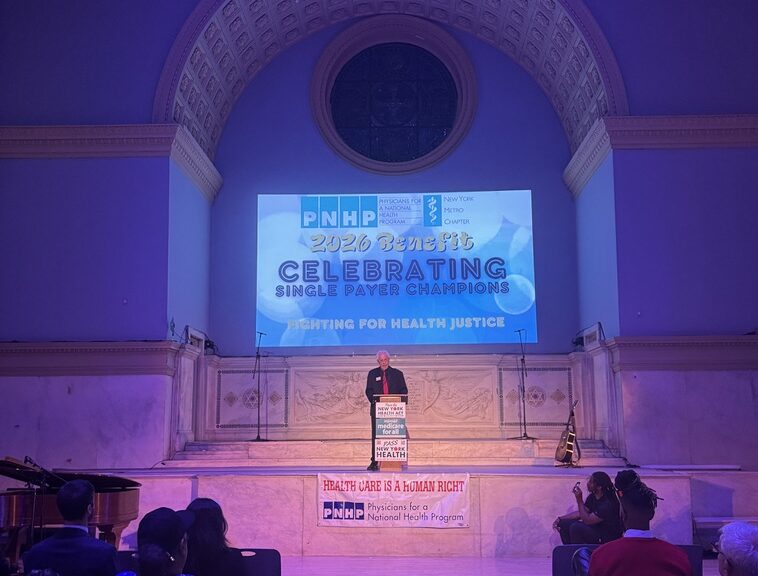
Last month, Pruchnicki was one of three honorees named a “Single Payer Champion” by the New York Metro chapter of Physicians for a National Health Program (PNHP), at the group’s annual benefit in Greenwich Village. He was recognized alongside Dr. Julie Wegener and the community group Our Bronx. PNHP’s New York chapter, founded in 1990, began with a simple, yet radical premise: healthcare should be free from profit motive. Today, PNHP, with over 25,000 members, remains the only physician group in the country solely dedicated to a single-payer solution.
For Pruchnicki and many of the other physicians in the room at the benefit, their most formative moments in advocacy began with their patients. Pruchnicki went to medical school at Albert Einstein College of Medicine in the Bronx, serving some of the most marginalized communities in the country. There, he saw first-hand the impact of profit-driven healthcare: insurance denials, discrimination, and the uneven distribution of care.
During his residency at Overlook Hospital in Summit, New Jersey, he saw that even in wealthy communities, patients were not immune to privatization. “You’d see the same problems,” he said, “insurance companies interfering with care because of financial issues.” He describes seeing patients turn down care they needed, just so they could leave something behind for their families. “I’ll take my chances,” he recalled them telling him. “I’ve saved up all this money. I want to leave it to my kids.”
For years, Pruchnicki did not see any opportunity to make a difference. “What was I going to do? Just one person against the whole healthcare system,” he said. That changed when he came back to New York and joined PNHP’s newly formed New York Metro chapter in the early 1990s.
Around the same time, the New York State Nurses Association and other advocates persuaded a Manhattan assemblyman, Richard Gottfried, to write a single-payer bill for the state. Gottfried introduced the New York Health Act in late 1991, and the Assembly passed it in 1992, one of the first single-payer bills of its kind to clear a legislative chamber anywhere in the country. It has since passed the Assembly four more times. Nevertheless, it has never come to a vote in the State Senate (despite periods of Democratic control of both chambers). Today, the Act, which promises to fold Medicare and Medicaid into a single state plan covering every resident, including long-term care, with no premiums, deductibles, or copays, remains unpassed and to-date, has not received endorsement by Governor Kathy Hochul.
However, Pruchnicki is quick to note that, just because the New York Health Act is still in limbo doesn’t mean progress hasn’t been made over the decades. Single-payer was once an idea that left people confused; today it’s familiar enough that even its political opponents must engage with the concept. “First we talked about single-payer, and people didn’t know what we were talking about,” Pruchnicki said. “So we started saying, this is like Medicare for All. And people understood that. People like Medicare. Now even the guys who are against it have to give a reason,” he said, “an alternative.”
Pruchnicki also points to concrete policy wins that serve as proof that advocacy work can make a difference, like the Affordable Care Act (the 2010 law that expanded coverage to millions under President Obama). More recently, the Inflation Reduction Act (IRA) of 2022 let Medicare negotiate the prices it pays for prescription drugs for the first time in two decades. The first 10 negotiated prices take effect this year, with 15 more due in 2027.
The IRA also delivered other changes that Pruchnicki has seen help his patients. It capped what people on Medicare pay out of pocket for prescriptions each year at $2,000 when the limit took effect in 2025 and $2,100 now. It also held their insulin costs to $35 a month, made recommended vaccines free, and closed the longstanding coverage gap known as the “donut hole.” Pruchnicki has also felt the difference himself. “By June or July I’ve used up the maximum, and then every time I pick up a medication the bill says zero,” he said. “It’s so nice to see that zero.”
Still, single-payer has a long way to go before it is a sure bet, and today it is facing a particularly vulnerable moment. Critics often point to its cost, the higher taxes, and the disruption to existing health insurance plans that unions spent years negotiating for their members. The compromise most often floated (the public option) lets people buy into a government plan while private insurers stay in business. However, Pruchnicki argues that this compromise defeats the purpose of universal health care. “The savings of single-payer come from cutting the administrative overhead and the constant fights over coverage, and adding one more insurer does neither. A public option just says, instead of 200, now you’ll have 201,” he says.
Meanwhile, the federal law known as the One Big Beautiful Bill, signed in July 2025, cut roughly $1 trillion from Medicaid, which the Congressional Budget Office estimates will leave about 10 million more people uninsured over the next decade. In New York City alone, 230,000 individuals are set to lose the no-cost Essential Plan in July 2026, and hundreds of thousands more could fall off Medicaid under new work-reporting and eligibility rules. At the same time, the enhanced subsidies that made Affordable Care Act plans affordable expired at the end of 2025. On average, subsidized enrollees saw their premium payments jump 58%, and many traded down to plans with higher deductibles to keep up.
For single-payer advocates, this upheaval has been the clearest argument yet for the New York Health Act. If Washington can pull coverage from hundreds of thousands of New Yorkers in a single budget bill, they argue, the state needs a guarantee of its own. Pruchnicki has watched this cycle before. “When the Democrats win, we get a few reforms,” he said. “When the Republicans are in, they cut them back, or we get nothing.”
Asked what ordinary readers can do, Pruchnicki’s answer was simple: find out where your elected officials stand on Medicare for All and on the New York Health Act, and hold them to it.