Let’s talk shampoo, a conversation that I think is long overdue. For years I bought mine from Arrojo, a local salon, in jumbo plastic containers. The products had none of the bad stuff—parabens, phthalates, synthetic fragrances—and I figured one big container uses less plastic than several smaller ones.
Then the algorithm started to feed me ads on Facebook for a shampoo bar with a funny name: Humby. The ads featured featured lovely women running their hands sexily through their long, thick, frizzless silver hair. I was skeptical.
I Googled “how bad are shampoo bottles for the environment?” Interestingly, most of the answers are from companies that make shampoo bars. Most of them repeat a statistic: it takes a shampoo bottle 450 years to degrade. I won’t even ask how they know. Another stat: each year in the U.S., 550 million empty shampoo bottles are thrown away, enough to fill 1,164 football fields.
The Head and Shoulders website rationalizes the situation this way (albeit not very grammatically or logically): “Just like your body is mostly water, so is shampoo. In fact, up to 80% of shampoo is water. This is particularly important because it ensures all the ingredients blend together so your shampoo can clean effectively.” Other websites put the amount of water even higher: up to 90 percent. Even if these numbers were exaggerated tenfold, even a hundredfold, that’s a lot of plastic bobbing and shedding in the sea.
I filled out the Humby hair questionnaire online. The Blueberry Fields shampoo and conditioner pair chosen just for me came in a small, unbleached cardboard box. They’re locally sourced with no chemicals. You rub the bars right on your head (though the shampoo becomes too soft to pick up; I pluck a smidgeon). They’re pretty. They smell like real blueberries. The tiniest bit of shampoo lathers up like crazy and keeps my hair clean for days. I’ve been using the bars since May and they’ve hardly shrunk. Why is it even legal?
My hair still frizzes at the least whiff of moisture and doesn’t show signs of thickening, as promised, but otherwise my main reaction is this: why is liquid shampoo in plastic containers even legal? Why did rigid shampoo containers ever become a thing? Whatever happened to Prell Concentrate in the skinny, flexible tube? The Prell Company, currently owned by AFAM Concepts, is mum on the subject, as is the Wikipedia entry. A vintage seven-ounce tube can be had on eBay for $75.
In a related thought about cleaning products, why do humans lug home jugs of laundry detergent sturdy enough to survive bombs when they could just buy little bags of powder or slender envelopes of detergent strips at the health-food store? I recently noticed that the strips are even available at D’Ag’s. Are clothes an iota or two whiter that important to the populace? Can manufacturers no longer build a machine capable of dissolving powder?
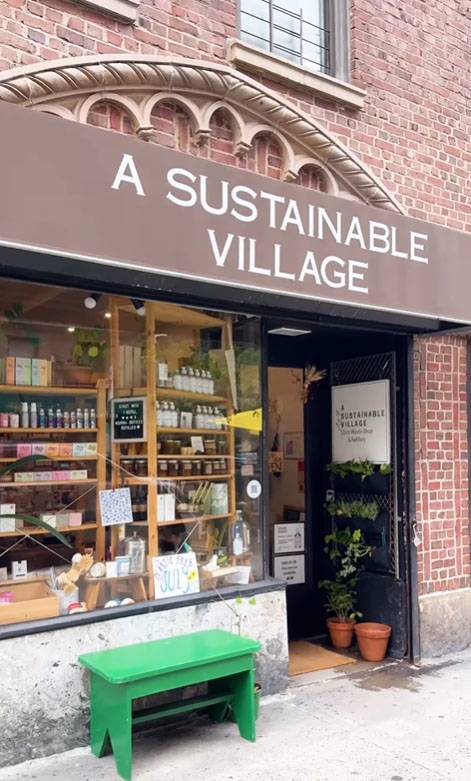
This brings me to a wonderful new store I discovered on University Place between 9th and 10th. It’s called A Sustainable Village, and it’s known in the business as a refill store and zero-waste store. It’s an attractive little space filled with goods that create virtually no waste (non-paper towels, makeup and deodorant in cardboard tubes, silicone and aluminum storage containers and more) along with products that can be refilled, either in pleasing aluminum bottles you buy in the store or in any containers you bring with you and put on the scale set to “tare.”
I’ve been trying out the goods. I started with toothpaste tablets in a tiny wax-paper bag, as do many new customers, I later learned. Half a tablet is plenty. You chew it for a minute like a mint. It grows foamy. You brush your teeth as usual.
The product that has me most excited is the reef-safe bulk sunscreen, because I’m horrified by those perennial articles about how to use the stuff properly. If you followed the industry guidelines (apply liberally, reapply every two hours) you’d go through a container in less than a week. All that plastic must be making climate change worse, which in turn increases the need for sunscreen: an insidious loop.
I bought one of the inhouse aluminum pump bottles and the woman on duty filled it for me. I dislike the feel of sunscreen on my skin. My verdict: this kind is less unpleasant than the drugstore brands. I adore the ease of the pump and the fact that I can reuse the bottle forever. With the holidays almost upon us, I’m looking forward to stocking up on sustainable gifts for my family members.
I decided to interview Em Hynes, the store’s co-founder and manager. I was impressed by her knowledge, drive, practicality and optimism. She’s refreshingly free of self-righteousness or absolutism of the sort that might turn off skeptics. What’s more, she has a movie-worthy life story.
Life experience
She comes from people who are indigenous to the Mekong Delta in Vietnam, and she comes to this zero-waste world out of first-hand hardship. Her father fought with the American soldiers in the war and then spent a decade as a POW, though not held fully captive. After that, when Hynes was five, the family escaped in the night to Cambodia and began a four-year journey from a refugee camp to resettlement in Bridgeport, CT, in 1989.
Hynes’ time in the camp left a strong imprint. “Saturday I would spend the day with other children going through the trash and looking for treasures,” she recalled. “Mainly the treasures were plastic bags we could sell for a penny or two to buy candy.”
Meanwhile her mother—one of 12 children, illiterate—would cross into Thailand and bring back desirable items like coffee, tea, sugar, ramen, tobacco. “She had this little ‘convenience shop’ in our hut,” said Hynes. “She’d sell the goods for a bit of a profit.” This enabled Hynes and her four siblings to get more nutrition than the humanitarian rations provided. “She kept us all alive in the camp.”
In Bridgeport the hard-working family moved quickly from welfare to home ownership. They didn’t die from the cold, as they initially feared. Hynes said, “I eventually went off to college on a student loan, made my way to New York, met my husband and started a career in fashion.” She grew disenchanted with the industry. In the back of her mind swirled dreams forged from the example of her smart, entrepreneurial mother.
Hynes was already living a low-waste life, which impressed her friends in New York. On long walks during the pandemic she and a fellow mom at her daughter’s school toyed with the idea of developing their own zero-waste products. When that proved too risky financially, they imagined opening a store that would showcase existing products. A great space in the East Village became available, and they took the plunge. They added the University Place location in 2023. Then her partner moved on and the East Village location closed because the building was being sold. This
left Hynes, whose kids are now 14 and 11, as sole owner of the University Place store.
“I’m very happy to run just one store,” she said. “I’m able to focus more on our products. And we decreased our costs and increased our sales.” She has formed strong relationships with local companies. She persuaded them to sell her soap (hand, dish and laundry) in 55-gallon drums. “When we run out they come in with a new drum and take the old one back to reuse. It’s a completely closed loop.”
She remains clear on her mission: reducing plastic waste. “That’s our north star. It helps us in so many ways; we don’t get distracted by other things. Any brand that aligns with our mission we investigate to see what else is good about them. We test to make sure the product works, make sure we like it, the quality is good and customers like it.” She is also wide open to recommendations from customers. And from her kids: they agreed with her that watermelon-flavored toothpaste tablets are disgusting, so she doesn’t carry them. With only 236 square feet, she has to be picky, carrying only products that move off the shelf and that don’t spoil.
Finding the right aluminum bottles was surprisingly difficult. “Because I worked in fashion and I am vain,” said the woman who comes across as anything but vain, “the bottle has to look aesthetically pleasing.” Several companies, she said, have created an aluminum line, but then reverted to plastic when the aluminum proved hard to procure. She found a 12-ounce aluminum bottle she likes, and now buys them in batches of 5,000.
She’s developed a bit of a side hustle selling bottles to others in her business. “They’re helping me reduce the risk because I’m not taking on the expense all by myself. I welcome other stores buying the bottles and putting their labels on them. It allows us to compete against big brands.”
A Sustainable Village currently has thousands of the bottles in circulation, and she dreams of reaching 800,000. Aluminum, in addition to its attractiveness and near weightlessness, has a well-established recycling infrastructure: some 70 percent of the aluminum ever made gets recycled. It can be recycled an infinite number of times. Roughly 8 percent of plastic is recycled, and it breaks down after one or two generations.
I asked Hynes how she convinces potential customers to rethink the impact their current consumption habits are having on the planet, and how much she thinks her store can move the needle.
People who walk in the door, she said, may already feel unhappy with the way they’re living, or have climate-change anxiety they want to alleviate. “We take the pressure off. You just have to make small investments at a time. Eventually when you reuse a container over and over you start to see that it’s a good investment. We’ll get there one day. I believe we will.”
A Sustainable Village, 50 University Place (646) 998-4015