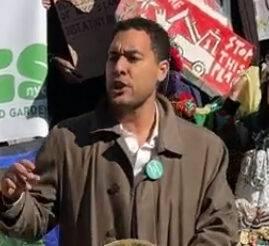
Brody Hale describes himself as “the poorest lawyer you’re ever going to meet,” but it’s his fierce intensity, sharp tongue and equally sharp intelligence that distinguish him. He is literally a man on a mission, a mission to keep Catholic churches from closing—and so far, his efforts have saved at least 20 churches across the country.
Will Hale get to add the Church of the Most Holy Redeemer to his win list? The blind Massachusetts attorney with the burgeoning, donations-only sideline in Catholic canon law may be what keeps the shuttered East Third Street church from the wrecking ball.
Conflicting communiques from the New York Archdiocese
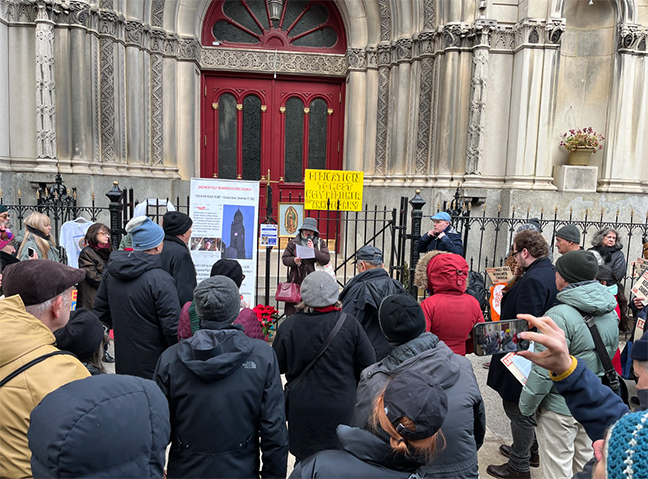
To the anguish of Most Holy Redeemer’s 300-plus parishioners, in July they were told by the archdiocese that their cathedral-like 174-year-old church, long an unofficial landmark, would close at the end of August, for lack of clergy to conduct services.
More recently, in December, the archdiocese shifted its rationale for closing. Parishioners were told they couldn’t open the church to celebrate mass because of an unidentified safety issue.
And yet the church was briefly opened for one day on Jan. 17, for a funeral service, triggering Hale’s ire at what he sees as diocesan deceit. At a Feb. 21 save-the-church event at Mary House, the Catholic Worker residence and soup kitchen, Hale declared, “Speaking as an attorney, I’m going to tell you right now: Anybody who’s facing liability [issues] isn’t going to open the place up…for a funeral where people can walk around willy-nilly as they see fit. It’s just not going to happen.”
Continuing his skeptical shredding of diocesan claims, he suggested that Most Holy Redeemer is no longer unsafe—if indeed it ever was. This prompted another volley of irate logic from him: “Why isn’t it open now?” he asked, noting that none of the official steps for closing a church have been followed. “Most Holy Redeemer Church has not been deconsecrated. Most Holy Redeemer-Nativity parish (the merged parish with the closed Church of the Nativity) has not been eliminated. No decrees have been issued against either [the church or the parish].”
He proclaimed, “I fail to see on what canonical basis the Diocese of New York right now is preventing people from having mass services regularly and is preventing people from entering for private prayer. I fail to see on what grounds these things are happening. If someone is here and wants to tell me, appreciate it!”
In response to a query from the Village Star-Revue, archdiocese spokesperson Joseph Zwilling repeated that Most Holy Redeemer has been “temporarily closed due to safety concerns, until the building can be made safe.” He confirmed that the Jan. 17 funeral had taken place, explaining that “the pastor determined that the congregation for the funeral was small and the affected area inside the Church was able to be isolated and not used during the funeral mass.”
Hale expressed frustrated disbelief at Zwilling’s statement, observing “I feel like I’m constantly having to deal with someone running a con game when I deal with members of the church hierarchy. There is no transparency.” He speculated that the alleged safety issue was the patch of plaster that had fallen from the ceiling of Most Holy Redeemer in early summer; the small affected area by the altar had been roped off and the church had continued to be fully operational for weeks afterward, packed with parishioners during services.
The parish administrator has not responded to parishioners’ requests to see an engineering review and a repair plan. No work has been observed and no plans or permits have been filed.
A national scandal?
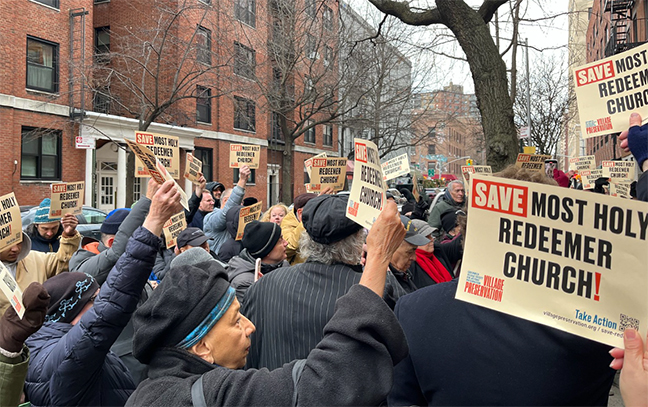
At the February event, Hale and the Save Most Holy Redeemer crowd made clear their fear they’re being played in a vast swindle of money and real estate, with cardinals, bishops, and monsignors arrayed against them. Hale characterized the wave of Catholic church closures nationwide as the hierarchy’s venal betrayal of the faithful, with church higher-ups treating churches and parishes as “nothing more than poker chips in Vegas to be cashed in to pay for whatever mess they’ve gotten themselves into or whatever pet project they would like to undertake.”
That theme was underscored by the documentary shown and discussed at the February event, “Foreclosing on Faith: America’s Church Closing Crisis.” Released in 2018, the film forcefully argues first, that the scale of the continuing closures are directly tied to the Church’s obligation to pay damage awards for sex abuse and second, that Church leadership have been carrying out these closures in stealth and bad faith, with no regard either to canon law or parishioners.
Follow the money
In Manhattan, since 2003, more than a quarter of Catholic churches have been sold. Most Holy Redeemer parishioner Peggy Grocett, a retired educator who’s researched sale records, has estimated the total sale value at $620 million (with an additional $490 million for sale of land across the street from Saint Patrick’s Cathedral). Sales do not appear aligned with canon law, which allows the selling of churches only for “grave cause,” such as a lack of parishioners or funds—after all, the Church’s primary mission is supposed to be saving souls, which means prioritizing outposts and outreach.
Instead, what Grocett sees is a pattern of real estate profiteering, observing, “Surely it is not coincidental that so many of the church properties sold were in areas of rapidly escalating real estate value,” with three of the sold church properties especially valuable because they were along the route of the new Second Avenue subway.
As for Brody Hale, he points out that net proceeds from the sale of parish churches are supposed to go to the parish—and that there’s a missing $26 million from the sale of the nearby Church of the Nativity. Now an empty lot awaiting real estate development, Nativity, on Second Avenue between Second and Third Streets, was closed and merged with Most Holy Redeemer in 2015, deconsecrated in 2017, and sold for $40 million in 2020—yet today, there is only $14 million in the joint Most Holy Redeemer-Nativity parish account. With heavy sarcasm, Hale remarked “I find it hard to believe that between both parishes that there was a total of $26 million in debt, but hey, anything’s possible.”
Petitioning Rome
Despite appearances to the contrary, Most Holy Redeemer has not been officially closed. That would require the archdiocese to issue a decree, which then could be formally appealed to the Vatican. Parishioners from the Church of the Nativity reportedly were unaware of their right to appeal before they lost their church.
Because it’s not been officially closed, Most Holy Redeemer remains an “open” parish church. And that also creates grounds for appeal: by canon law, a parish church must offer mass at least on Sundays and Holy Days (and parish churches typically offer mass daily). This is the basis of Brody Hale’s petition to Rome. “This parish has been eliminated via what you might call a shadow docket. It’s been done entirely outside of normal procedures. No decree has been issued.” This means, Hale argued, “The parish needs to resume operations.”
He reported that “a very, very large package went to Rome in January. We will see what happens.”
Landmarking pursued
On the secular front, local officials and preservation groups immediately responded to the threat to Most Holy Redeemer by rallying to get it landmarked, which would prevent demolition and perhaps hinder sale.
Former Council Member Carlina Rivera wrote to the New York City Landmarks Commission in July, urging designation. She cited the church’s cultural and historic importance, reflecting the German-American community that built it, and also the building’s “immense architectural value, with a unique blend of Baroque and Romanesque influence. This combination is seen through the building’s grandeur and elaborate ornamentation.”
Rivera’s successor, Council Member Harvey Epstein, also supports designation, and spoke at a large save-the-church rally in December. Thus far, the Commission has only responded with a form letter acknowledging that the church “may merit consideration” for landmarking.