Gwendoline Riley broke boundaries when she came out with her sort of existentialist, prize-winning novel, Cold Water, at age 22.
Cold Water is full of humor that is wry, dark, and dry, and narrated by a young woman working in a distinctly American-style bar in Manchester. Gwendoline Riley herself worked in such a Manchester bar and uses her dark humor to describe the eccentric if defeated clientele who “carry their emotional life around like a dead rat in a box.”
That was 2002, when Cold Water was named one of the five best debut novels by The Guardian, and Gwendoline Riley received the Betty Trask Award.
And so it has gone, for a total of 7 novels, often prize-winning, or at least short-listed, making Gwendoline Riley one of the most highly regarded novelists within the British literary community.
Although known among the more serious British reading public, it is as a sort of writer’s writer who hasn’t garnered the kind of commercial success enjoyed by her esteemed contemporary, Zadie Smith. Perhaps the wider public doesn’t like its humor dark.
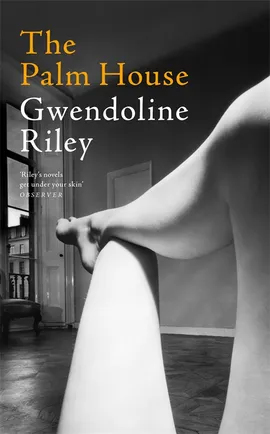
That same dark humor pervades her new novel, The Palm House, just out from NYRB in April. And just to make sure that she doesn’t have to get behind a bar again any time soon, Yale University has given her the $175,000 Windham-Campbell Prize at the same time.
Riley is relatively unknown in the US, and her propensity for keeping a low profile won’t help remedy that. She does not appear anywhere on the US edition of The Palm House, and she’s protective enough of her personal history that we don’t even know her birthday, just the birth year, 1979.
Gwendoline Riley grew up in the north of England and lived there during early adulthood, while writing her first novels. She was still working in that bar when her second novel, Sick Notes, appeared in 2004.
The Palm House is, like all her novels, short, sparse, and compressed. It is narrated by a woman, one Laura, living in London, but of northern English origins. She describes herself as “about 40,” which fits the age when Riley would have begun writing The Palm House. (I could note other such parallels, while insisting at the same time that personal experience is not the prerequisite for art, much less great art. After all, Joni Mitchell wrote the defining anthem of the Woodstock Festival without having been there.)
The present tense parts of The Palm House are set in a very literate London crowd, contrasting nicely with chapters set in the narrator’s past that are full of northern English speech patterns, regional colloquialisms and even dialect expressions, much of it embedded in the brilliant, trenchant dialogue of which a great deal of the novel consists.
The novel opens with the resignation of Laura’s friend, Edmund, from his editorial position at a major London literary journal, due to the appointment of a new, philistine boss who plans to dumb down the publication, even though it is successful.
Five sections, broken into chapters, alternate between present day London and the narrator’s dark, sad northern English upbringing (including a horrific episode of sexual molestation at 15, by a famous comedian), although satirical humor also abounds.
The chapters function much as panels do in multi-panel medieval paintings, implanting images in the reader’s brain. Riley accomplishes much with little, often using a single resonant word or short phrase much as an artist employs a striking brush stroke. “Determined abstraction,” “Bright, brittle competence,” and plenty of other jus- right phrases energize her prose.
The protagonist/narrator, Laura, is a 40-ish woman exploring the different interrelated worlds within a vast London. She is a freelance writer who sometimes contributes to the journal called Sequence, from which her editor friend Edmund has resigned. She has a love affair with an older actor working in the London theater world. She bounces around from one unstable living situation to the next, since London, like NYC, has become prohibitively expensive.
The Palm House of the title is the famous Victorian greenhouse of Kew Gardens, on the outskirts of London, and well-known to the London public as an iconic historic structure. It is a hothouse in which a tropical rainforest has been recreated, and rare plants thrive.
Perhaps The Palm House of Kew Gardens represents the hothouse atmosphere of the literary journal Sequence.
All I know is that the novel is magic from the very first page, where a scene is quickly set and characters spring to life the moment they open their mouths and speak. Gwendoline Riley has the gift of granting literary characters instant presence. And, though short, The Palm House somehow has all the weight and richness of a much longer work. Few writers have had this particular mysterious Chekhovian ability to evoke so much depth and resonance in a few lines.