“Disability rights are human rights! The future is disabled!”
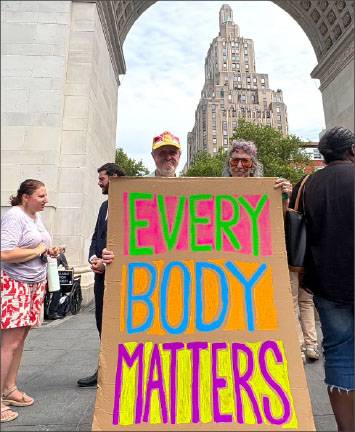
Perhaps two hundred shouting and signing disability activists, many in wheelchairs, converged by the arch in Washington Square Park on Saturday July 26, both to celebrate the 35th anniversary of the landmark federal law, the Americans with Disabilities Act (ADA), and urgently to warn that hard-won wins are at risk.
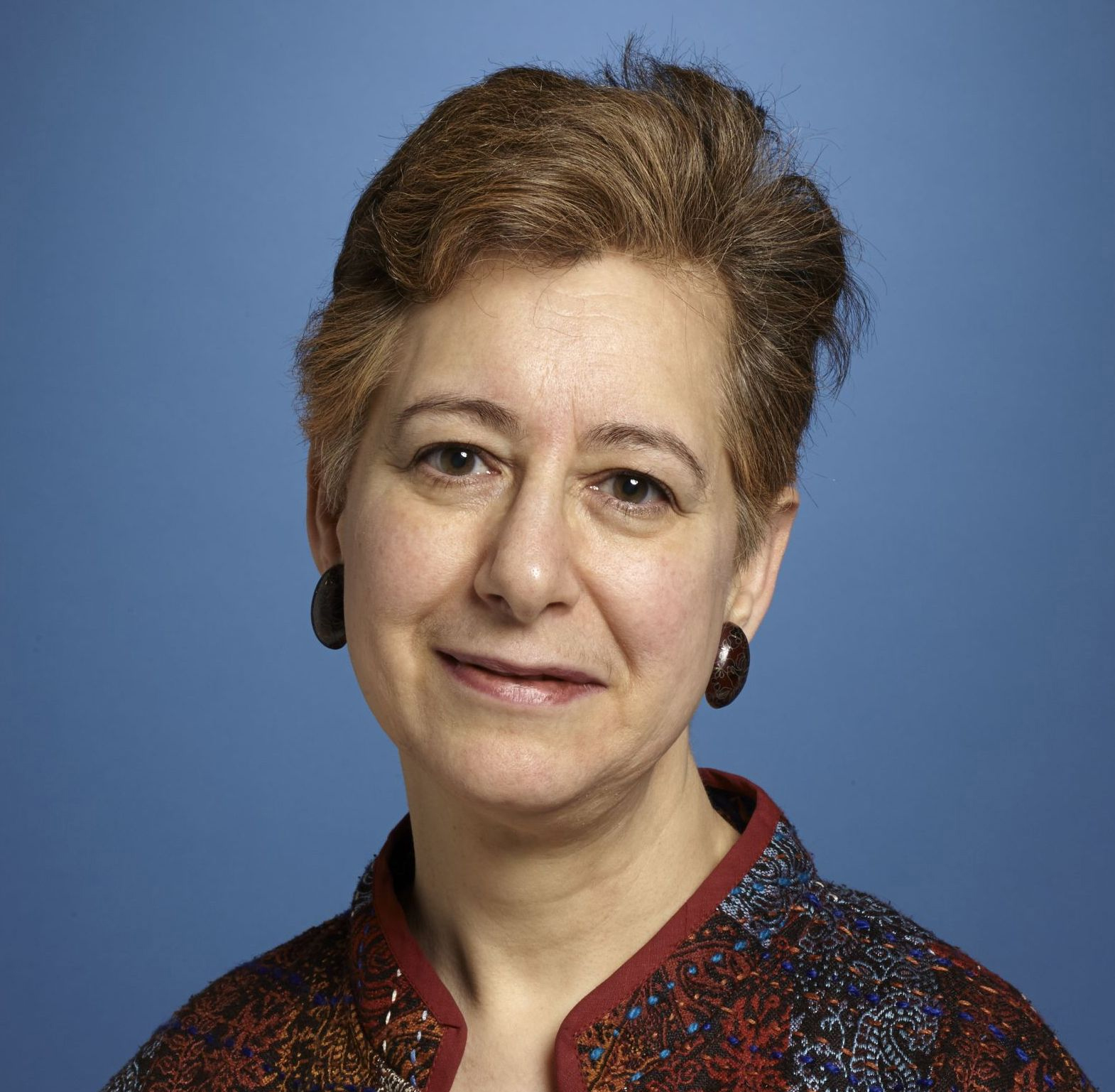
Jennifer Bartlett, an activist, author, and poet with cerebral palsy, who helped plan the event from her bed in a rural Icelandic village where she is getting a degree in Icelandic, launched the event. She remarked on the startling possibility that she could be on the news given that “people with speech impediments are never ever, ever, ever on TV or on the news.” The earner of two master’s degrees, she noted that she’s been “called retarded” and “discounted my whole life.”
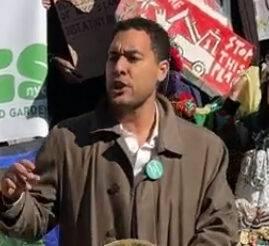
Activist Sasha Blair-Goldensohn underscored that the ADA is for everyone—protecting the one in four Americans who currently live with a disability, plus “the future rights of non-disabled folks, too.” He noted, “Disability can enter anyone’s life at any time, as I learned 16 years ago, when a giant tree branch fell on me in Central Park.” Now a wheelchair user, he’s been a leader of Rise and Resist’s Elevator
Access Group, which has forced the MTA into a legal agreement to triple the rate of subway elevator installation.
Dr. Sharon McClennon-Weir, the blind executive director of the Center for the Independence of the Disabled (CIDNY) spoke to how increased accessibility would make the city more open to everyone, tourists included. She celebrated the benefits “we take for granted” that have flowed from the ADA, easing the lives of all New Yorkers, beyond the 1.8 million with disabilities: “If you’re on a train or a bus, and you hear an announcement, that’s ADA. Every time you go to Starbucks, or Walmart, or Target, and you have that wonderful family restroom, that’s ADA. Every time you buy a book on audible.com or get an accessible book in the library, that’s ADA….When you’re able to go to a show…and get headsets…that’s ADA.”
Edward Yood, a longtime public sector worker with neurodivergent and auditory disabilities who chairs the Communication Workers of America Local 1180 Committee on People with Disability, passionately linked labor history to the current moment. He described new Medicaid work requirements as “a death sentence for many of us who have committed no crime, unless having a disability is now declared to be a crime as it was in Nazi Germany.” Quoting August Spies, the Haymarket labor leader wrongfully hanged, Yood declared that suppression of people with disabilities will backfire: “Here you will tread upon a spark, but…flames will blaze up. It is a subterranean fire. You cannot put it out.” He cited disability activists’ persevering resistance, including the famous 1990 “Capitol Crawl,” when wheelchair users protesting inaccessibility literally crawled up the steps of the United States Capitol, helping to win the ADA.
New policies put lives in danger
Mental health advocate Christina Sparrock, who lives with bipolar disorder and is the mental health chair of New York City’s 504 Democratic Club, warned that policy shifts and cuts to Medicaid, the Affordable Care Act, and the Supplemental Nutrition Assistance Program (SNAP) “put lives in danger. Without care, people with mental health conditions decompensate. That means more crisis, more unnecessary hospitalizations, and more harmful interactions with police.”
Disability leader George Gallegos, who described himself as “seated in a sleek, and yes, sexy, manual wheelchair” spoke to the “powerful call” for a seat at the table that once animated the disability rights movement: “nothing about us without us.” Today, he said, “I realize that our mantra is no longer enough, because every decision, every policy, every budget impacts people with disabilities, whether or not the word disability is mentioned. We are affected by transportation, housing, education, public safety, health care. It’s all about us. So today, I sit here and say…it’s ‘nothing without us.’ Not just when the topic is disability, but in every room at every table, in every conversation that shapes our future.” He declared, “We are not a sidebar to society; we are society….So to every policymaker, every agency, every ally: If you’re planning for the public, and we’re not in the room, start over!”
ACT-UP activist Lou Hill, a Mohawk-wearing, wheelchair-using, trans-masculine queer 16-year-old with chronic illness, urged ongoing attention to the most vulnerable and marginalized, emphasizing that he did not choose either disability or transness. “I hate that so many people would hate me based purely on being trans, and not the contents of my character. I hate that I would rather spend time deeply, skin-crawlingly uncomfortable [than tell people my pronouns]….I hate that when I went to a rally [to protect trans kids], I sobbed…because it meant so much to me that so many people actually wanted to protect people like me. I hate that I had to ask my mom if we could go to Canada if trans health care is banned, so I could get top surgery so I finally no longer feel alien in a body that was supposed to be mine.”
Inconvenient
Hill emphasized, “I did not choose disability, either. To protect trans youth is to also protect people like me—people whose disabilities and chronic illnesses are habitually deemed too ‘inconvenient’ for others to actually give a damn about us. I became sick at 13, and my life changed forever. I can’t attend school…. I don’t leave my house other than to go to doctor’s appointments, I’m in constant pain and deeply exhausted.” Still, he said, “what people don’t understand” is that people with disabilities and chronic illness fiercely want to work, and to be financially independent, at least as much as those who oppose their care want them to work and want to refuse financial support. “I can’t, and I hate it!” Hill declared of his own inability to function independently. “I may be different from other, able-bodied teens, but I have just as much to give the world as anybody else.”
Novelist and essayist Siri Hustvedt, who has written of the hardship and insight that come with chronic illness, including her own migraines and undiagnosed violent tremors, spoke bluntly of today’s backlash against people with disabilities: “Let’s call it by its right name, 21st century fascist eugenics.” She noted, “We have seen it before,” describing an onslaught of U.S. anti-immigrant, nativist, eugenic, and sterilization laws a hundred years ago, laws that inspired Adolf Hitler to create his own Aryan-loving legal code. Today, Hustvedt said, “disability rights are being crushed. The cruelty is not incidental. Sadism is elemental to fascist eugenics, then and now….The radical cuts in the Ugly Bill will force people into institutions, increase the suffering of millions, and kill many.” She declared, “Fear is what they want! We refuse to comply! Resist, shout, and tell your stories!”
A spirited slow march along University Place to Union Square followed the rally, with marshals from Rise and Resist helping to clear the way. Later that afternoon, about seventeen disability activists took their protests inside Trump Tower, where, according to the Daily News, perhaps eleven who refused to leave were arrested.