

Kelly Reichardt might be one of our era’s most subversive filmmakers. In this attention-addled age, cinema has gone increasingly loud, increasingly bombastic, increasingly frenetic. And not just in mediocre blockbuster franchise flicks, like Mission: Impossible—Final Reckoning or Tron: Ares, where you expect a certain kind of screaming antsyness; it’s found in more ambitious, highbrow films, too, like Eddington and One Battle After Another, where quiet moments are spaces to be shattered by violent externalities rather than interiority or reflection. Now, when we see any movie, regardless of subject or genre, we’re primed to be balls of anxiety, even if the movie we’re watching is a coming-of-age tale about a girl and her primate friend (The Legend of Ochi).
Reichardt totally rejects that mode of storytelling. Showing Up, from 2022, was gentle and loping, a peek into a community of artists where the biggest conflict is whether a certain work will be completed in time to be included in a gallery show. If you settle in for that movie and encounter a molar-rattling Hans Zimmer BRAAAM sound effect as someone reveals a bit of pottery from a kiln, something has gone seriously wrong. Showing Up is more in line with what Reichardt is known for: films like Old Joy (2006), Wendy and Lucy (2008), and First Cow (2019), which play like life, with revelation and devastation erupting from small encounters, without much fanfare and even less movie scoring. But now and then she’ll wander into more muscular genres, like the Western (Meek’s Cutoff, from 2010), or, the heist picture, as in her latest film, The Mastermind, which screened at the New York Film Festival and is in limited release. And it’s in these works where her subversiveness comes into focus.
You’d expect a movie about a privileged, charming underachiever (Josh O’Connor) orchestrating the theft of paintings from a regional New England museum in 1970 to be kinetic, thrilling, nerve-racking. It’s none of those things. Because only the first third of the movie is concerned with the actual heist. The rest of the 110-minute runtime deals with the consequences of titular mastermind James’ blithe naivety. His crew is bumbling: One of the best moments of the film is when the two thieves, robbing the museum while it’s open, are caught in the act, clad in work clothes and stockings as masks, by two elderly patrons who dismiss them as a cleaning crew—blabbermouths. And when one is caught sticking up a bank, he turns rat on James, both to the cops and the mob. The latter take the art; the former put James on the run, pulling him further and further away from his wife (Alana Haim) and two sons (Sterling Thompson and Jasper Thompson). And what begins as a heist film quickly settles into something more interesting: a deliberately incomplete character study of a dashing loser that keeps us engaged by making us work to fill in the blanks.
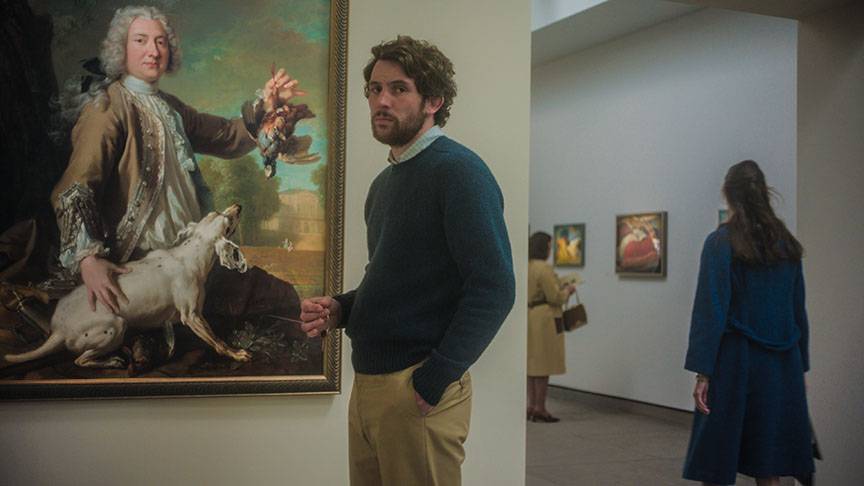
The Mastermind opens with James pilfering an old wooden chess piece from a museum display. A scene or two later, as he’s planning the big score with his guys, we see the chessman on a shelf, alongside other smaller, seemingly old items. Did he pinch those too? How long has he been doing this? Is this mild-mannered dad deep down a thrill-seeking adrenaline junkie? Is this a midlife crisis? Spoiler alert: we’re never told. We’re meant to supply the backstory ourselves. Likewise the paintings James targets. Why these four mundane Modernist works by an artist no one has heard of? When he crashes with his friends Fred and Maude while on the run, Maude corners James and says he took paintings that were meaningful to a former art teacher. Did he? Were they? Who’s the art teacher, and why’s he so important? Who knows. I dunno. Beats me.
Such opaque storytelling is emblematic of the era Reichardt recreates. The cinematography has this gauzy period look, while every actor, every set and location, every design choice brilliantly evoke America circa 1970. But her dramatic decisions, that kind of deliberate withholding of clues, undercuts the entire genre. James is a criminal; convention dictates we’re meant to understand why he broke the law, especially in such a brazen and confounding way. But Reichardt isn’t interested, to the point that when one of the crew pulls a pistol we gird ourselves for the inevitable: a murder, a misfire, a shootout. None of it ever materializes, even when violence seems imminent (like when he tussles with a security guard), Chekov and his gun be damned.
So what then is she concerned with? The answer is as open-ended as the film itself, but it seems that a major concern is control, or lack of it. James is a doting dad and caring husband (in his 1970’s way), but it’s clear he feels shackled by both institutions. His father, a big-deal judge, is a center of gravity he can’t pull away from. His mother loans him money because, as a frustrated furniture maker, he can’t seem to hold a job. He’s at the mercy of his crew, the police squeeze him, the mob robs him, and all around him is the ambient hum of authoritarianism, TV news talking about the escalating Vietnam War and the actions of Richard Nixon. His thievery—be it a small chess piece or a large painting—returns a sense of agency, a feeling of control. The only time he ever seems truly happy is when he hangs one of the stolen paintings on his wall. Here, he finally has accomplished something.
Of course, once he’s on the lam, control drains away completely. Eventually, after finding a passport left behind in some clothes (a dead man’s wardrobe?) in a dingy, short-term rental, James isn’t even James anymore. His charm disappears; he tries sweet-talking his wife into getting more money from his mother, only to be hung up on. And he robs an old lady of her pocketbook—a simply snatch and grab but a crime of violence nonetheless, one he would never have considered earlier. And in the end, he’s done in not with any intentionality or because he’s some famous art thief, but by the anonymizing brutality of a police force viciously cracking down on a peaceful anti-war protest march.
While the irony flirts a bit too closely with being O. Henry, it’s typical of Reichardt’s sensibility. We’re rarely masters of our fate, and sometimes life takes strange, calamitous turns. And then the story ends. Few filmmakers are confident enough to hit a point that feels right and roll the credits. But as The Mastermind brilliantly reiterates, Reichardt isn’t interested in convention. That choice is especially resonant today, when convention and conformity turn movies into a thin gruel pumped out for streaming services. In this environment, maybe subversive isn’t the right adjective for Reichardt’s cinema — maybe it’s transgressive.
The Mastermind is now playing in theaters across the city.