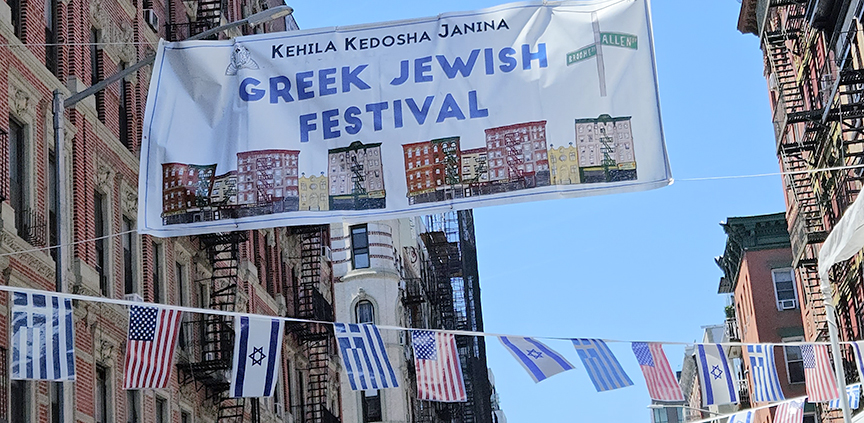
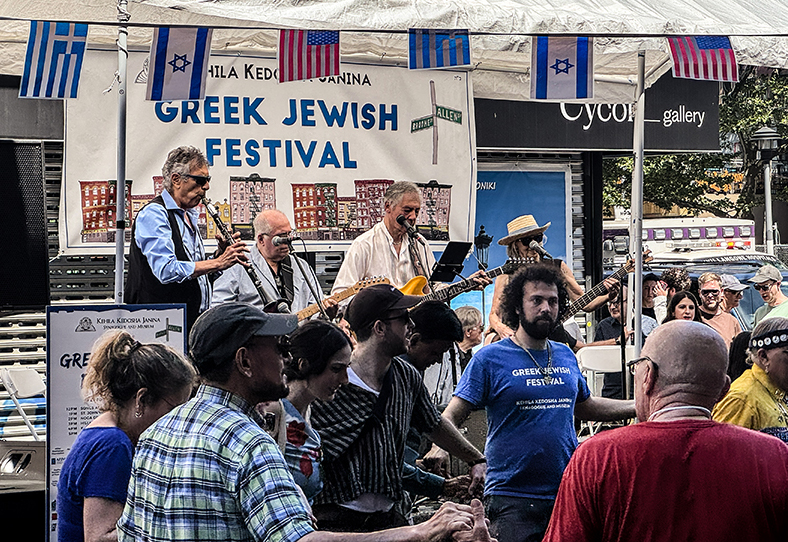
On Sunday, May. 17, Hellenic food, dancing, and music held sway at Congregation Kehila Kedosha Janina’s 11th annual Greek Jewish Festival, which took up the length of Broome Street between Allen and Eldridge Streets on the Lower East Side.
The festival lasted six hours, and several thousand people braved the 85-degree heat to attend. Familiar Greek foods like bourekas and Greek salads, as well as other Middle Eastern foods like hummus, were served. The only difference was that the food at the festival had kosher certification (known in Hebrew as a hechsher).
Worthy of attention
The festival also served to shine a spotlight on an unusual Greek-Jewish community, the Romaniote community. They have lived in Greece, mainly in the town of Ioannina, since the days of Alexander the Great. Historically, they spoke a Greek-Jewish dialect. Kehila Kedosha Janina is the only Romaniote synagogue in the U.S.
By contrast, the larger Greek Sephardic Jewish community, whose best-known settlement was in Salonika, can be traced to Jews who were expelled from Spain in 1492. They spoke, and still speak, Ladino, a Judeo-Spanish dialect.
The two communities are on very friendly terms, and the siddurim (prayer books) used by the Broome Street synagogue, Kehila Kedosha Janina, are Sephardic prayer books. A stall selling CDs of traditional Greek-Jewish music sold albums of both Romaniote and Sephardic folk songs.
Of course, anyone and everyone was welcome at the festival. Plenty of non-Greek Jews were represented at display tables, such as PJ Library, an organization that introduces Jewish books to children. (One book they sold was “The Fabulous Tale of Fish and Chips,” which tells how Sephardic immigrants introduced fish fried in oil to England.)
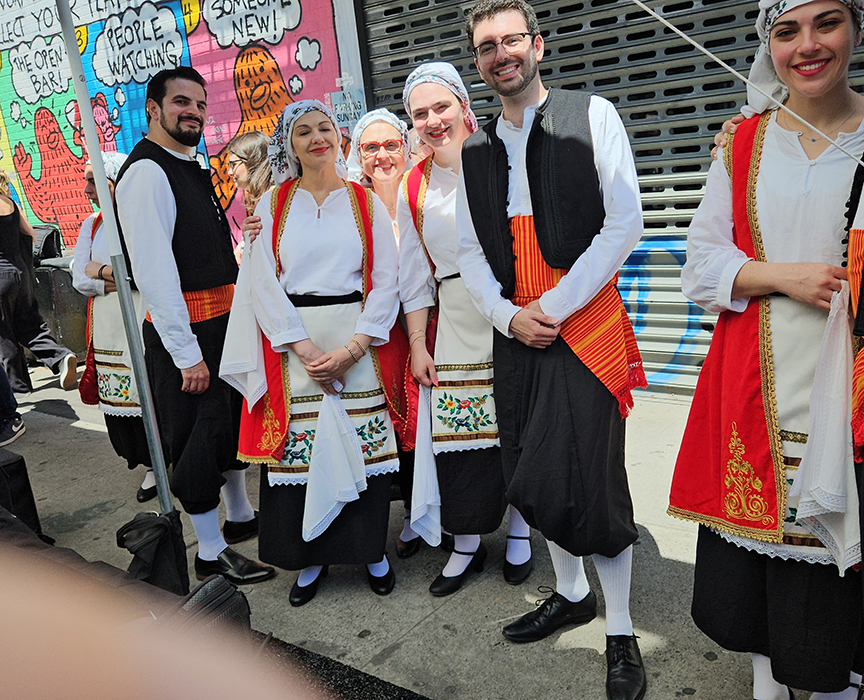
There were plenty of non-Jewish Greeks, too. One group of colorfully clad dancers, the St. John’s Hellenic Dancers of Blue Point, came to the festival from a Greek Orthodox church on Long Island. Representatives of both the Greek and Israeli consuls general, as well as a Greek Orthodox archbishop, made brief remarks. And is is unfortunately the case nowadays at Jewish-sponsored events, NYPD police vehicles were parked at both ends of the street.
This writer witnessed several musical and dance groups. The Fin Trio, both vocal and instrumental, sang mainly in Greek, although they did a version of “Sway” by Bobby Rydell (which, because of its minor key, has a Mediterranean vibe). They also sang “Never on Sunday” in the original Greek.
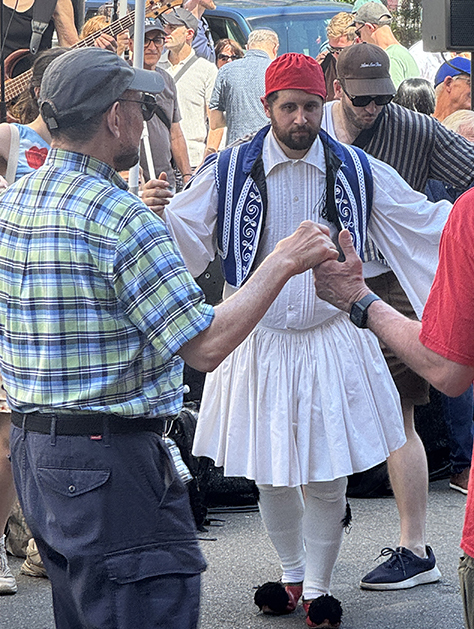
Some festival-goers started doing the Sirtos, a traditional Greek circle dance, and at least one yelled “Opa!” a Hellenic expression which can be loosely translated as “Well, all right!” or “Oh, yeah!” Later, the aforementioned St. John’s Hellenic Dancers looked striking in their red-and-white outfits.
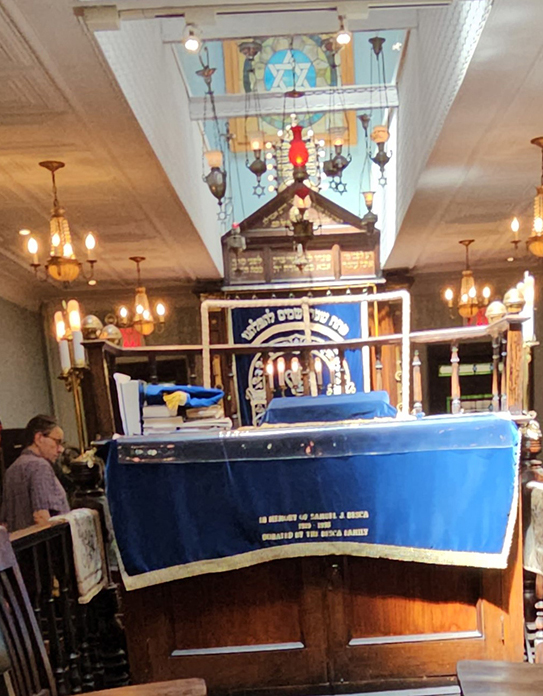
Several times during the day, one of the trustees, Elliot Colchamiro, led a tour inside the synagogue. It was built in 1927, when most of the Lower East Side was still a solidly Jewish area. The building was designated a New York City Landmark in 2004 and underwent a major restoration in 2006.
Colchamiro himself grew up in Brooklyn. “Most of the time, we went to an Ashkenazi synagogue in Brooklyn, and that’s where I had my bar mitzvah,” he said. “But our family went here for special occasions.”
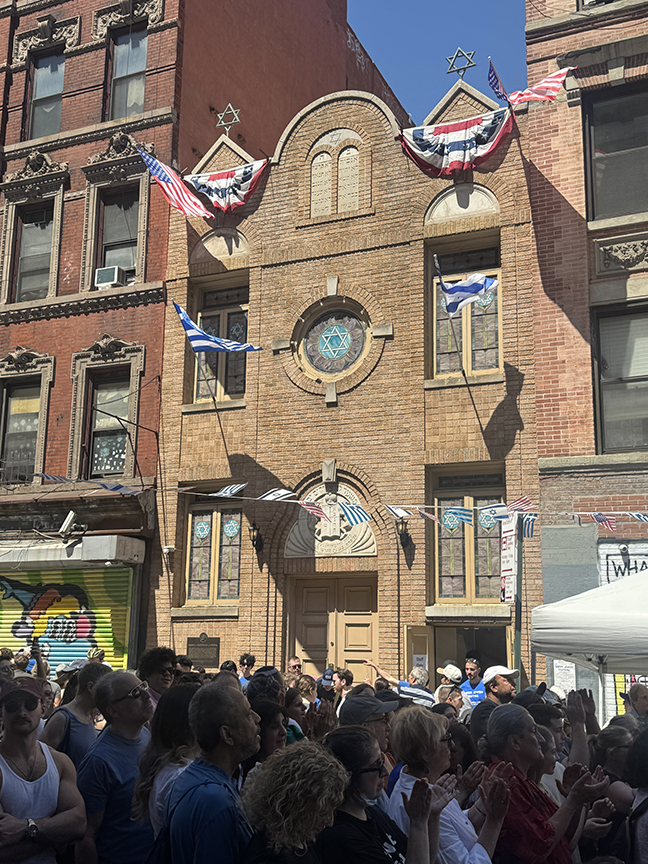
He pointed out several differences between Kehila Kedosha Janina and more mainstream Ashkenazic synagogues. Most readers will be familiar with synagogues where the bimah (pulpit) and area holding the Torah scrolls are combined. But here, as in most Sephardic congregations, the bimah is in the center of the sanctuary.
Eighty-seven percent of Greek Jews were killed in the Nazi Holocaust, with only Poland having a larger percentage of victims. Asked whether any Jews remain in Ioannina, he answered, “When I went there about 20 years ago, there were about 30, all elderly. Now, there are probably many fewer. They do have a beautiful synagogue, though.”