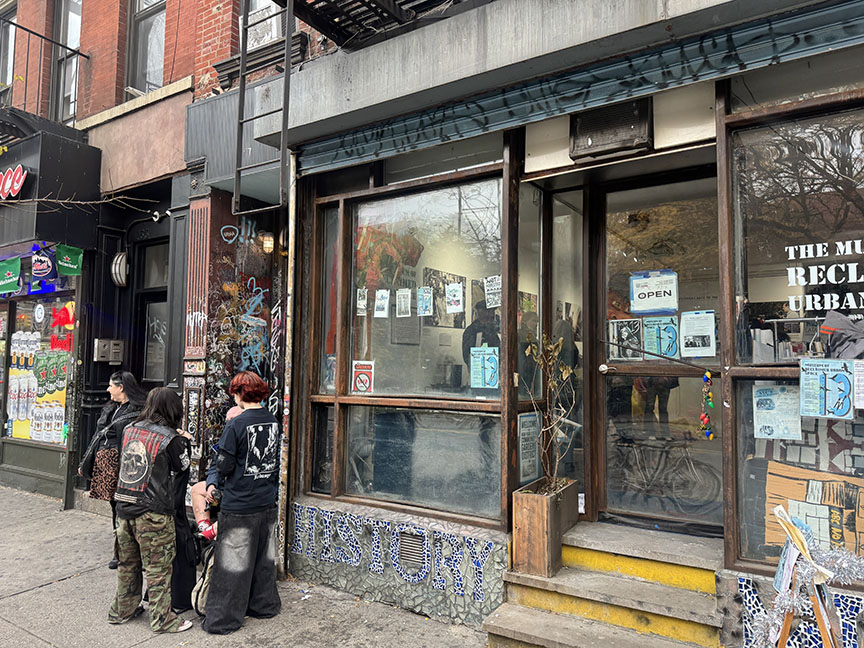
In a storefront like any other on Avenue C, between a burger joint and a convenience store, sits the Museum of Reclaimed Urban Space (MORUS). Though many museum curators stay shut up in their offices when not hunting for new acquisitions or donors, the same cannot be said about Bill Di Paola, the museum’s founder. On a November afternoon, Mr. Di Paola could be found in a nearby community garden he is on the board of, talking to a group of college students from Cooper Union. As the students dispersed, he began helping a pair of organizers set up a portable sauna in the garden. In response to questions about MORUS: “You got to talk while I work,” Mr. Di Paola said. “I’m trying to save the world.”
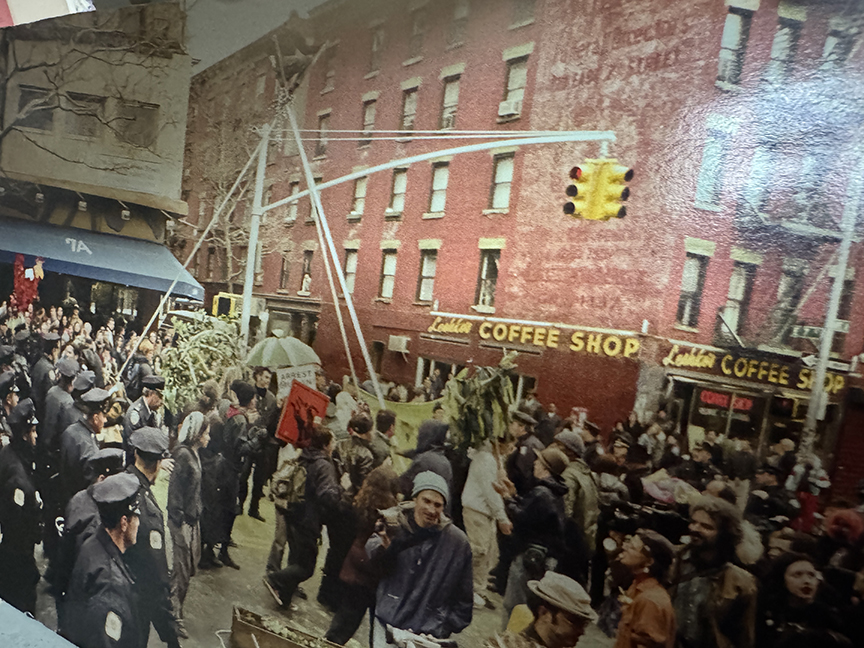
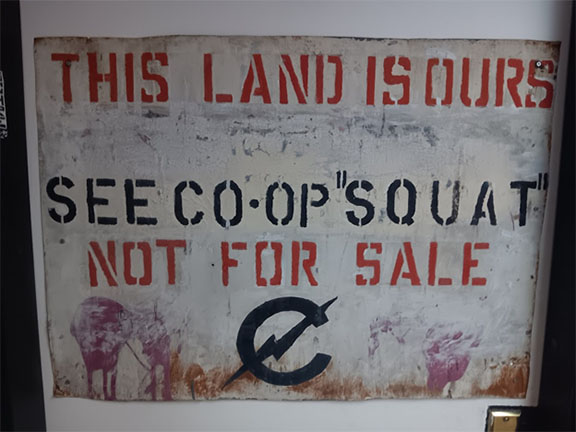
Mr. Di Paola is the co-founder of MORUS as well as the founder of TIME’S UP! an NYC-based environmentalist activist group founded in 1987. Mr. Di Paola and his co-founder, Laurie Mittelman, founded MORUS in 2012 to showcase the history of the Lower East Side, using one of the last still-occupied squats in the LES. The museum’s building was abandoned by its landlord during the 1970s recession, occupied by squatters in 1989, and eventually legally turned over to the community in 2002.
MORUS, together with TIME’S UP! hosts three hundred events a year, and exists to preserve three key pieces of local history. It also showcases numerous aspects of community activism, such as the use of surveillance in protests and ways of organizing communities, on top of selling books and zines.
The first bit of history preserved is the struggle of the people of Manhattan to keep their community gardens. Throughout the 1980s and 1990s, grassroots organizers on the Lower East Side turned abandoned lots into thriving community gardens. It was in those community gardens that large-scale recycling and composting—the law of the land in today’s New York City—began. Alongside community compost heaps, piles of horse manure from Central Park were brought down to be used to create fertile paradises; many other communities in the city followed suit in repurposing vacant lots.
In 1999, the city began a wide-reaching initiative to bulldoze community gardens to be developed for housing. Organizers were unable to get the word out about the city’s destructive initiatives via corporate media sources. Instead, to raise awareness, organizers built large-scale puppets on bikes to stage parades; stenciled graffiti and other street art around the city; and circulated zines, a poor man’s version of corporate media. Through their protests, the organizers were largely successful in preserving dozens of the city’s community gardens.
Mayor-elect Zohran Mamdani may support the city’s many community gardens, says Mr. Di Paola—on the other hand, he may elect to remove them in lieu of building more housing. “The city says the community gardens belong to the city,” said Mr. Di Paola, as opposed to belonging “to the communities, the ones who actually built them.” Mamdani in a recent press conference alluded to the city’s recent shelving of developing Elizabeth Street Garden after a ten-year legal battle with locals. Though the De Blasio and Adams administrations spent years trying to tear down the garden, Mayor Eric Adams has since backpedaled and tried to make it harder to destroy the garden, much to Mamdani’s chagrin, who hopes to renew housing initiatives that would destroy the garden.
The second aspect of history the museum preserves is the years-long fight by the city’s bikers to make the city safe for bicycle riders. Although today, the city has bike lanes used by athletes, businesspeople and food deliverers alike, this was not always the case. For years, the city opposed efforts by cyclists to make the five boroughs more hospitable for bike riders. Protests consisting of bike riders cycling in unison were shut down by authorities as “Unauthorized parades,” who saw the bicycle as another form of prohibited traffic.
The museum also preserves the memory of hundreds of cyclists who were killed in various traffic accidents, and the lackluster efforts of city officials to protect bicycle riders. One minidocumentary that plays on the basement’s television set showcases protests and memorials honoring city cyclists.
Bikes have always been powerful tools of change for the Lower East Side; literally in one case. In the aftermath of Hurricane Sandy, LES organizers hooked up a phone charger to a bicycle, allowing people to charge their phones with the power of pedaling. That bicycle now sits in the basement for museumgoers to enjoy.
The city now has a robust system of bike lanes, a system Mr. Di Paola hopes will continue to expand. At the same time, he says the city seeks to rewrite history, as though the city had always supported bicycles and had not only done so after years of legal challenges and battles. Now, City Hall acts as though they were always for bikes and has even commercialized cycling on a macro scale by promoting the Citi Bike initiative.
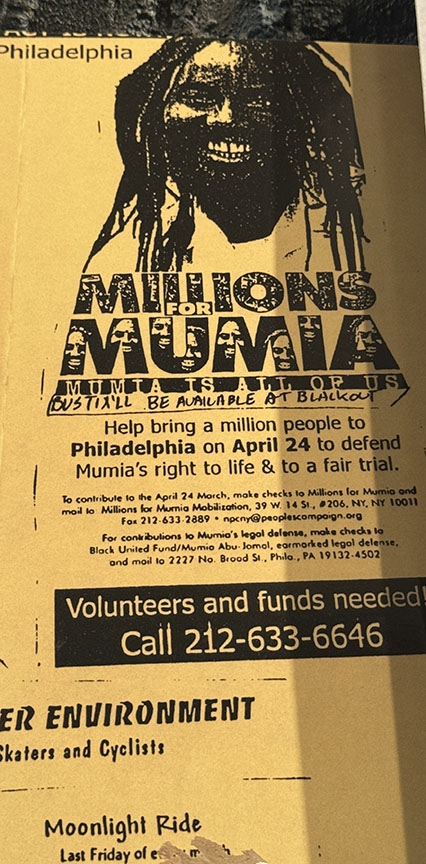
The third aspect of the museum’s history is the sense of community vanishing in neighborhoods all over the city. The museum seeks to remind people that community exists in the Lower East Side and that the gentrifiers have yet to get their hooks in all of Manhattan. Mr. Di Paola says the Lower East Side has a healthy amount of low- to middle-class households, so he feels confident about the neighborhood’s sense of community.
On top of all this, MORUS has to talk about what other people refuse to talk about. As examples, Mr. Di Paola cited the feudal system of recent graduates shackling themselves to corporations for healthcare, alongside corporations monopolizing housing in communities. As another example, he cited the acceptance of buying bottles of plastic water constantly. “Maybe you don’t need bottled water,” he suggested.
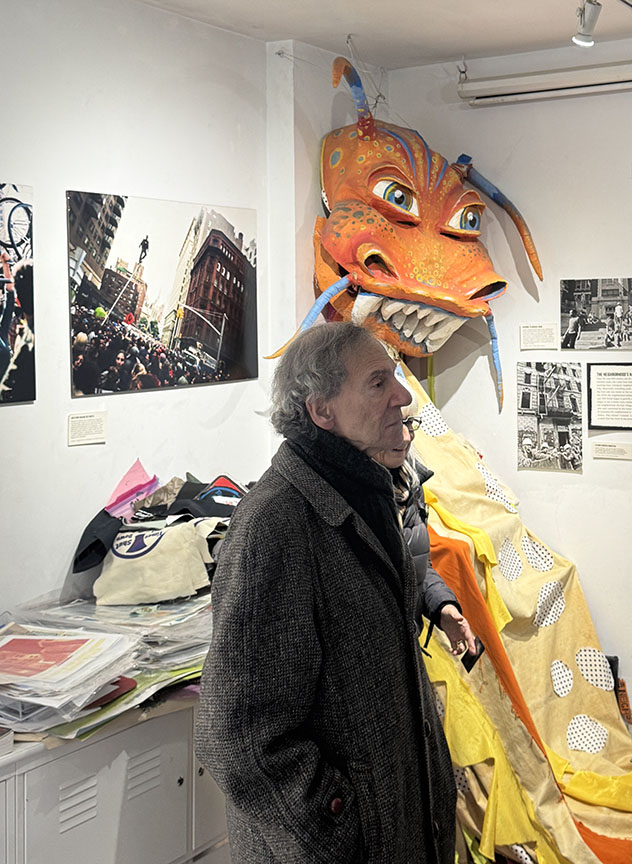
MORUS is entirely volunteer based, with its staff consisting of Mr. Di Paola and five to six interns at a time. Upon returning to the museum from the local garden, Mr. Di Paola immediately started helping an intern seal envelopes for holiday donation requests. “This is an old system,” Mr. Di Paola emphasized; MORUS eschews modern-day email blasts. Hundreds of letters were being prepared—a sizable number, but a drop in the bucket compared to MOMA’s or the Met’s number of benefactors. Fighting to save the world is always an uphill battle, but one Mr. Di Paola is tirelessly fighting.
On the note of saving the world, Mr. Di Paola acknowledged the challenges Mr. Mamdani faces in the aftermath of his electoral victory. “He’s particularly going to have a very tough time,” Mr. Di Paola said. However, he added that Mamdani’s greatest resource is not the potential of free buses, rent freezes or childcare—but hope, hope for change, hope for a better tomorrow.
The Museum of Reclaimed Urban Space is located at 155 Avenue C, New York, NY 10009. MORUS is open from 12 noon to 5 pm, Wednesday through Sunday. Admission is always free; a five-dollar admission is suggested.