“Please allow me to demolish this building so I can build luxury condos.”
That, in a nutshell, is a derelict landlord’s request to the New York City Landmarks Preservation Commission (LPC), according to Lower Manhattan District 1 Council Member Chris Marte.
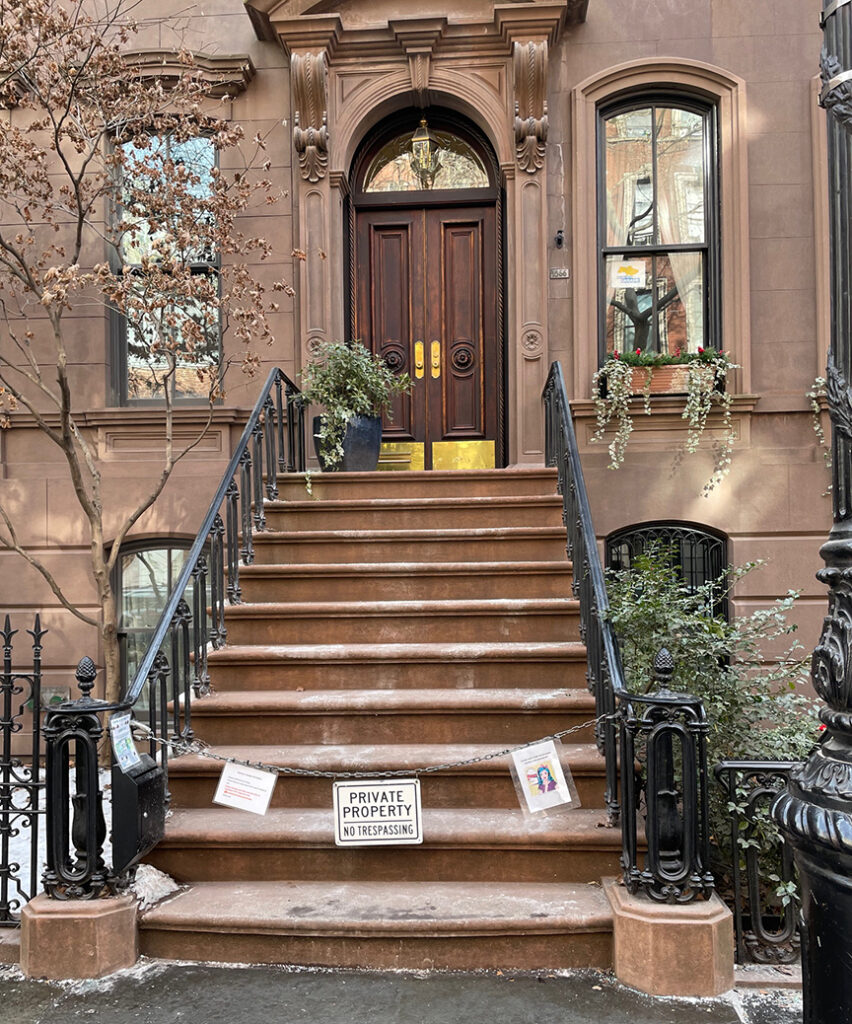
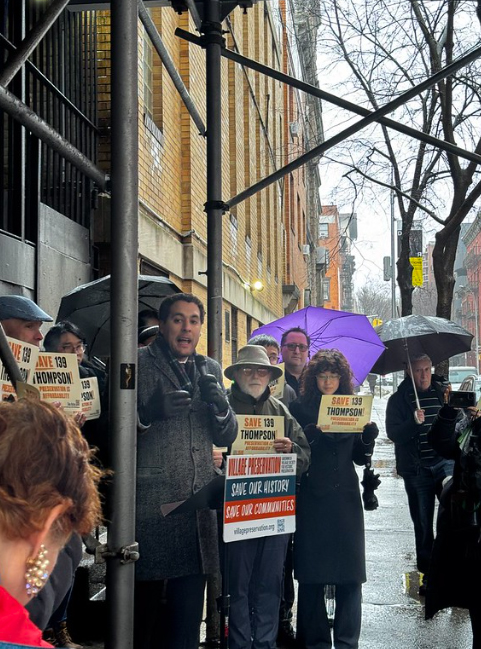
Speaking at a rain-drenched Feb. 20 rally to save the landmarked and vacant 150-year-old building at 139 Thompson St., Marte condemned the anonymous owner who, he said, had “chosen not to do repairs, chosen not to have new tenants come in,” instead deliberately letting a historic building with 19 housing units, 12 of them rent-stabilized, “fall apart.”
Referring to owners who attempt to subvert the landmarks law via “demolition by neglect,” Marte declared, “We see this all across Lower Manhattan. … This is not just an outlier … it’s a pattern, and we have to put a stop to that pattern.” As the newly appointed chair of the city council’s landmarks subcommittee, he proclaimed, “We are ready to fight.”
Rewarding disinvestment
Andrew Berman, head of Village Preservation, the local preservation advocacy group, described the owner’s proposed plans at 139 Thompson, part of the Sullivan-Thompson Historic District, as the convergence of “two of the worst trends we’ve seen in our city over the past couple of years.” Trend number one is the LPC letting “owners and developers neglect their [landmarked] buildings, let them fall apart, and even give them the okay for demolishing [them].” Trend number two is landlords replacing many units of affordable housing with significantly fewer units of luxury housing, in this instance “six super-fancy, super-luxury oversized condos.”
Berman suggested that the owner’s neglect was made obvious by the still-pristine condition of the building’s once-identical twin, right next door, properly maintained by a different and responsible owner. He also asserted that 139 Thompson could readily be repaired: “Within … blocks of here, we have buildings that are way older, some from the 1700s, all of which remain standing, all of which have been repaired, and renovated and fixed over the years, and that’s what they should do here.”
Valerie De La Rosa, Chair of Manhattan Community Board 2, spoke as both a community leader and as an economist, declaring “Public policy should never reward disinvestment, especially when it leads to a net loss in housing.” She decried the precedent that would be set if the LPC approved demolition “without compelling proof that preservation is impossible. It creates an incentive structure that rewards disinvestment….It will accelerate the loss of affordable housing units. This is not good policy and this is not what our community needs.”
Gary He, from Youth Against Displacement and the Coalition to Protect Chinatown placed this particular battle into the larger context of tenant struggles. He noted what can happen when buildings are occupied by organized tenants, describing the victory of rent-stabilized tenants at 83-85 Bowery. Evicted because their buildings were in dangerous disrepair, tenants won the right to return to their rent-stabilized apartments, repairs to their buildings, and $25,000 each in damages for having been made homeless for six months. “Real estate speculation … is at the root of the problem. We won in the Bowery … and we are gonna win here, too. We call on the city to stand by their affordable housing commitments, refuse to play the developers’ games, and maintain the landmark status of these rent-stabilized buildings.”
Frampton Tolbert, head of the Historic Districts Council, the citywide preservation group, emphasized that the threats to older housing stock, and the affordable units they often contain, are a problem throughout the city. “Bad stewardship should not be rewarded,” he noted. “We call on the LPC to do due diligence with an independent engineering review on whether this is an intentional case of ‘demolition by neglect.’ … We are skeptical the building is beyond repair and worry that approval will lengthen the list” of landmarks approved for demolition because of owner “neglect and illegal work.”
Jeannine Kiely, a Democratic district leader and candidate for the New York State Assembly District 66 seat now held by retiring Assembly Member Deborah Glick, spoke last. She condemned the “massive, massive loss of housing” entailed by the owner’s actions. “Bottom-line,” she said, “I want stronger state and city protections and review, and, if needed, net loss protections at the state level, because we cannot build our way out of this crisis.”
How will LPC rule?
At the time of the Friday rally, the LPC was scheduled to hear the owner’s application the following Tuesday, but the hearing was subsequently laid over to a date not yet set.
In early February, Marte wrote the LPC urging the Commission to reject the owner’s application. Marte observed that the owner allowed the building to fall into significant disrepair only after it had been designated by the LPC. All but two of 14 outstanding building violations and two “Class 1 ECB” (immediately hazardous) violations “have come since the building’s landmark designation, illustrating a steep decline in maintenance only after protections were applied.”
Marte’s letter also notes that the city has sued the owner for neglect, and that case remains open. “Permitting the demolition of this building would not only disregard the categorical failure by ownership to maintain their building, it would effectively sanction such gross negligence as a viable means of destabilizing rent-regulated housing, and of redeveloping a site despite its landmark status.”
The council member also raised concerns about how the building became vacant, noting that ownership provided Community Board 2 “no explanation of how these units were vacated or assurance that such action was done so legally.”
Legislation in the works
Meanwhile a small group of volunteers, calling itself the “Campaign for a Liveable City,” has drafted net loss legislation that it is seeking to get introduced during the current session of the New York City Council.
Talking to the Village Star-Revue, organizer Simeon Bankoff described the plans for 139 Thompson as a “clear example” of a larger problem—the city’s loss of 1,500 housing units a year to new construction, with an estimated 750 of those units being rent-stabilized. The draft bill would require a landlord with construction plans that would reduce the number of housing units not only to secure approval for that reduction, but to pay “a fee calculated to defray the cost to the city of replacing a commensurate number of units.” That fee would be deposited in a community-board specific capital fund and returned if not used within a specified time.
Several council members, Chris Marte among them, have expressed interest in bill sponsorship.