Ignoring community opposition, less than two weeks before ex-Mayor Adams’ term drew to a close, his administration gave the green light to the demolition of the landmarked Tony Dapolito Recreation Center at Clarkson and Varick Streets, as it approved the development of “Hudson Mosaic,” an apparently 350+-foot-tall tower at 388 Hudson Street, on a city-owned lot across the street.
In a December 18 press release, the administration touted the tower as a “first of its kind development combining affordable housing and a public recreation center.” Although the release did not say so explicitly, the planned recreation center at Hudson Mosaic presumes the demolition of the Dapolito Recreation Center.
Village Preservation, the 45-year-old membership organization that “works to document, celebrate and preserve the special architectural and cultural heritage of Greenwich Village, the East Village and NoHo,” slammed the plan, which it described as “shocking and disappointing” but not surprising. The group characterized “contempt” for community input as a “hallmark” of the Adams administration.
The organization observed that the plan is not “anywhere near approved or assured.” Mayor Zohran Mamdani, the City Council, local City Council Member Erik Bottcher, and Manhattan Borough President Brad Hoylman-Sigal all need to approve it, during a seven-month process known as the Uniform Land Use Review Process (ULURP), which has not yet started.
Council Member Bottcher has already expressed support for a tower at 388 Hudson; however, as he has also announced his intention to run for Hoylman-Sigal’s vacant state senate seat, he may not be involved in ULURP. A special election to fill the seat is expected to be set for the first week in February.
Saving Dapolito
The Tony Dapolito Recreation Center, on Clarkson and Varick Streets, built in stages starting in the early 1900s and landmarked in 2010, has been closed for repairs since COVID, more than five years. The long-standing community hub includes the former Carmine Street Pool, featured in the film “Raging Bull.” The pool’s famous Keith Haring mural dates to 1987.
The most recent city budget controversially included about $52 million for Dapolito’s demolition. In August, the Parks Department again confirmed demolition plans to Manhattan Community Board 2. Nevertheless, in a site visit with stakeholders, the Parks Department Deputy Director of Engineering apparently corroborated that repair of the center is feasible from an engineering standpoint.
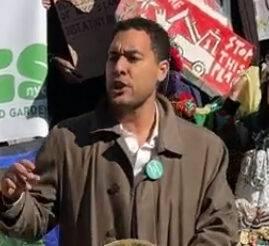
The community has rallied in support of saving Dapolito. In June, Sommer Omar, the founder of the Coalition to Save the Public Recreation Center Downtown (SPRCD, pronounced “sparked”) spoke to a rally of hundreds of Villagers, announcing her discovery: Years earlier, $120 million in capital funds had actually been allocated to repair the center, yet had remained unused.
In September, at a town hall at Saint Mark’s Church, then-candidate Mamdani appeared to commit to repairing the center. Emphasizing that democracy depends on working people’s faith that city government will not betray them and will instead keep its promises, he acknowledged the city’s past promise to repair the center. He then stated, “It’s quite clear to me that the important thing to do here is not just to fulfill the promises you have made, but also do your best to fulfill the promises that have been made prior to you.”
Following Mamdani’s election, in November, Council Member Erik Bottcher wrote the Mayor-elect, calling the city’s plans to demolish Dapolito “unacceptable.” He did not call for repair of the center, but instead asserted that a “viable and forward-looking plan must include preservation of the building’s visible facade.”
In December, outgoing New York City Comptroller Brad Lander also wrote the Mayor-elect, urging him immediately to halt demolition plans “and instead work closely with the West Village community to preserve, renovate, and revive this beloved community institution.”
SPRCD founder Omar condemned the city’s attempt to tie the development of 388 Hudson Street to the demolition of Dapolito. She told the Village Star-Revue, “We have not wavered in our position: the community does not need to pit public sites against one another, where the creation of some public resources requires the complete destruction of others. That is a false choice, especially when […the center] has been left closed and idling for years despite…capital funding already earmarked for its repair.”
She noted, “Mayor Mamdani ran on reviving faith in the government’s ability to deliver for working New Yorkers, and reopening Tony Dapolito would be an early, concrete expression of that commitment.”
Village Preservation head Andrew Berman observed that demolishing the landmarked rec center would require the approval of the city’s Landmarks Preservation Commission and “there would be an enormous outcry against such an application, which would have no chance being approved on the merits since there is no reason why this building can’t be renovated and reopened. However, the Landmarks Preservation Commission is controlled by the Mayor, as is the Parks Department, which would be filing the demolition application. So if the application is filed, that means City Hall is supportive of demolition, which means getting the LPC to reject the application…will be tough.”
The Planned Tower at 388 Hudson
The planned tower at 388 Hudson Street, while controversial, has significantly more support than the demolition of the Dapolito Recreation Center. Although the city’s press release is vague on specifics, it characterized all the “nearly 280” anticipated residential units as affordable, with “at least 15% of the units…set aside for formerly homeless New Yorkers,” with support services for them on site.
The press release did not specify affordability levels, which are pegged to regional standards that can be higher than what average New York City renters can afford. The city’s request for proposals indicated that affordability levels for 388 Hudson would range from less than 30% area median income (meaning less than $34,020 for a single individual or $48,600 for a family of four) to 130% area median income ($147,420 for a single individual or $210,600 for a family of four). Although the RFP stated that the city’s “goal” was to make these units permanently affordable, it did not require the developer to so designate them—and the press release does not designate the residential units at Hudson Mosaic as permanently affordable, suggesting that affordability requirements could eventually lapse.
The release quoted CB 2 Chair Valerie De La Rosa as celebrating the Hudson Mosaic development plan. Noting that CB 2 has sought affordable housing on that site since 2015, she stated, “The selection of a developer moves the project closer to reality and represents an important opportunity to deliver 100% affordable housing that responds to the needs of our community.”
Also of note, in the release, Adams’ former Executive Director of Housing, Leila Bozorg praised Hudson Mosaic as a “critical step forward in developing high quality, deeply affordable housing and developing brand new recreation space in a high-cost neighborhood.” Bozorg has been promoted to Deputy Mayor for Housing by Mayor Mamdani.
For his part, Village Preservation’s Berman expressed hope that saving the Dapolito Recreation Center could present a renewed opportunity to scale back the Hudson Mosaic tower “and go back to the drawing board on the terrible design,” as well as to ensure that residential units are permanently affordable.
He described Hudson Mosaic as “outrageously oversized,” the tallest in the Village, and urged the city instead to mass the building as a lower, bulkier structure that steps back from nearby JJ Walker Park and the Greenwich Village Historic District. He also characterized the facade as monotonous and pock-marked, “an office-tower with measles.”
Whither Preservation?
The future of the Dapolito Recreation Center is arguably a harbinger for the Mamdani administration.
While Mayor Mamdani has aggressively advocated the construction of new affordable housing and praised Mayor Adams’ “City of Yes” loosening of zoning restrictions, his concern for aesthetics and existing historic structures remains unknown. Thus, his choice to be sworn-in at the exquisite, abandoned 1904 City Hall subway station gave some historic preservationists hope, especially as he described the Gilded Age structure as “a physical monument to a city that dared to be both beautiful and build great things that would transform working people’s lives.”
In December, Village Preservation updated a report on the Adams administration, condemning “outgoing Mayor Adams as the worst mayor in history for new landmarks designations” since the 1965 landmarks law was passed, significantly worse than even the “fiscal-crisis wracked” Abe Beame.
Andrew Berman declared, “I hope our new mayor will rethink all of our former mayor’s plans and start fresh…[ending] Mayor Adams’ dismal record of slowing landmark designations to a trickle and almost exclusively limiting them to sites that face no threat [or…] will have little impact.”
He urged Mayor Mamdani to attend to “the many historic areas…where contributions…to our collective story face erasure,” citing an array of endangered Village sites the LPC has thus far failed to act upon, among them Our Lady of Guadalupe Church at 229 West 14th Street (the first Spanish-language church in New York), the New York Eye and Ear Infirmary, and Most Holy Redeemer Church in the East Village, as well as the neighborhood south of Union Square, from Third to Fifth Avenues.