
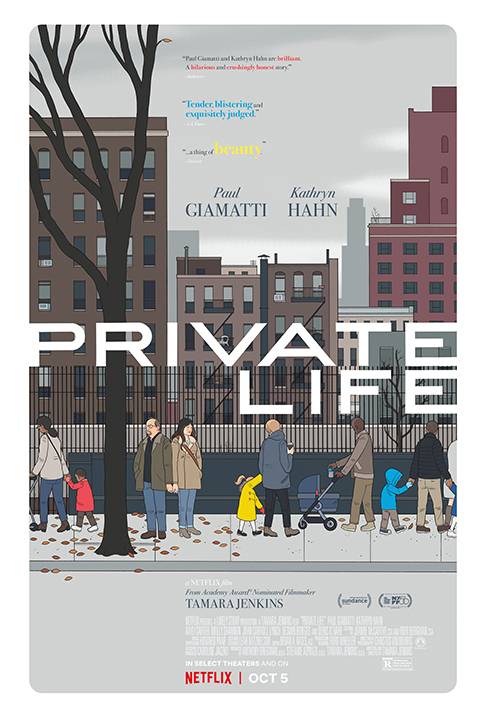
Private Life opens on the lower half of Rachel’s body, expectant. She’s clothed in only underwear, supine in dim lighting, and a male voice asks from behind, “Are you ready?” A needle appears out of thin air, confirming that she’s not about to have sex, as the film’s positioning would have you believe; she’s about to be administered a fertility shot by her husband Richard.
This is the approach writer-director Tamara Jenkins takes in her 2018 comedy film about a couple struggling to have a baby: sympathetic, unvarnished, witty. Rachel (Kathryn Hahn) is a 41-year-old writer who is not as fertile as she used to be. Richard (Paul Giamatti), an acclaimed actor whose career has soured (he now runs a pickle company), is 47 and only has one testicle, which is blocked. They live on Sixth Street in the East Village. Condos encroach, announced by billboards that read “Live in Luxury, Party like a Punk.” Things are not as they once were when they started a life here together in the 90s.
Richard and Rachel have tried a few ways to start a family: a heartbreaking failed surrogacy is gestured at, they’ve spent money and time they might not have on fertility drugs and procedures. Rachel removes her jewelry and dons a stiff disposable robe with a casual comfort that comes from spending a lot of time in doctor’s offices. The way the film documents Richard and Rachel sitting in a crowded reception waiting room, Richard initialing a form, or Rachel waking up to a bottle of apple juice and box of animal crackers sums up the monotonous and dreamy feeling of suspension when you can’t find a cure for what ails you.
Richard’s step-brother Charlie (John Carroll Lynch) and his second wife Cynthia (Molly Shannon) present a foil to the lifestyle Richard and Rachel’s have chosen: They live in the suburbs in a sizeable house provided by his successful dentistry career, and their daughters, including Sadie (Kayli Carter), are college-aged. Charlie lends his brother money even though Cynthia thinks he’s enabling something futile — “They’re like fertility junkies!” she exclaims at one point.
When Sadie drops out of Bard months shy of graduation, she moves into Richard and Rachel’s cozy apartment and becomes entwined in their fertility journey. She’s also a writer, but is repulsed by what she views as her classmates’ pretension and is looking for inspiration in something as grand as what happens in the stories she loves. The three of them decide Sadie will donate her eggs (the film confirms she is not related to either Richard or Rachel), and Private Life assumes a new, less comedic shade.
I’ll leave it at that so as not to spoil anything, but the film’s second half was spellbindingly moving to me. Jenkins, known for Slums of Beverly Hills and The Savages, ditches the clever comedy of the opening scene and takes a gentle and exacting look at how painful and beautiful it is to want something so desperately that is out of reach.
Sadie’s involvement reveals that Rachel and Richard’s single-minded quest to conceive — and all the silly, crushing, and arduous obstacles it entails — has distracted from longstanding rifts and loneliness in their marriage. In Jenkins’s hands, though, neither party nor the ways they feel forgotten, blamed, or maligned is wrong. In fact, both are so right. As A.O. Scott said in his review for the New York Times, “Not that I would want anything different about Private Life, even as I often found myself wishing that everyone in it would take it easier on themselves and one another. Though if they did, it wouldn’t really be life, and it wouldn’t be art either. The joy of this film is how completely it’s both.”
Rachel can be prickly and cold to Richard, her reactions often feel like a nail file against Richard’s dogged support. Hahn, whom I have sometimes found to be the opposite, is so perfectly subtle. When she erupts, it is always from a place of deep pain and self-criticism, painting a realistic and ever-sympathetic picture of the pressure women deal with in shouldering questions and concerns about their fertility. She deftly delivers Jenkins’s perfect dialogue, the funniest jokes and most exacting barbs, while conveying just as much with her eyes: her posture towards Sadie is a complex patchwork of envy and protectiveness that is singularly specific to relationships between women.
Richard is exhausted by this process, and his once burning desire to have a child has faded to a dull throb, like a distant toothache. He’s checked out, which leaves Rachel to carry some of the load on her own — or maybe she was always doing so all along. Giamatti plays the thorny parts of masculinity so well as Richard: even as he boxes out her despair with his forgotten wants that have finally boiled over, he’s never unlikeable or selfish—just human.
Sadie stole the show for me. Where has Carter been my whole movie-watching life? She spouts my favorite dialogue, including a heartbreaking and hilarious Thanksgiving toast. Her frustrating, brassy, and myopic front belies a sweet idealism and painfully loyal undercurrent. She so badly wants to know her purpose, and it’s dawning on her how helpless you actually are as an adult in a way I, too, felt when I first left college.
Private Life is also a perfect New York City movie. They make cramped adjustments to their apartment when a relative visits. They bicker and cry on the street with equal parts claustrophobia and abandon. They move around each other between rooms and take phone calls in each other’s presence. The sky blooms when they drive to the suburbs. They treat a restaurant like Cafe Mogador as an extension of their apartment, laying out their tension without shame. They scramble for parking. They grip a version of their neighborhood that once was. The film’s title felt especially funny in these scenes—what does a private life look like in the East Village? Set against a chalky sky, Private Life embodied the East Village in the winter perfectly to me.
The details are also so precise and perfect: Sadie’s faded WYNC tote, the book titles stacked up throughout their apartment, how they debate verb choice (“Suppress it? Or repress it? Or whatever that is more appropriate for this instant?) and the references they make (“Why do I feel like I’m in a Wendy Wasserstein play?”) mid argument.
In a world of one-dimensionally derisive “eat the rich” content, Private Life is crisply realistic in how it depicts the woes and flaws of the bohemian-bourgeoisie. Jenkins is never gratuitously cruel; instead, she cleverly and patiently documents how upper-middle-class artists’ egos around their own work can blind them to the world speeding along beside them. It makes for more rigorous and just more interesting viewing, and leaves me frustrated that there aren’t more movies like this, or that this movie, streaming on Netflix, was not widely seen.
The end is completely uncertain, which is also refreshing; I really don’t know what I think happens. As their characters shed the walls they’ve put up to protect themselves from what they want so hopelessly, I felt myself doing the same, which is all I can hope for when I watch a movie. Hopefully, Jenkins makes another one soon.