I moved to the city in the 1990s for a publishing job. Wally Lamb’s “She’s Come Undone” had just become a bestseller, and I remember an in-office celebration with a sheet cake decorated with the book’s cover. New and nervous, I hadn’t yet learned the hierarchy: editors sat at the table, assistants along the wall.
Publishing was—and still is—a notoriously low-paid industry. Books were currency and could be converted into cash. At the end of each month, I thinned the bookshelves of my East Village apartment and carried stacks over to the Strand to sell for rent money.
Crowds, bestsellers, and balloons
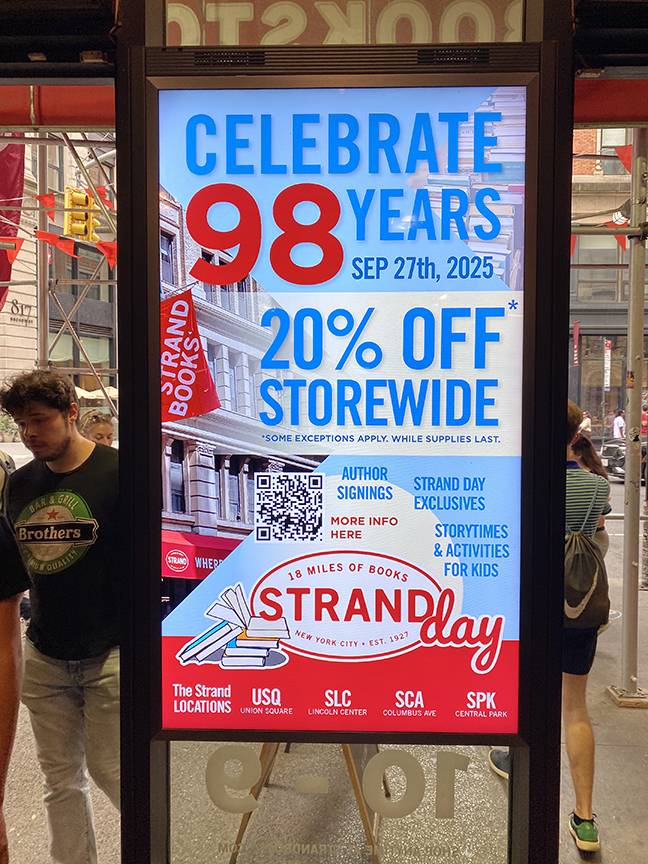
On September 27, the Strand marked its 98th anniversary with Strand Day, a celebration that included author signings, story time for kids, and a rare 20 percent discount.
I ducked into the Union Square flagship late Saturday afternoon. As usual on weekends, the place was packed. The only visible difference was the bobbing helium balloons hovering above the bookcases. The air conditioning was on the fritz, and the humidity intensified the musty smell of old books.
The chatty crowd made it nearly impossible to browse the narrow aisles of the main floor. But I’m not much interested in many new releases. For me, no book ages more poorly than today’s “must read” manufactured bestseller. When I see those books on my shelf years after their heyday, I always feel a twinge of remorse for following trends rather than my own idiosyncratic whims as a reader.
Upstairs and downstairs, the quieter corners still hold what the Strand has always promised: unexpected discoveries, especially in its selection of used books. In a clearance bin, I spotted a brick-sized Calder biography ($12) and a Donna Karan monograph with photos of Demi Moore and Bruce Willis when they were young and in love ($10).
From Book Row to behemoth
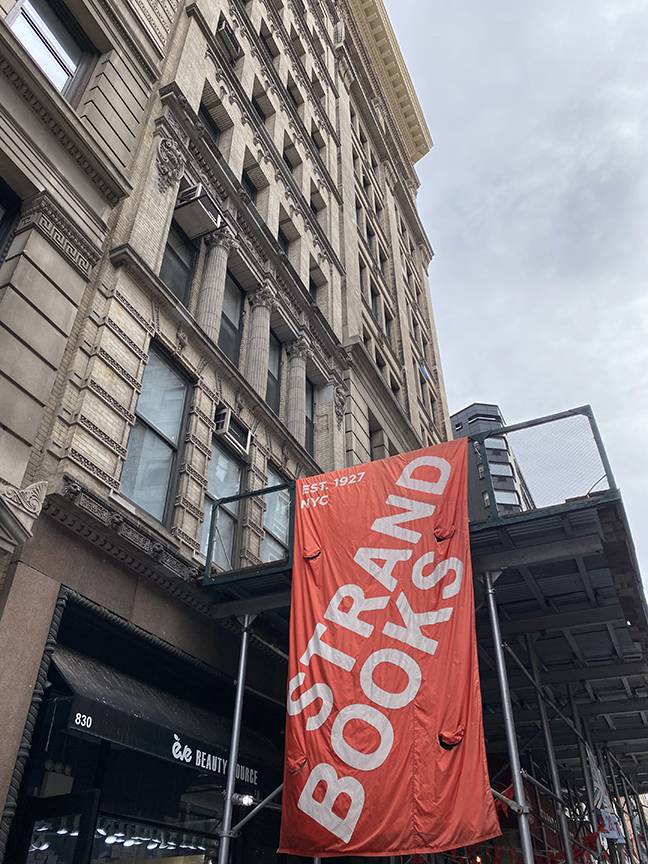
The Strand began in 1927 as a single shop on Fourth Avenue’s “Book Row.” Now a third-generation family business, the flagship retail fills four floors of its 11-story landmark building. The business has grown to include locations at Lincoln Center, Columbus Avenue, and kiosks in Central Park. For an independent bookstore, the Strand is a behemoth.
That success has attracted critics as well as admirers. The Union Square location has become a tourist destination, where serious readers sometimes feel crowded out by day-trippers in search of branded merchandise. Alongside its “18 miles of books”—an estimate of the length of its stock lined up side by side—the Strand hawks a full line of canvas totes, T-shirts, hoodies, and the like.
While now something of a commercial powerhouse, the Strand has managed to remain, in spirit if not in scale, a bohemian refuge. The staff unionized in 1976, and its most famous bookseller might be Patti Smith, who writes in her memoir “Just Kids” of how she “hated being stuck in the basement unpacking overstock.” Its most beloved employee might be Ben McFall, who presided over the fiction section for more than 40 years until his death in 2021. Described by owner Nancy Bass Wyden in his New York Times obituary as “the heart of the Strand,” McFall is a reminder that what gives the place its soul is its people.
From necessity to habit
It’s understandable why the tourists would show up in droves. Few places feel as New York as the Strand. When you’re upstairs in the art section, savor the sound of the creaky wooden floors. The bookstore’s draw is its history and the possibility of finding a book meant for you and you alone. In the basement on Strand Day, that was “The Butch Manual,” a reissued 1982 satire that reads like the gay man’s version of “The Preppy Handbook.” I bought it with a credit from selling books—just as I did when I first moved to the city. As Smith writes of Robert Mapplethorpe learning to conserve film, selling books began as a necessity and became a habit. Nearly a century on, the Strand remains the city’s best place to buy, sell, and discover books.