When people talk about Art Deco architecture in New York, some think of the Chrysler Building and the Empire State Building. Others think of the luxurious apartment buildings on the Bronx’s Grand Concourse. However, there’s another center of Art Deco — Manhattan’s Chelsea district.
Among Chelsea’s Art Deco structures— built during the late 1920s and 1930s, the heyday of Deco — are a few commercial and industrial buildings, as well as Fashion Industries High School. But most are apartment buildings. In height, they range from a 21-story tower at 300 West 23rd St. to a four-story walkup at 335 West 19th Street.
While there are many definitions of Art Deco, its buildings include some (although not necessarily all) of these features: Light-colored brick interrupted by vertical or horizontal bands of differently colored or raised bricks; corner windows; modernistic bas-reliefs, murals or other ornaments; rounded entrances with stylized street numbers or building names; and colorful, mirrored lobbies with terrazzo floors.
Walking through Chelsea, with the aid of the Art Deco Society of New York’s website, I was able to find more than 20 Deco buildings. Here are some of my favorites:
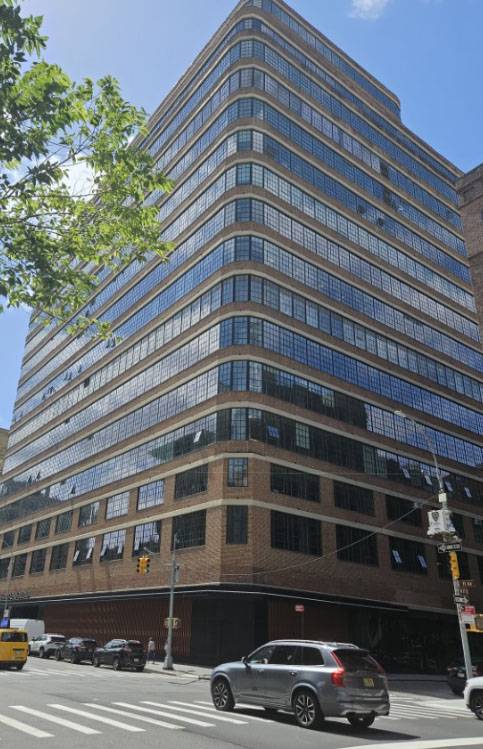
The Starrett-Lehigh Building, originally an industrial building but now an office hub, occupies an entire block between 10th and 11th avenues, 26th and 27th Street. Built in 1931, it had freight trains and driveways at ground level, and large elevators that brought trucks up to the building’s floors. Its seemingly endless bands of windows and rounded corners put it firmly in the Deco mode. Today, the ground floor contains trendy shops, restaurants and a gym, and the one freight elevator that hasn’t been converted to passenger use lifts up food trucks.
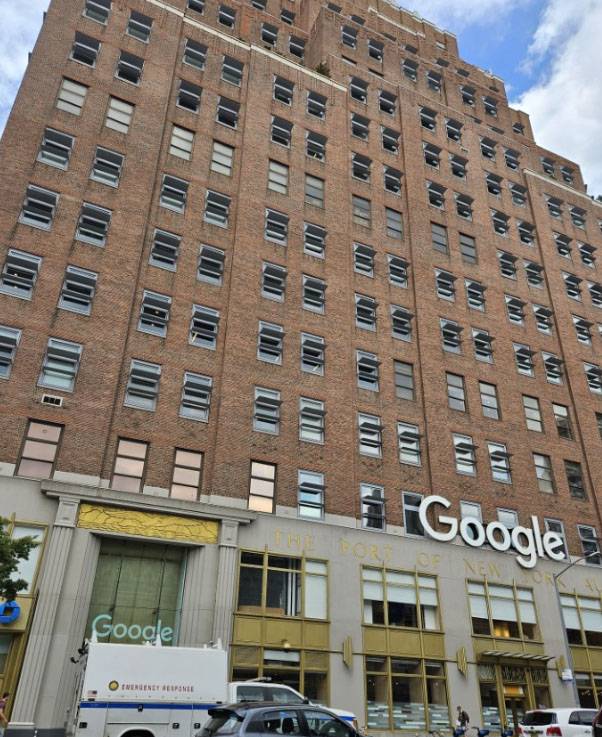
The Google Building at 111 Eighth Ave. was originally the Port Authority Building. Like the Starrett-Lehigh Building, it takes up an entire block and was built with truck elevators. When it opened in 1932, it was a freight-shipping hub. Portions were leased to eight railroad companies as well as Woolworth’s, Rand McNally and other prestigious firms. The second floor housed Commerce Hall, a large space devoted to exhibitions. Industry declined in the ‘60s, and the building went through several owners until Google bought it in 2010.
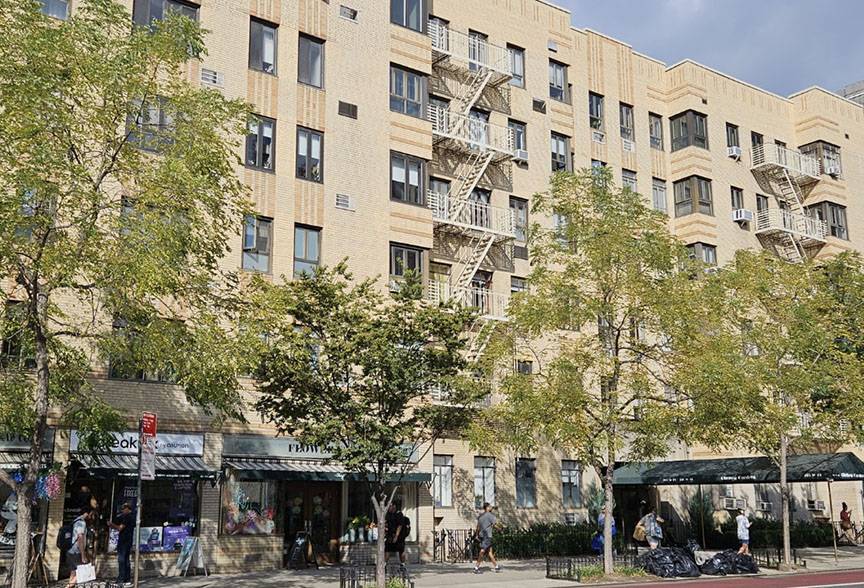
Chelsea Gardens, a block-through co-op apartment complex completed in 1940, has two addresses, 255 W. 23rd St., and 250 W. 24th St. Its 23rd Street façade is a Deco-lover’s dream: White brick, horizontal and vertical bands of orange brick, corner windows and rounded fire escapes. The 24th Street façade is more plain. But both entrances lead to a marvelous central garden, with shrubbery, trees, flowers and benches.
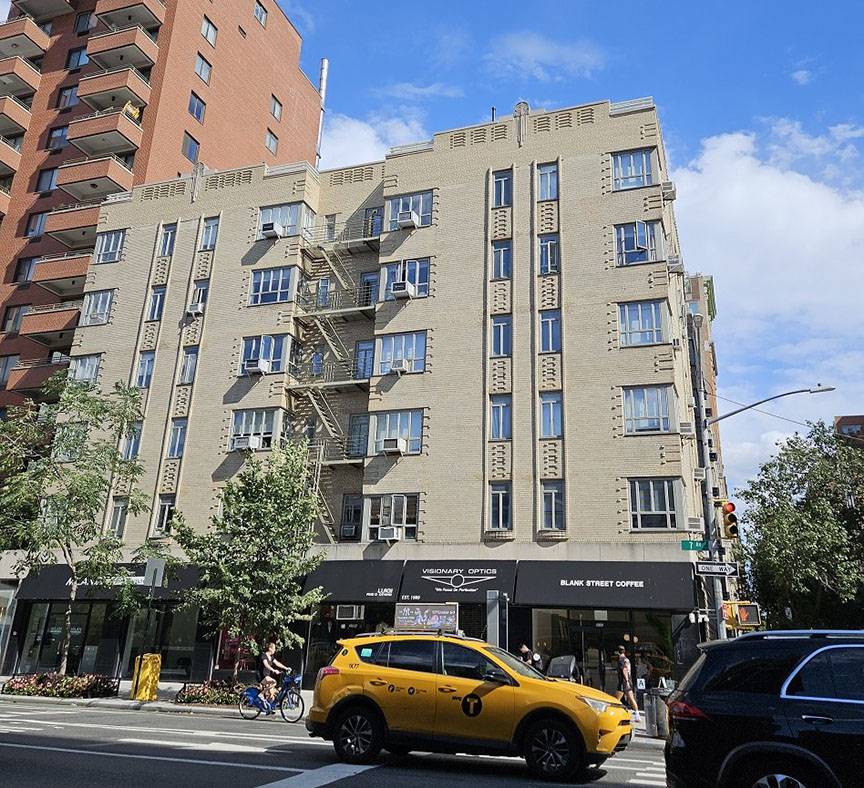
The Chelsea Warren, two identical co-op buildings at 155 and 165 W. 20th St., was built in 1938 and designed by Horace Ginsbern, who was responsible for many well-known Art Deco buildings in the Bronx. It features beige brick punctuated by raised brick patterns, corner windows, sunken living rooms inside the apartments, and two opulent lobbies.
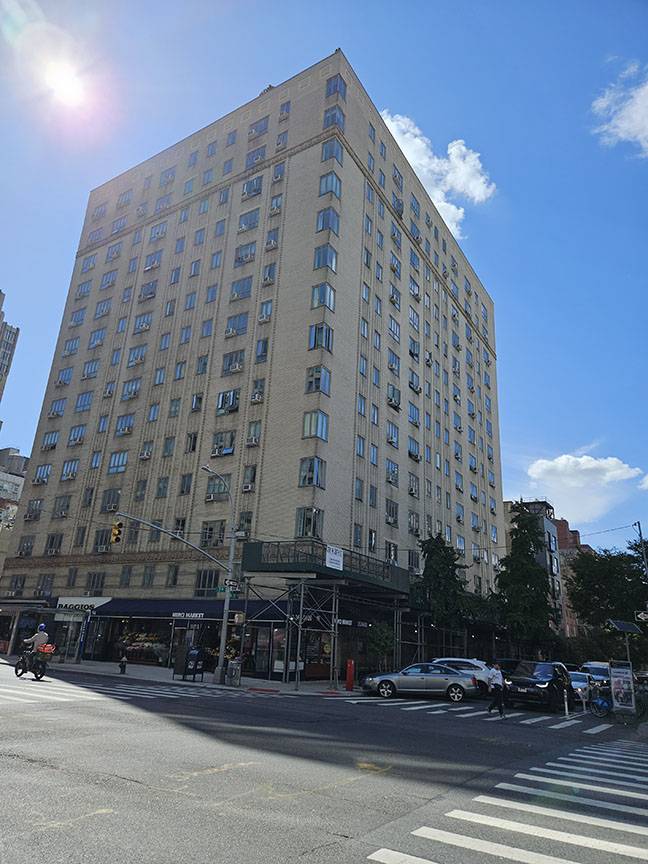
The 15-story Kensington House at 200 West 20th St., kitty-corner on Seventh Avenue, from the Chelsea Warren, was designed in 1938 by Emery Roth, who also designed such famed New York landmarks as the St. George Hotel in Brooklyn and the San Remo Apartments on Central Park West. While the Kensington’s façade is somewhat understated, the Art Deco Society calls attention to its unusual concave entrance, featuring a metal overhang, bands of colorful mosaics, a row of terra cotta panels above the second floor, and a revolving door.
The Walker Tower at 212 W. 18th St., also known as the New York Telephone Company Building, was built in 1929 as a telephone company switching station and office building. Part of the building is still used by Verizon, New York Telephone’s successor, and the attractive grillwork seen in our photo covers these lower floors. The upper floors have been converted to luxury 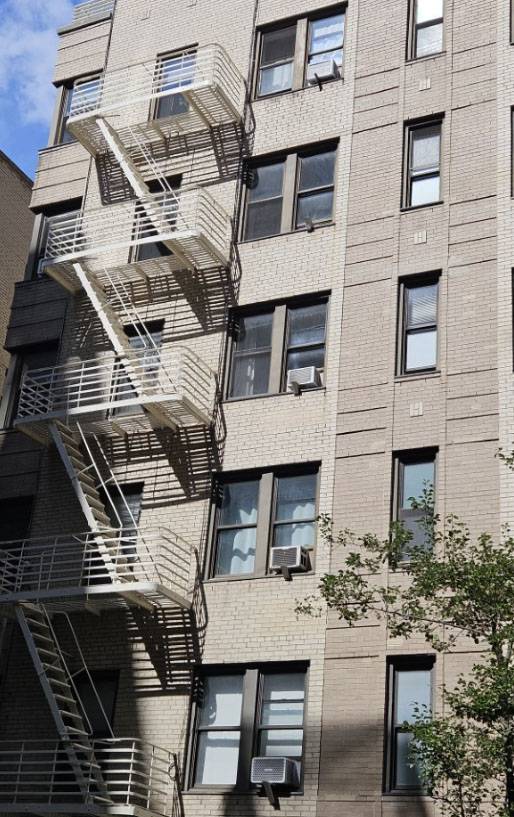
condos. While new elements, such as a black-and-white marble lobby, have been added, they complement the original Art Deco style.
225 West 25th Street, finished in 1939, is a typical six-story Art Deco apartment building, with corner windows and beige bricks alternative with alternating beige and tan bricks. It sports a curved entrance flanked by two columns that leads to a mirrored lobby.