
“New York City housing stock is being gobbled up by multinational investment companies, investment funds, and people who have tons of cash,” Brooklyn City Council Member Sandy Nurse declared. “To buy a home, it’s impossible, unless you have a million dollars.”
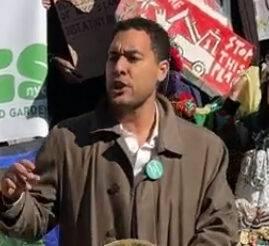
Speaking on the steps of City Hall on Nov. 12, Nurse rallied an eager throng of tenants’ groups and housing advocates, the crowd buzzing with hope as they looked forward to the likely enactment of a landmark measure—one that would begin to level the playing field by giving nonprofit housing groups the chance to compete with speculators and predatory landlords.
Nurse, who represents Bushwick and North Brooklyn, is the lead sponsor of the Community Opportunity to Purchase Act (COPA), which would give selected housing nonprofits the first opportunity to purchase multifamily buildings when they go up for sale—thus creating and preserving deeply and permanently affordable housing.
COPA would give first dibs to community land trusts and other eligible nonprofits by establishing a 120-day wait period for them to make a first offer, and the subsequent opportunity to match a bid. The 120-day period gives nonprofits the possibility of assembling financing, a delay typically not needed by deep-pocket speculators and other for-profit ventures.
If no eligible nonprofit expresses interest in the property, the seller is exempted from the wait period. The COPA wait period will also not apply to most small property owners seeking to sell, unless they are severely neglectful of their building’s condition.
Currently, 87 percent of the city’s rent-stabilized apartments are owned by the top-five percent of corporate landlords.
A pitched battle
It’s a down-to-the-wire pitched battle, but the current city council is expected to pass COPA in December, before their session ends. And outgoing Mayor Eric Adams is expected to veto it.
The excitement of the crowd reflected the popularity of the measure; COPA had secured 34 sponsors, the two-thirds majority necessary to override a mayoral veto.
But immediately following the rally, business and real estate interests launched an anti-COPA campaign, contending that the mandatory 120-day wait period will unfairly handicap landlords. A New York Post editorial sounded the alarm, claiming “Council radicals are speeding toward their goal of destroying New York’s housing market in the name of ‘saving’ it.” COPA supporters have pointed to protections for small property owners and countered that the wait period is reasonable; according to Property Shark data, the average time a building is on the market in New York City is 160 days, 238 days in Manhattan.
In response to the anti-COPA campaign, Queens city council member James Gennaro defected, dropping off the sponsor list.
Incoming City Council Member Harvey Epstein—elected to Manhattan’s District 2, representing Greenwich Village, the East Village, the Lower East Side, and Murray Hill—is expected to swoop in to save COPA. He will be sworn in early, December 6, to replace already-departed council member Carlina Rivera. Epstein, a former tenant lawyer, will thus be available to obtain the two-thirds majority if and when an override vote is needed.
Tenants and advocates speak out
John Leyva, a tenant leader at 63 Tiffany Place in Brooklyn, where he has lived over 30 years, recounted how he and his fellow tenants have struggled to hold successive profit-seeking landlords accountable for the upkeep of their building and how much COPA could help as they again face their building’s sale. He exulted in the “air of optimism and positivity” following the mayoral election, noting that “last week, over a million New Yorkers made it clear that the city’s priority must be to lower the cost of living and give tenants and working-class New Yorkers power over our homes. We are ready!”
Deyanira Del Rio, executive director of The New Economy Project, which has helped to build the COPA coalition, placed the measure in the context Mayor-elect Mamdani’s affordability agenda.
“We know that to address people’s housing needs, we need to do more than just build new housing. We need to stabilize existing affordable housing. We need to make sure it stays truly and permanently affordable, and we need to take it out of the hands of predatory landlords and speculators who don’t have their tenants’ interests in mind. Through community land trusts, through nonprofit developers, COPA will make that happen.” (Within two weeks of the rally, Del Rio was appointed to the mayor-elect’s transition team.)
Justin Liriano, a 22-year-old leader of the Youth Alliance for Housing, waxed lyrical on the need to protect the city’s working-class neighborhoods. His Washington Heights childhood, he recalled, “meant growing up in a place where community and culture filled up the streets, as the sidewalks were treated like a living room, and my neighbors and I were family. We weren’t secluded in luxury condos, in glass skyscrapers. I was raised by the blaring sounds of bachata from the deli heading to school in the morning…and the smell of fresh meat at the intersection.”
Now, as the block parties and businesses disappear, “watching my community change, fills me with grief…. I miss the ease that existed before everyone was worried about being displaced. And I often wonder how the story could have been different if the community, the people who live here, who grew up here, who built their families here, if they held control over our housing, not the real estate industry. I wish for a different future for myself, and future generations.”
Re-engineering a predatory system
Brianna Soleyn, a board member of the East New York Community Land Trust, described key ways the existing system destabilizes housing.
First, the tax lien sale “leaves the door wide open for long-term Black and Brown homeowners to be exploited by private equity. Many of these homeowners are low-income elderly, and they live in communities like East New York that are so vulnerable to gentrification.” These homeowners, often “the pillars” of their communities, are then “subjected to extra fees, to harassment, and to predatory treatment.” Reforms would shift the city’s focus from debt collection to debt resolution.
Second, the tax lien sale endangers what Soleyn characterized as “some of the last naturally occurring affordable housing”—multifamily buildings “occupied by working class people, undocumented people, elderly people…. The city cannot leave these people behind.” When these tenants suffer landlords who default on their taxes, “it’s unacceptable to leave their fate to the will of speculative investors and private equity.”
Reforms would prioritize the public interest by selling the city’s debt not, as now, to a profiteering Delaware trust but instead to a New York City land bank. A land bank could facilitate transferring neglected and distressed properties to community land trusts, thus turning “blight into opportunity,” in the words of City Council Member Gale Brewer, who represents Manhattan’s Upper West Side.