Eating’s a basic biological act, but like sex, it’s so much more. What we eat and how we eat it are social signifiers—markers of our place in a stratified world, reflective of our status, our privilege or our oppression.
I’m the child of Depression-era parents who ate canned vegetables and rewashed and reused plastic wrap. When I first encountered rich people accustomed to being rich, I was stunned to discover their special access to an alien and rarified level of pleasure, the pleasure of exquisitely prepared fresh food.
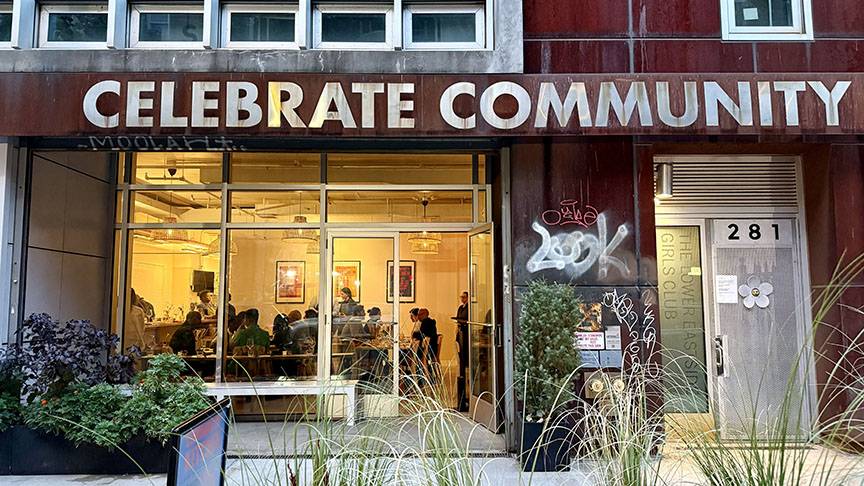
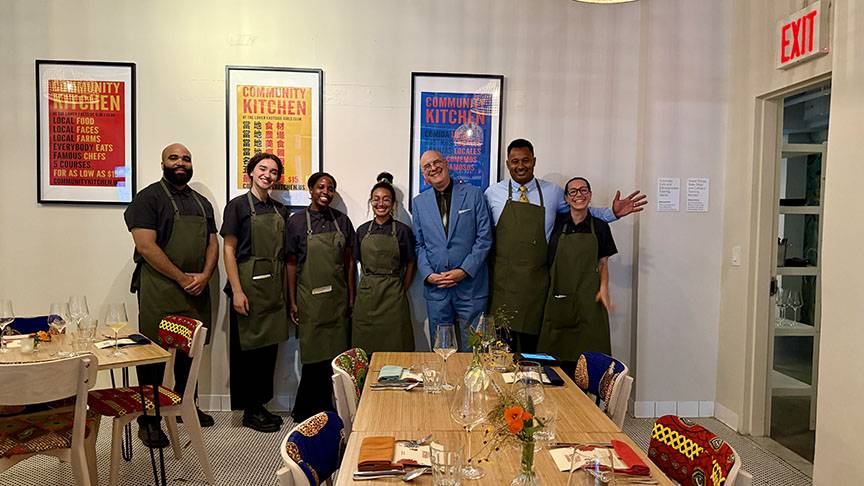
Community Kitchen, a nonprofit restaurant and pilot project on the Lower East Side, is storming the barricades of food equity and class by making exquisitely prepared, fresh and healthful food available to all. If you can snag a reservation or walk in before they close up shop, you will savor a leisurely fine dining experience: nine courses that embrace, cherish, and spotlight ingredients in a deconstructive way reminiscent of modern art. CK’s execution of their inaugural menu blew my mind: one course featured a luxe spoonful of corn and butter, a startling corn silk tea, and a killer corn pudding—I’d never thought so intensely and appreciatively about corn before!
Nor had I ever thought so intensely about food, money, and class. CK offers the same 9-course meal to all guests on a sliding scale basis—when you reserve, you choose, based on your family income, to pay $15, $45, or $125 for your meal. The website says that the $45 level, which I paid, “covers the full cost of your meal” but I seriously doubt it—the restaurant prides itself on fair wages (for example, servers are paid $29 an hour), and I was there three hours, with little turnover among the guests. It occurred to me that I could actually afford the $125, but if I paid that amount I could never enjoy my meal—the spirits of my parents would choke me!
So instead, I followed up with a donation. And I marveled over this extraordinary, ambitious, foundation-funded social experiment, a flourishing, exotic orchid that’s taken temporary root within the Lower East Side Girls Club, on East 7th Street just west of Avenue D. The brainchild of food activist and bestselling author Mark Bittman, it’s been years in the making, finally launching in September.
Spreading the gospel of nonprofit restaurants and food equity
The basic concept exists globally—nonprofit restaurants abound in international pockets. There’s Mexico’s social cafeterias, Poland’s milk bars, Singapore’s hawker centers. But as CK’s Executive Director Rae Gomes explained to me, those highly affordable eateries are all government subsidized.
For now, Community Kitchen relies on private philanthropy and aspires to launch a movement, replicating nonprofit restaurants across the country and the world.
The goal is revolutionary change to the food supply and restaurant culture: to support local, marginalized farmers who use agroecological practices; pay living wages and benefits to restaurant workers; use fresh, local, and seasonal ingredients to prepare delicious food; offer that food at affordable prices; and also to publicly and vocally connect all the food equity dots through visibility, education, and advocacy—even by just talking to curious guests about the BIPOC (Black, Indigenous and People of Color) breeders who grew the spectacularly beautiful carrots on their plate.
The “awesomeness” of good food, the harshness of restaurant culture
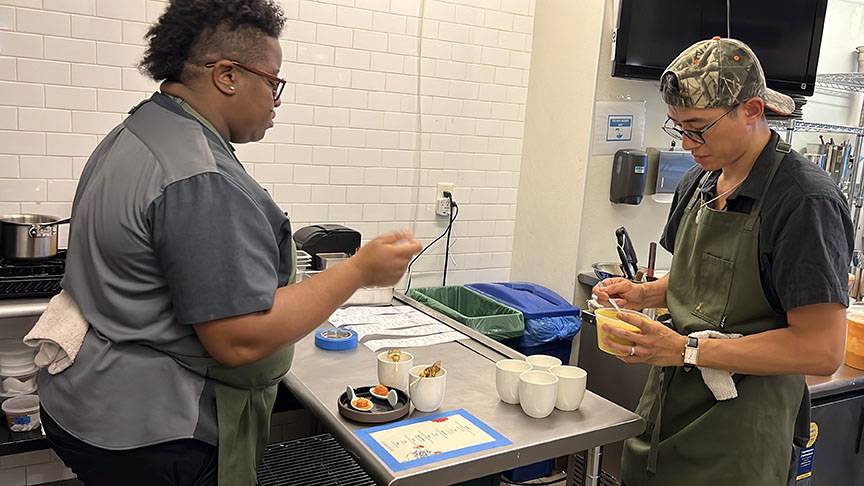
Community Kitchen’s chef, Mavis-Jay Sanders, a James Beard award-winning champion of locally-sourced cuisine, is especially eager to spread “the awesomeness” of fine nutritious food, and to educate communities about where their food comes from, noting that some “people don’t even know” that beef comes from a cow.
That ignorance, she observed, goes hand-in-hand with a disastrously deficient and inequitable food supply. “When I was working at Michelin-starred restaurants I was working with chefs who were working with breeders to make vegetables more nutritious and better for the land, and that was really cool….I would go home to Georgia, the small town that my family’s from, and I couldn’t find vegetables that were nutritious, [just] old and wilted. It didn’t hit me till I went home to cook that I didn’t have access.”
Sanders lamented that when she went home for Mother’s Day, she had to “drive four hours to get scallops that were fresh instead of frozen because all they have is stuff from Walmart and I didn’t want that for my mom.”
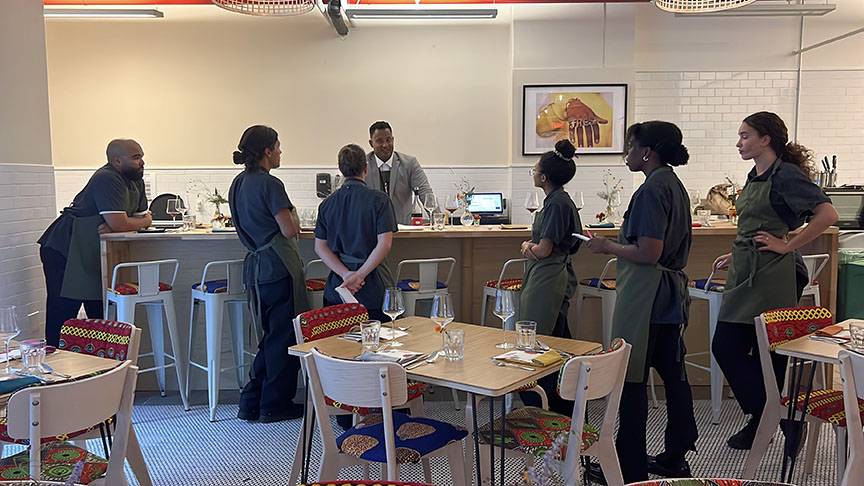
The chef also aspires to change restaurant culture. For the guest, “people are yearning for places where they can feel comfortable” and welcomed, where there are no assumptions based on how you look. And for the worker, she seeks more freedom, the freedom of diversity where not everyone has “the same haircut” or tattoos and the freedom from fear “somebody could throw something” at you.
Gomes points out that food and domestic workers are the only workers excluded from Social Security, arguably a legacy of the longtime concentration of workers of color in agricultural and household jobs. As part of its commitment to dignified jobs, Community Kitchen hopes, in its next iteration, to make Social Security and health insurance available to staff.
From pilot to movement
For sure, the pilot has thus far been a resounding success. Gomes described the enthusiasm of all the players—the staff, the community, the local food suppliers, the Lower East Side Girls Club—everybody wants the pilot to stay open beyond the original November 30th end date. If CK can find the money, the pilot will be extended through mid-December.
And then will come the hard work of launching a permanent restaurant, which will probably not open until 2027. During 2026, “We’re really going to focus on building up our coffers, so when we open the long-term project we’re not scrambling.” That permanent restaurant is intended to be the launching pad for a multitude of other eateries adapting the CK nonprofit model to their own communities.
Where will it be? No promises, but Gomes “would love” for CK to remain on the Lower East Side: “We like it here! People are lovely to us,” she exclaimed. And although the LES is not public transit friendly, “People typically come here for dining….It is hard to get here but…people figure it out.”
Will it be a fine dining establishment? That too remains to be seen. Gomes, a single mother, would relish kid-friendly meals. But she also believes that “everyone should” have the opportunity to experience fine dining, the pleasure of “being taken care of” and the chance “to take some time and really experience the ways tomato or corn can taste.” Still, the next Community Kitchen will have “more robust community input…guided more by the community and less by us” and could be “casual dining” or “family style.”
A visceral education
For Gomes, a long-time advocate for food equity who’s never opened a restaurant before, the lessons of the pilot have been revelatory—she’s been stunned to remember that food can be a visceral joy. Food equity advocacy is “not sexy” she noted, but she feels like Community Kitchen is adding the sex back in, and “later you can add on the knowledge and heavy-handedness around the education.” The pleasure of great food, she hopes, is the gateway to turning people into advocates.
What’s also surprised her has been how reactions to the food have been “so personalized” and so intense. She recalled how a 10-year-old Girls Club member came in and “she was eating the lamb and she loved it….I particularly had feelings about this because my son does not like lamb…and lamb is my favorite meat.” The girl asked “Can I get a little bit more?” and Gomes “sent her home with a box,” excited to imagine the impact of “this experience in her life, moving forward.”
It has also been an education to attempt to apply food equity values to real life situations. Gomes described discussing a hypothetical fundraising meal with the kitchen staff, who immediately recommended champagne and caviar. Gomes responded by asking them to consider “what is the local and sustainable version of that? Is it natural wine and oysters? Okay, maybe it’s not but how can we inject…a little bit more value, a little bit more justice” into the work.
Chef Sanders too dreams of what great restaurants can do to promote a better world: “I really feel that food is a common language. I can hand you something I’ve been toiling over all day, and for you to consume it and feel peace and calm, you know that I care for you….I want people to come here and feel cared for, in a way that isn’t extractive or disruptive, that enhance[s] their lives.”