Political meet-and-greets are a funny hybrid, with two separate goals folded into one gathering. You go to get to know a candidate who may be only vaguely on your radar, and an hour or two later the campaign manager is passing out palm cards and pointing to the QR code that leads you straight to the donation page. Having been to a few of them over the years, I also know that they can be invaluable: generally pretty intimate, so you end up having a good feel for the positions and character of a person who would otherwise be just another eager stranger with a clipboard collecting signatures at the Greenmarket.
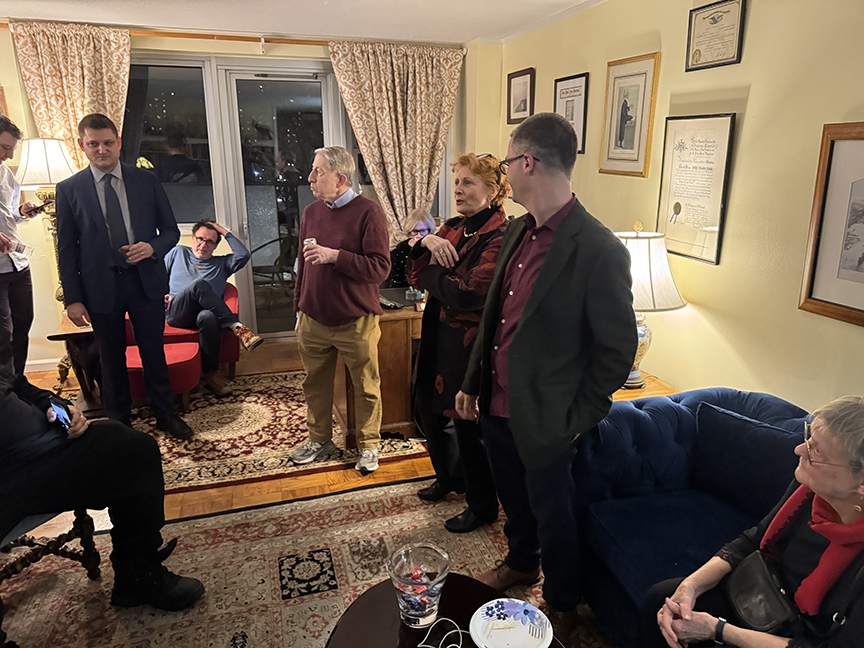
On a rainy Saturday last month, my husband and I attended a good meet-and-greet for David Siffert, a State Assembly candidate I hadn’t even heard of because I hadn’t yet shifted my attention from the April special City Council election to the June 23 primary; it’s a busy voting year for us West Siders. Siffert is one of the six Democrats running for the Assembly seat that Deborah Glick is relinquishing after 35 years.
The hosts were a lovely, down-to-earth couple who are old friends and neighborhood comrades of ours, both extremely active in the Village Independent Democrats club (VID). We sat down in their compact living room in their six-story postwar brick building on Bank Street, and I instantly felt at home in the company of old-time Villagers, the kind I wrote a whole novel about: engaged, opinionated, feisty, not rich. Two 92-year-old women were present, vocal and completely sharp, along with an NYU professor and a couple of friends from the Westbeth singing class.
We all spoke the same language, a patois of zoning terms (as of right, air rights) and local shorthand (Gottlieb building, Nadine’s). This rare middle-class island in the super-luxury enclave the West Village has become felt like the perfect setting, with the affordability crisis top of mind for voters everywhere.
We all quietly sussed Siffert out: looks very young, but is 42. Wore an ensemble that seemed designed to make a statement (brass-buttoned double-breasted blazer paired incongruously with floral shirt and pastel bowtie) but talked with not an ounce of showiness and a lot of detail and knowledge. A self-described State Assembly nerd, a breed I didn’t know existed.
I learned only later that Siffert is nonbinary and uses they/them pronouns. A lifelong Manhattanite, they rose through the ranks of the VID to become president. They are a civil-rights lawyer, adjunct NYU Law professor, and a go-to writer of bills (over 100!) for the state legislature, another “breed I didn’t know existed.
The attendees fired off a list of issues: outsized towers in our low-rise neighborhood, accessibility, the 14th Street bus lane, subway safety, empty storefronts, gun violence. Some issues were hyperlocal (the fate of Dapolito Rec Center) and others international (West Bank settlers)—both pretty far removed from Albany.
Tact
I found Siffert’s answers politic and nuanced. Asked to say something positive about Deborah Glick, they offered this (I paraphrase): she’s incorruptible. I never had the least doubt she voted her conscience. She staked out a fairly narrow range of issues to focus on: higher education, the environment, animals. On the war in Gaza, something along these lines: I have family and loved ones in Israel and care deeply about it, but cannot sanction the government’s actions. Some other takeaways: Siffert kept coming back to the pressing need for AI regulation. They also talked about an ability to get along with people, and I tended to trust this response, given the earnestness and evenness of their demeanor.
My husband, who is not a cynic but a serious skeptic after a long career in city government, reminded me later that I always come away from meet-and-greets impressed by the candidate. He’s right. I so want to believe they have the intelligence, fresh energy and drive to storm City Hall or Albany or Washington, as the case may be, and hack through the corruption and inertia. I even remember swelling with optimism as I watched Governor Andrew Cuomo’s inauguration, though I never trusted the guy. Just look at how that turned out.
I got to thinking about my own decision-making process. How do I weigh my own gut reaction against the opinions of people and institutions I trust? How important is the candidate’s resume when set against their philosophy and personality?
For starters, on the principle of cleaning the bathroom to create momentum before tackling the whole apartment, I want candidates to show me something specific they can accomplish right off the bat. I don’t mind if it’s low-hanging fruit. Maybe I even prefer low-hanging fruit. I thought Brad Lander did this well when I attended a jam-packed Upper West Side meet-and-greet for him during his run for mayor. He touted his idea of vendor scorecards, à la Yelp, to compel NYCHA contractors to improve their deplorable follow-through. For bonus points: tell me why the person in power now has failed to pluck this fruit from the vine and how the candidate, if elected, will avoid whatever invisible forces prevented it from getting done before.
What else? Show me that you have the discipline and finesse to avoid alienating the people you have to work with to get anything done. Show me you’ve been in the trenches of the jurisdiction you hope to serve. If you’re a newbie, show me that you understand how this particular system works and are not superimposing lessons from another profession with different rules and conventions and immovable objects. Because I’m a sucker for eloquence and self-effacing wit, convince me that you have the less sexy goods: focus, organization, follow-through.
What I liked best about the Siffert event was that we were a small enough group, sitting around the cheese and crackers on the coffee table, for a back-and-forth. The whole time, something was weighing on my mind. It had to do with a meet-and-greet I had attended for Ryder Kessler when he ran for Glick’s seat in 2022. He’s one of Siffert’s opponents in the current race (along with Furhan Ahmad, Corinne Arnold, Jeannine Kiely, and Ben Yee).
The Kessler event was hosted by an old friend who lives in Tribeca. He’s a policy analyst, economist, and activist I’ve worked with and respect tremendously. He was supporting Kessler in part on the strength of Kessler’s aggressive stance on the housing crisis, the theory being that the only way to make housing more plentiful and affordable, particularly for young people, is to build big and build everywhere. In recent years, this has become a core tenet of the Abundance movement, while detractors call this the “build-build-build” or “trickle-down” camp.
I came home from that evening four years ago swept up in the excitement about the young, charismatic candidate. But, having long fought to preserve the historic fabric and architecture of the Village, I was also tamping down some serious cognitive dissonance. Does building more market-rate towers in low-rise neighborhoods actually increase supply for everyone? Don’t developers always manage to shrink the percentage of affordable units? Doesn’t an influx of wealthy residents price out the masses and make neighborhood goods and services less affordable? Isn’t it short-sighted to play down the irreplaceable value of history and neighborhood character?
Only by one percent!
So I asked Siffert: why would his very intelligent opponent promote a strategy that doesn’t seem to work? Siffert was ready. He said that the data do show that building more does increase availability across the board, but only by one percent.
I’m not by nature an issues-based person or a data-driven one. I tend to see the world more in terms of intangibles like motivation and interpersonal dynamics and creativity. This is why I grow frustrated with politics and why I generally steer away from writing about it. (Or them? I’m not even sure if the noun is singular or plural, and words are my realm.)
Politics is (or are) so big and amorphous that it’s easy to spout opinions and cherry-pick facts. It’s easy to accuse those in office of corruption or laziness. It’s easy to put down governing bodies for being slow-moving and beholden to special interests. But I live with someone who’s spent his career in city government and I know that it’s not so black and white. Sometimes local residents are knee-jerk anti-development. Sometimes public servants are doing their damnedest with few resources. Sometimes well-intended regulations put in place to solve one problem create another.
I found a handy resource at the Downtown Independent Democrats’ website: all six candidates’ answers to a 40-item questionnaire. I printed out Siffert’s and Kessler’s, each 12 pages long, and compared their answers on housing supply and preservation. These are issues I know something about from many years with Save the Village, The Federation to Preserve the Greenwich Village Waterfront, and West Villagers for Responsible Development.
I didn’t find the gulf between the two candidates that I expected. Kessler’s response on preservation is philosophical but offers no specifics, where Siffert’s is practical: use air rights as a bargaining chip. I then turned to the other candidates and was pleasantly surprised to find long, specific and fervent answers.
Several addressed what has always struck me as a crazy opaque process (one I’ve participated in), that drives land-use and preservation issues: angry, frustrated neighbors line up at hearings to object noisily to whatever proposal is on the table, sometimes in opposition to any change but more often to fight overblown plans that blatantly favor developers. Then the Board of Standards and Appeals or Landmarks or City Planning goes into executive session behind a closed door and makes a decision based on who knows what criteria or influence or pressure.
Here’s a response I liked from Ahmad, a political rookie:
Decisions should be guided by objective standards, equity, and public benefit, not volume of opposition alone. If a project meets clear standards but faces organized opposition, I would weigh preservation against housing need, climate impact, and displacement risk using transparent criteria.
Meanwhile, now that I’m on Siffert’s mailing list I’ve received two requests for a donation, but also an email about their “State Government 101 Office Hours” in Washington Square Park. That is, David answered any question people could think of related to the New York State Legislature.
Maybe I should know better by now, but I was charmed.