
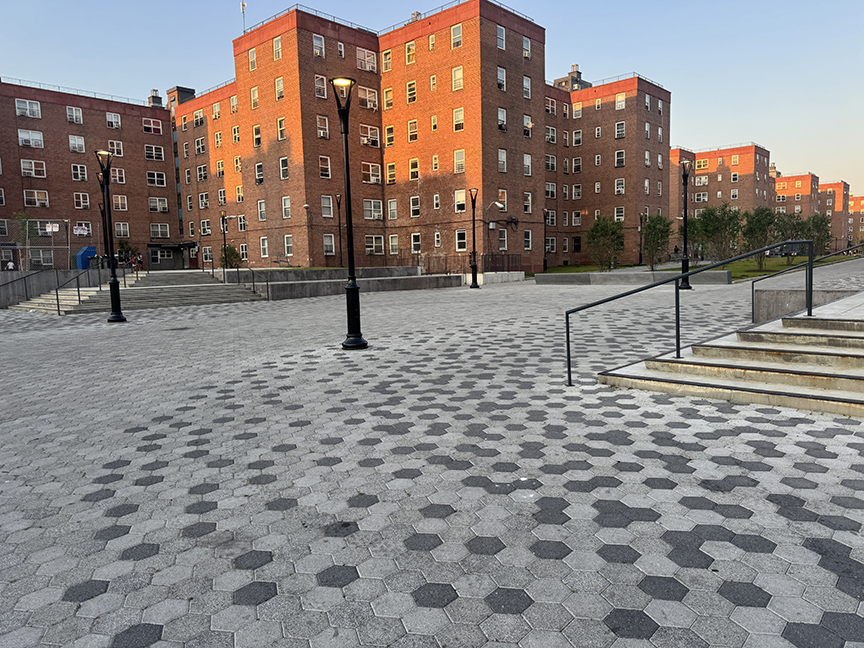
Public housing must remain public. The name really says it all. This should not be a radical idea. It should be the municipal equivalent of “water is wet.”
And yet, after forty years of historic disinvestment in housing, the assault is shifting. It is no longer only the housing that is being assailed. It is the word public itself that now requires a forensic accountant, three board books, and a strong drink.
For decades, NYCHA residents were told there was no money. No money for roofs, for boilers, for elevators, for mold remediation, lead abatement, working heat, or bathrooms. But the moment public housing can be converted, bonded, leveraged, ground-leased, and made legible to private capital, money appears, immaculate, generous, well-mannered, and carrying a term sheet.
That is the trick. Not scarcity. Selective abundance.
New York City’s FY2027 budget arrives wrapped as a major investment in housing, preservation, and NYCHA. All are desperately needed. But under the NYCHA banner, what exactly is being funded: repairs that keep apartments in Section 9 public housing, or conversions that move them into Section 8 project-based voucher structures through RAD/PACT or the Trust?
Tenants have reason to ask. The last time they were told to trust the paperwork, demolition was somehow described by the word “decanted”.
So, the news of new capital is received with great suspicion. Is this an investment in public housing or privatization on steroids?
Section 9 is traditional public housing. Section 8 is a rental subsidy program, allocated to private property owners who rent units to low-income tenants and receive a large portion of the rent from the federal government. Both serve low-income tenants, but they are not the same model.
When a NYCHA development is converted from Section 9 to project-based Section 8, the building is handed to the private owner who receives the full market rent for each unit, with a portion coming from the tenant and the balance from a federal subsidy. For example, a unit in Fulton Houses in Chelsea would earn $4892 for a 1br, if Related got their way.
Unfortunately, this year’s city budget includes approximately $1.5 billion over two years to exclusively support Section 8 PACT conversions. The documents indicate that this will involve 62,000 units, roughly 40 percent of NYCHA’s remaining Section 9 portfolio.
The Fulton and Elliott-Chelsea Houses in Manhattan provide a useful case study because the public documents are unusually revealing. In November 2025, the New York City Housing Development Corporation considered and approved financing for the first phase of the Fulton and Elliott-Chelsea redevelopment. The HDC materials describe a financing package that includes a Subordinate Market Rate Revolving Term Loan, known as a SMRRT Loan. The borrower would be Related Companies and Essence. According to the HDC (Housing Development Corporation) and HFA materials, the loan amounts were approximately $61 million for Fulton and $140 million for Elliott-Chelsea, with an 8 percent interest rate and a 40-year term. The project is held in court by a lawsuit by tenants and community leaders including Senator Tom Duane.
Astronomical
The HDC board voted to approve the financing package on November 19, 2025. The HFA (Housing Finance Authority) package is revealing. It shows that the cost per unit is over $1.2 million, which at scale brings the project to an astonishing $2.4 billion. At the time, Crain’s noted that $1.2 million/unit was astronomical and not at all on par with housing development cost, especially once you account that the land is going for $1.
NYCHA is understood to have an obligation over time to repurchase the loan. Based on the financing schedule, the loan begins at approximately $61 million, rises to about $143 million by year ten, and could balloon to approximately $1 billion at maturity. The risk is high that the loan will never get repaid.
It was disturbing to discover that the SMRRT loan instrument was touted by the current administration as a brand new and never before used financing tool meant to be scaled up.
The SMRRT loan deserves particular scrutiny: an 8 percent interest rate over a 40-year term is not a footnote. It is a long-term obligation with very sharp teeth.
For those who do not read municipal budgets over breakfast muesli, let us put it plainly: 8 percent is a very high interest rate for a public-housing deal. And because the principal is not actually paid down, the loan’s much-advertised “revolving” quality is, shall we say, not especially revolvant.
The issue is not whether NYCHA needs money. NYCHA needs money urgently. The issue is whether public dollars should be used to preserve public housing as public housing. If New York City directs public capital to preserve Section 9 housing, it strengthens public housing. If it directs public capital primarily to facilitate conversion into Section 8 privatization models, it destroys public housing by way of privatization.
Public housing is not merely a portfolio of distressed assets waiting for financial creativity. It is a public good. The land is public. The homes are public. The social promise is public. This was the vision of Fiorello Laguardia and Eleanor Roosevelt 90 years ago. The people who live there are not obstacles to redevelopment or variables in a capital stack. They are the public in public housing.
The city must invest directly in Section 9 modernization, with transparency, accountability, and resident control. The City Council should redirect those $1.5 billion monies to fund Section 9 units.
Public housing must remain public. Every budget line should begin there.

Great article! Very informative. It is a shame that this administration, a democratic socialist led administration, is choosing to privatize and end public housing. The irony of that is mind boggling, and very disappointing.