
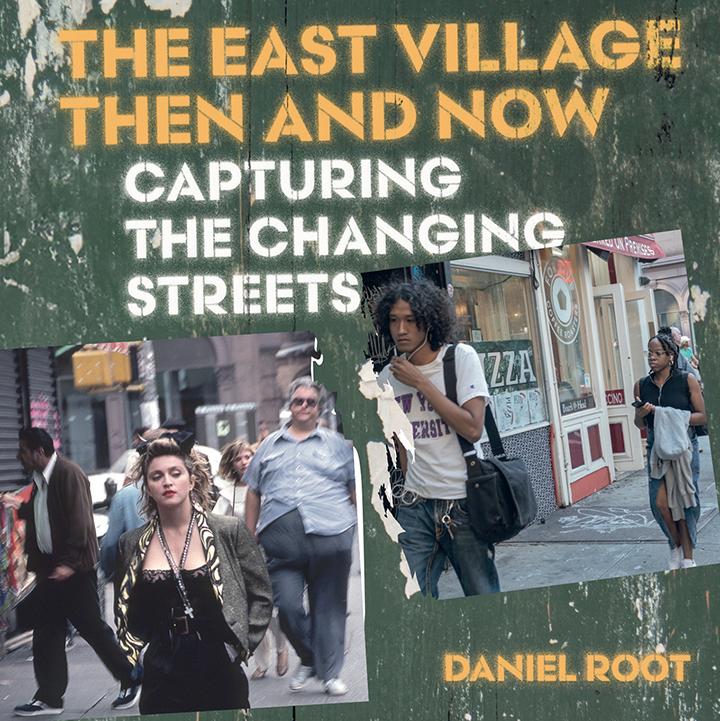
At six in the morning, long after last call, Daniel Root is most at home. The dive bars and restaurants are closed and empty and no one is there to notice he’s taking photographs. Even if someone did, they wouldn’t care. Root drifts around the Village, and when something reveals itself, he photographs it. This has been his method for decades: an instinctive practice that has produced some of the most quietly evocative images of downtown New York.
Born in Binghamton, NY, Root started visiting in the 70s but didn’t move to New York City in 1981 with a clear mission. The move, after all, followed drifting (there is that word again) through six colleges without a degree. “I wasted a lot of money, but I had a good time,” he says. It was his mother, hoping he might finally find something that held his attention, who gifted him his first real camera. A gesture that proved prescient, not because it imposed direction, but because it provided a tool for a craftsman.
Downtown Manhattan, like the rest of NYC at that time, was still emerging from the “Ford to City: Drop Dead” days. And the East Village was in the midst of an artistic makeover with storefronts turning into galleries for emerging art. Artists were working in untraditional ways. “The downtown gallery scene was taking off,” Root recalls, “laundries were turning into galleries,” he said. “People I was getting to know were making art and not always using traditional methods and materials.” Street art was urgent and accessible.
Richard Hambleton’s Shadowman series struck Root as both confrontational and meditative. “(It) worked as ‘straight art’ and social commentary,” he says. More importantly, the downtown scene gave Root a sense he didn’t need credentials to participate. “Being in the Village gave me permission to make things without needing an art degree.”
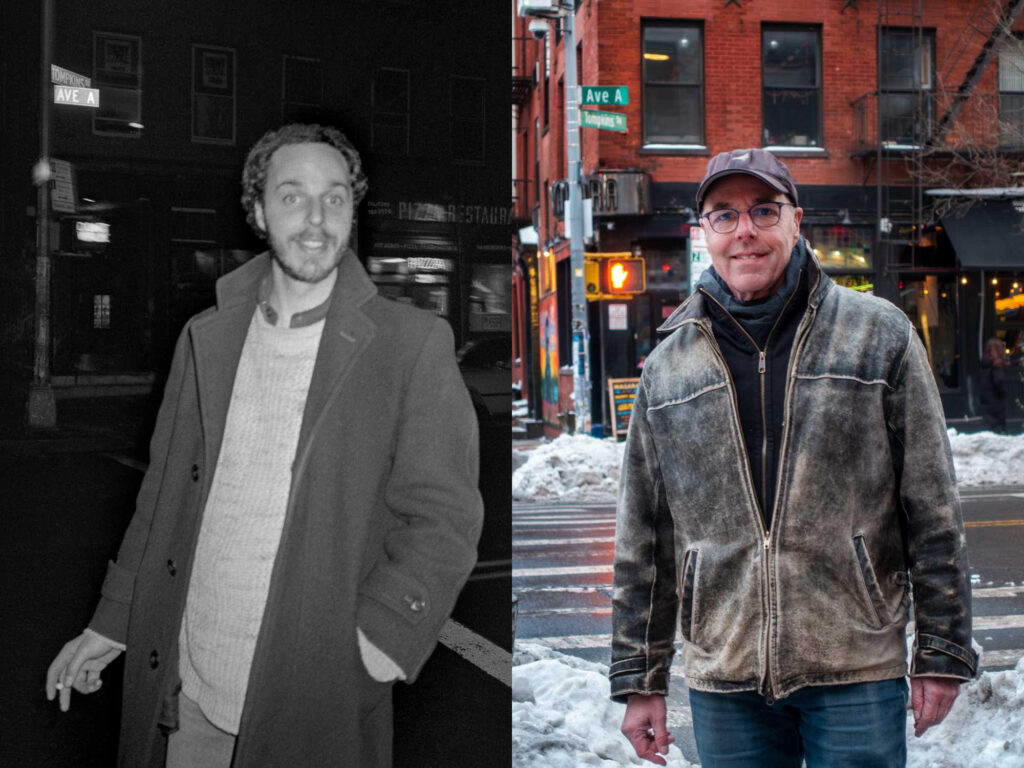
Influenced by Robert Frank
That permission evolved into the Root method, one less grounded in rigid planning, and more in observation, repetition and doing. Root credits Robert Frank as a major influence, both for Frank’s mastery of the street photography genre and his willingness to embrace imperfection, intentional ambiguity, and the fleeting nature of city life.
Root encountered Frank once in the Village; he passed his building frequently after all, and acting on instinct, took his photograph. A risky undertaking with the famously touchy master. The influence of Frank’s later work looms large, particularly in Root’s experiments with altering negatives and prints of his landscape photographs. However, he adds, “I can’t pin on any one influence which led me to start physically altering my photography process,”
His early career began with more structured opportunities at the white-hot center of downtown pop culture. Through the production company ATI, “kind of a low-budget MTV,” as he describes it, he began photographing musicians and actors for promotional purposes. When the ATI people moved to MTV, Root found himself working with ever larger and more well-known subjects. Working with MTV meant assignments also included shooting major music label portraits of artists ranging from Ozzy Osbourne to Mary J. Blige, Liza Minnelli, and Itzhak Perlman. One of his images would eventually land on the cover of Vol. 4 of Neil Young’s official re-release boxed set series.
His observational distance, that would later come to define his street and landscape work may have started with the need not to be star-stuck with his famous portrait subjects.
His reflective sensibility finds its pinnacle in Root’s exploration of New York’s pre-dawn interiors of bars, nightclubs, and diners. The Lower East Side and Chinatown have been his muse, and the spaces that seemed suspended in time became his milieu. The technical needs that come with the low light of closed establishments required long exposures, which transformed his images initially in unexpected ways. Colors deepened, beer logo lights lingered, and empty rooms took on otherworldly qualities. These photographs, especially those collected in New York Bars at Dawn, speak to a recurring theme in Root’s work: as an outsider looking in. His subjects are often discovered rather than intentionally pursued, and are rendered with deliberate care, patience, and skill.
That balance between chance and intention was tested in 2012 when Hurricane Sandy flooded his storage space and destroyed 25 years of negatives. “It was one of the only times I cried as an adult,” Root says. The loss felt nearly unbearable; the sheer volume of the erasure of nearly his entire decades-long personal archive is still hard to comprehend for the artist, even today.
With that loss still weighing on him, Root’s upcoming book, The East Village Then and Now: Capturing the Changing Streets, feels both like a cleansing and logical reaction. Returning to locations he first photographed in the 1980s, he pairs his earlier images with new ones taken from the same vantage points, accompanied by his commentary. And this photographer writes great captions! The project is an intentional act of revisiting, comparing, and reflecting on four decades of change, with there being no better photographer to create such a book on the subject. The book was published by Abbeville Press on May 12, and features a foreword by artist Peter McGough and an essay by Beat historian Bill Morgan.
East Village Then and Now documents the LES transformed, for better and worse. It reaffirms Root’s commitment to looking closely at his beloved neighborhood, altered by time, decay and development.
With the evolution in his subjects, from portraits of musicians, to downtown street scenes, to his altered landscapes, Root’s underlying approach remains remarkably consistent. He ventures out across the Village without a fixed agenda, guided instead by instinct, experience, and a seasoned eye. Much of what he finds is unintentional: a moment, an eerily lit room, or a haunting landscape often presents itself because of his keen inspection of his sourroundings. Root’s skill to recognize, frame, and preserve it, is anything but accidental.
In the quiet hours before New York fully wakes, Root continues to wander. He moves through the city as he always has, ready for whatever reveals itself next.