Pleasure, Dilation, and Mythology in the Works of Reza Abdoh: A Historical Profile
by Asal Azari
Contradiction, infection, and a stimulation that drones. The work of Reza Abdoh warps the present moment as it straddles across seas and dual-identities.
Born in 1963 in a pre-Revolution Iran, Abdoh’s father was heavily influenced by Western culture, aesthetic, and tradition. By the time Reza was born, his family was established as high status by operating numerous businesses catering to the social elites of Tehran, including the Shah.
Exposed to theater at a young age in London, the pre-revolutionary Iranian attitudes towards diverse art and the celebration of art drove Abdoh’s experimentation with it at school abroad and at home.
The Iranian revolution of 1979 cost his family everything. Reza’s move to Los Angeles and continued involvement in theater intersected with his new life as an undocumented immigrant—from engaging in sex work to support himself and his brothers, working hotel night shifts, to navigating his evolving identity as a gay man.
He moved to New York in the 1990s and founded his theater company Dar a Luz, which means ‘giving birth’ in Spanish.
From exhibitions, video works, theatrical performances (sometimes site-specific), and opera, Abdoh’s exploration of power, sex, greed, repression, and family was fueled with an unwavering devotion up until his AIDS-related death at thirty-two. It is written in his monograph that “He raged—at injustice, at limits, at fate.” I couldn’t agree more.
Discovering Reza
I stumbled upon Reza’s work years ago in my first year of college when a studio professor was mentioning a list of directors I should know. Born in Iran myself, I was excited by the prospect of learning from and resonating with someone I could relate to. What was most striking about my initial encounter with his work, though, was not the “Iranian-ness” I was expecting to be emotionally impacted by, but rather the form and style of his works, in that they were not recognizable within the pedagogies I was training in.
What I witnessed was a kind of theater-making that did not rely on Western conventions—Aristotilian. I was left with more questions about the work I wanted to do than answers, but an affirmation of disruption that seeded in me this mantra: the work is not done.
Anything I know about Reza Abdoh’s process comes from my observation of his works, conversations with those who worked with him, and readings/videos I have come across since my initial encounter.
I am baffled by how little he is mentioned in theater schools and across contemporary considerations of the avant-garde. As a theater practitioner and director, Abdoh knew no limits as he realized that recognizing restraints of thought and body were to be at the forefront of his confrontation with the world.
Taking a look at his process in some of his earlier video works like “Sleeping With the Devil,” Reza is active in the piece as a performer, while also demonstrating an exactitude in his direction of the state of the body.
The text itself is a combination of his original writing and found text across interviews, television shows, and mythology. It was the first work he created after his AIDS diagnosis.
Using American culture
I don’t think that it is possible to encounter mythology without self-mythologizing, as we are the product and inspiration of the stories we tell. The iconography present throughout Abdoh’s work is mostly rooted in American culture, with government indifference manifested in the icon of a celebrity, with acts of cruelty on stage representative of power and greed.
In the moving ballroom theater piece, The Law of Remains, serial killer Jeffrey Dahmer is a part of Andy Warhol’s entourage of super-stars with cannibalism and murder becoming points of interrogation for sensationalist media and themes of desensitization.
Other American cultural icons become conduits for legibility in the context of familial structures as well, such as in Bogeyman. Here, American prairie scenes contrast with The Stepmother as the Bride of Frankenstein, and various acts of BDSM. These icons offer glasses through which to see the world that is being built. Together, the images come into focus by biologically rejecting each another, yet existing side by side.
Dilation becomes a key marker of Abdoh’s footprint. To continue with Boygeman, these contrasted scenes of “natural” prairie life parallel bodies in leather and face paint, illustrating a spectrum of “extremes” in conversation with another. Some of this conversation takes place through literal text, in which the musicality of the language is modulated to produce a crescendo and overall arc that is less positioned as a sole communication tool, but one of music.
Other forms of modulation are concentrated heavily on the body and its de-construction, potential for endurance, and nakedness. In Quotations From a Ruined City, for example, the politics of genocide and structural segregation are dilated in the human icons on stage. As a male couple wanders through history taking on various identities alongside Puritans, mummies, and businessmen, the witness is subject to an overstimulation of sound and movement that is a test of endurance for both the actos and audience. Most vivid is movement in which the characters carry out a repetitive, physically taxing sequence over and over again surrounded by a white picket fence—to exercise or exorcise.
Pleasure too, is in conversation with its implications. Reza teases the line of impropriety and lunges past it. There is a suggestion of literal pleasure as it relates to sex, and pleasure in practices of pleasure as they exist in tension with illness, indifference, condemnation, and self–mutilation.
What may be pleasing to Reza is overwhelming to his witnesses, such as the cacophony of sound, image, and movement. Yet, a sense of urgency and crisis infuses the work with a desperate need to be seen, turning sensationalism on its head by displacing associations to the perceived nonhuman, the supernatural, the stars, the forgotten. Works like The Law of Remains, Bogeyman, and Quotations From a Ruined City provide a greater degree of separation between the performers and the witnesses, as the performers can be seen either behind a fence, or in a box-like room, entrapped and bestial.
Time also plays a big role as Reza manipulates time by condensing it. Virtuosic phrases of action or language are compressed into brief vignettes throughout Bogeyman, and are juxtaposed by intimate soliloquies. In The Law of Remains, Andy Warhol’s superstars are infused less with emotionality, but intensity, as one-liners are delivered with great ferocity, speed, and discord.
Such chaos is then met by disruption that halts all action momentarily, only to return to its previous state of operation. Simultaneous action is also essential to the compression of time or establishment of multiple realities. Things happen at the same time. There is an impossible quality to this that positions my experience of the work in the hyper-theatrical.
To abstract time and space is one thing, but to extract multiple realities and place them in conversation with one another, prompts my understanding of the work to be that of interrogation rather than celebration. It is true that Andy Warhol and Jerffrey Dahmer both occupied high social standings, but the impossibility of this association to one another is exactly the realm of interrogation Abdoh calls on the witness to consider.
More than anything, Reza Abdoh’s legacy is a lasting confrontation with the unresolved realities of state violence, media spectacle, xenophobia, and public indifference to suffering and the policing of bodies. Abdoh’s work possesses the capacity to infect the present with its truth and its discomfort. He is not simply an Iranian artist, a queer artist, or an artist lost too young to AIDS. To categorize Abdoh is to relieve an audience through the comfort of resolution. Instead, his theater refuses redemption or coherence in any rational sense. It exposes contradiction as a condition of living. Through dilation, mythology, and relentless sensory excess, Abdoh forces disparate realities to collide until their contradictions can no longer be ignored.
reviews
The Farcical Chaos of Game Creek
by Asta Trivedi
Proposed as a screwball-noir written by Shea Stevenson and directed by Zara Zeidman, the play “Game Creek” completed its run at The Tank with riotous energy, verve and vivacity, spiraling into descending chaos, from head to toe. A tight-knit ensemble of seven, performers Isabelle Margulies, Alex Flanagan, Jacob Elijah Anderson, Natalia Soto, Piper Toohey, Micheal Adrian Burgos, Zara McCord, come together to deliver their own particular flavor of a new work comedy.
Opening with a bare stage soon filled in with lush, woody, and animated scenery, theatrical from the onset, the melodrama of its world is immediately revealed. Somewhat haphazardly merging the rustic and nostalgic with the contemporary and the casual, the central character stumbles in, claiming to have no memory.
This amnesiac, discovering somebody else’s wallet in their jacket — somebody they might have killed — finds out with much astonishment that they are expected at court the next day. We follow a trial, false courting and performative attempts at marriage, rivalry and competition, ending in a desperate need to either escape the strange town or find a way to settle into it (that is, to get drunk).
Through the winding, circular absurdities, the performers commit wholly to their self-described “screwball” genre conventions, infuriating one another on and on again in a mock-up similar to a cult film or the board game Clue, simulating the ludicrous, nonsensical “nothing matters” trope, but without clear purpose. The fullness and boldness of physical and vocal comedy take center stage, propelling time and action forward, with little substance of story to give meaning to the archetypes established. The lens to view this play is by its liveliness and energetic charm. Simply put, the genuine and admirable desire to have fun.
Here however, this intention becomes lost in translation.
Where technical world-building fails, appeal to the audience fares better, the audience responding fluidly with a child’s laughter casting a spell every so often.
All in all, the big old question is the big old “Why?” of the piece as a whole, and yet, when people react in delight, little else matters. What remains looming on the other hand, is how young artists can work towards a radiating, full and deep joy, as a few steps forward from hitting the punchline.
Outrageous Tenderness of Shell at SoHo Playhouse
by Asta Trivedi
In some ways, Ana Evans and Linnea Scott’s co-creation of “Shell” has one essential agenda: to tell us, unabashedly, that “Peanuts are small, and peanuts can kill.” Newly arriving from the 2025 Edinburgh Fringe Festival, the U.S premiere of this solo show collides the worlds of a rollicking hockey player, Andy, preoccupied with sex ed, with the personification of boundless child wonder, Peanut. Running to June 7th, this limited engagement at SoHo Playhouse’s Huron Room holds an audience together so intimately – literally – that we become one of the same.
Landing into this space, we are met with a task — take a slip of paper and pen and write down on one side — what do you really want? During the performance, the audience is prompted to draw on the other side of the paper. In fact, the audience is prompted to do several things from the get-go… a Mexican wave, taking a swig of beer, answering questions… are only the start of it. The audience meets and interacts with Evans’ hyper-intense hockey-player, comically and gracefully assessing and judging our relationship to anatomy.
This character switches dramatically to Peanut, and the shift—staccato to legato, a bright-eyed-pink-faced-soft-and-delicate entity taking charge ever so gently. This being – this peanut – desperately, albeit shyly, wants to know what it is you most desire, what it is you wrote on that little slip of paper. Evans snaps between these two extremes, the endearing boyish exterior and the raw, fragile interior.
This performance vocabulary is set masterfully by what stays constant in the show — the participation, if not the contribution of the audience. When we are comfortable and familiar with the two versions of Evan that exist on either spectrum, we are then suddenly engaging with what appears to be plainly, the performer herself, perhaps lying in the center of that spectrum. The result is mesmerizing, not only because we hear the original voice, the original gesture, the original attitude, but because it feels like it is bravely earned. Spending all this time with a performer and a performance that is heightened, so energetically demanding of everyone in the room, in loud largeness and quiet smallness, there is then a shockingly sweet and tender transformation into self.
There is an understanding only at that moment that the audience is witnessing a metamorphosis. The audience takes part and contributes to a grand finale, supporting the last stages of caterpillar bursting forth into butterfly, by essentially making her a rock star. Many people are involved, hair is blown by a hairdryer, arms are extended for autographs, the name “Ana” is chanted, the performer is lifted in the air; we are all involved. The requests, though leading, are never instructions, never didactic, because Evans is not talking at us, but with us. And what Evans and Scott seem to be asking is: what is it you really really want?
Rain or Shine, Old and New: TNC Cabaret
by Cora Cadman
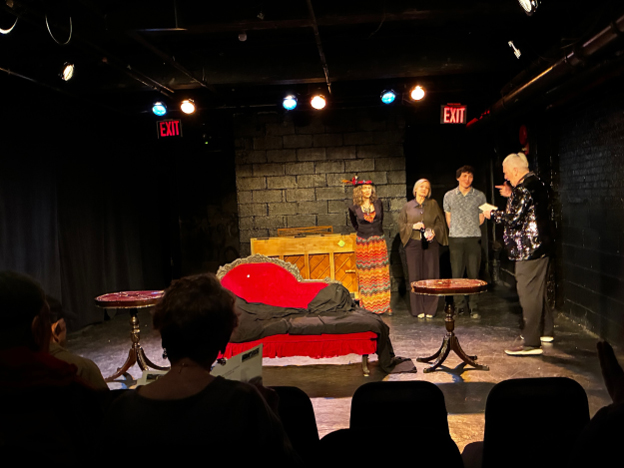
Despite it being a rainy Sunday night, Theater for the New City provided a full program of theatrical excerpts and performances. Part of their recent LES Festival included a cabaret-style medley of upcoming and past plays from TNC with live musical interludes. I sat in the Cabaret theater ready to be taken on a journey, and that I was. The blue sequined host opened with a semi-choreographed routine to “New York, New York,” complete with a one-man kick line and high harmony.
The Cabaret theater is always intimate but felt especially so as audiences came and went after each act, snatching glimpses TNC shows. Upcoming play “Goodnight, Mrs. Calabash” by India Marin Stachyra offered a glimpse into the apartment of a retired Hollywood starlet. An inquisitive NYU film student interrupts her hiatus with unexpected sexual tension and an exhumation of her past. The excerpt concluded with a tender dance that left me wondering how far the play would probe the murky waters of parasocial eroticism and intergenerational relationships. I am curious to see whether this new play will answer the moral quandaries it poses or present them without judgment as in this excerpt.
An older white woman in a light blue linen dress and a large seashell bead necklace presented a traditional Native American chant with a drum and a flutist. She invited the audience to sing along with her these two simple lines, “The Earth is our mother / we must take care of her / The Earth is our mother / she will take care of us.” The audience tentatively joined her in a moment that felt resonant and profound, broken only by her following song, “God Bless America.” Several audience members knew all the lyrics and sang along gleefully. Whether the contradiction was lost on them or whether they found it poignantly profound, I am not sure.
I was tickled by an excerpt that featured an alien strip tease. Upcoming play, “Miss Universe” hardly gave anything away about its premise except perhaps for its centering of an otherworldly love story. The scene felt delightfully youthful and refreshing.
Unlike a typical cabaret, this evening was notably unanchored by a theme. It felt rudderless perhaps in part due to several weather-related cancellations. I appreciated the piecework quality which, to me, is an endearing characteristic of TNC.
I did notice a lack of diversity though. The historical establishment of TNC as an accessible leftist theater back in 1970 in what has become a gentrified neighborhood exposes the difficulties historic institutions face .
Sex, Drugs, and Genocide: Leslie Ayvazian tells all in Mention My Beauty
by Jane Delaney
Mention My Beauty runs now through June 14th, 2026, at New York Theater Workshop’s E Fourth Theater as part of the theater’s In the Bricks Festival. In her auto-biographical one-person performance piece, playwright and performer Leslie Ayvazian tells stories from her young life as an Armenian woman, experiencing the thrills and heartbreaks of teenagehood amidst the budding cultural revolution of the 60s and 70s in America, and the relationship with her parents.
Everyone is still grappling with the devastating Armenian Genocide of 1915, which killed over half of the population and continues to be denied by the Republic of Turkey. Through her performance of this piece here and now, with decades of life under her belt, Ayvazian suggests that this rebellious nature might never entirely fade with age; that we might all, even in older age, be coming-of-age.
David Warren’s direction is simple yet effective. Ayvazian faces us, with nothing but bare stage lights, a music stand, her script, and a lifetime of stories, stains and all.
Perhaps the most striking element was the way in which Ayvazian characterized her delivery. Despite barely moving her body, her face tells all, almost as though commenting on and cringing at her past desires and mistakes from an older, wiser, wittier perspective. She also transforms into dozens of the incredibly specific people from her life’s journey — from her stern, doctor father, to the many, varied lovers and partners throughout her life — on a dime.
Ayvazian isn’t afraid to admit that she’s made mistakes along the way. There are some particularly earnest stories recounted throughout the show, including the admission of her sleeping with her best friend’s partner and destroying their friendship, or a botched at-home abortion in which her father, in a rare act of understanding, assisted the surgery and supported her while she healed. But she doesn’t just show us her guts for the sake of it. Ayvasian makes us bleed while looking in, revealing the cultural and social context for her desire to act out and detach; messiness met with empathy and understanding.
There were a few moments while watching, particularly at the beginning, where I, while enraptured by Ayvazian’s dead-pan delivery and sense of wit, was curious about the narrative’s throughline. But after a few stories, the production, rather smoothly and intelligently, reveals its few central, pivotal questions: what happens when you never quite age out of your teenage rebellion, and all that comes with it? In what ways is it a necessary act of political urgency, and in what ways is it just stupid, plain and simple? Ayvazian, in her infinite wisdom and lived experience, doesn’t seem to land on one singular, tangible answer.
It’s a complexity that lends itself to an incredibly captivating night of theater.
The Peculiar Patriot
by Jane Delaney
While not entirely verbatim theater, Liza Jessie Peterson’s one-person play The Peculiar Patriot, playing now at New York Theater Workshop, certainly has an intimate, almost documentary quality to it. It’s no coincidence, considering the playwright and performer’s closeness to the material, having worked extensively with prison populations. This is her attempt at turning the statistics of over two and a half million incarcerated individuals into universal stories of love, longing, and a desire for homecoming and true acceptance.
The look inside
It’s an attempt that pays off incredibly well. The play follows the sisterhood between Betsey LaQuanda Ross, a formerly incarcerated woman, and her friend Joanna, a mother who is still behind bars. Betsey sits close to the edge of the stage, thus casting us, the audience, into the role of Joanna. She tells Jojo stories from the outside. She brings her snacks and a quilt she is working on, to honor those who are still behind bars and track the passage of time. Betsey even, from time to time, takes the form of her boyfriends, reading out their love letters to her, or their manifestos, which trace the roots of the prison industrial complex to slave labor.
Jessie Peterson’s performance is so captivating that it’s easy, from time to time, to forget the harshness of the systems at play. In the preface for his Pulitzer Prize-winning play Doubt: A Parable, John Patrick Stanley asks us to consider “the silence underneath the chatter of our time.” As does Jessie Peterson, here. As she sits at a desk before her dear friend, we feel this silence sneak in from time to time. Her physicality is captivating, the dialogue sharp and ever flowing, the energy high. But underneath this brilliant comedic performance lies the hard truth, the silence underneath the chatter of our time: that Joanna is just one of approximately 150,000 mothers incarcerated in the US, many of whom, Betsy reminds us, are either framed or in for the most petty of crimes, often for decades to life.
It is this very silence, positioned in such jarring contrast to the humorous spirit of the rest of the piece, which allows us to connect so deeply with these women. When all else fails, Jessie Peterson suggests, we still have each other. We still need each other.
Liza Jessie Peterson has been performing The Peculiar Patriot for 25 years, having first put pen to paper in 2011. Now, for its final installation before Peterson “hangs up her jersey in the rafters,” the production runs through June 14th at New York Theater Workshop (79 E 4th Street Theater), presented by NYTW & National Black Theatre in association with Lena Waithe.
As part of NYTW’s In The Bricks 2026 Festival, Talvin Wilks directs, with scenic and lighting design by Andrew Cissna, projection design by Katherine Freer, costumes by LaToya Murray-Berry, sound by Luqman Brown, props by Berlynda M’Baye, and tour produced by James Blaszko. You can find more information about the play, as well as additional resources, here: https://www.nytw.org/show/the-peculiar-patriot/.
Catch it before it’s gone.
Poetry, Protest, and Persistence at TNC
by Cora Cadman
Theater for the New City has a no shortage of free and low-cost theater but one weekend a year they showcase almost 27 hours of performances at the LES Festival. I attended Sunday afternoon’s poetry slam and open-mic in one of the smaller theaters which, to my surprise, had an impressive turnout.
Host Lissa Moira facilitated a politically-charged afternoon of poetry, comedy, and original songs with a delightfully lively older audience. Many of the poets had the humble eccentricity of the Lower East Side’s iconic decades of outsider art and affordable loft apartments.
There were countless headpieces with colorful ribbons and feathers and patterned scarves. I stood out in the crowd as a 20-something wearing a plain sweater and jeans. The afternoon was full of bawdy jokes about Donald Trump and his tyrannical administration, one woman beginning her poem about being priced out of her studio in the East Village with “Never elect a landlord as the president.” From odes to Edward Albee and T. S. Eliot to monologues from Vietnam War vets to confessionals of heroin sex, the event was a time capsule of the generation of artists who made the LES what it was.
While some of the poets reflected on their youth and experiences that defined their lives, I was struck most by condemnations of the Epstein Files, AI, Elon Musk, and ICE. It had seemed to me that the progressiveness of the late 20th century artists was strangled by corporate interest and left behind an unfeeling, wealth-hoarding class of Baby Boomers. But in that room I observed that their optimistic radicalism is very much alive even as their bodies are visibly weakened with ankle braces, canes, and chemotherapy.
My use of “optimistic” may sound contradictory to the topics at hand. On the contrary, there was an abundance of laughter, love, and joy. One poet read a hilarious poem about how to choose a good mango followed by a dirty fantasy of being wrongfully accused of having an affair with another woman’s husband. Another read several snippets of dry humor, one being “I am going to the beach. / To do what? / To roast, and then drown.” A comedian attempted one-liners for each neighborhood in New York although the essentialism veered toward stereotyping which seemed to make the crowd more uncomfortable than humored. Still, the modest crowd was forgiving and awarded him applause.
One poet entered the theater quite past his time slot and immediately positioned himself onstage to begin, interrupting the acquiescent host’s own poetry. The crowd erupted in protest but Ms. Moira quieted them. While some of the audience clearly had known each other for several years or decades, there was an unspoken camaraderie that exists between those who have been ostracized, overlooked, and silenced. I found myself exclaiming “Let her finish!” This is the kind of community spirit which Theater for the New City inspires and amplifies in events like this poetry slam. It is defensive of its old-timers but welcoming to newcomers, full of hope and resilience, and unabashedly bizarre.