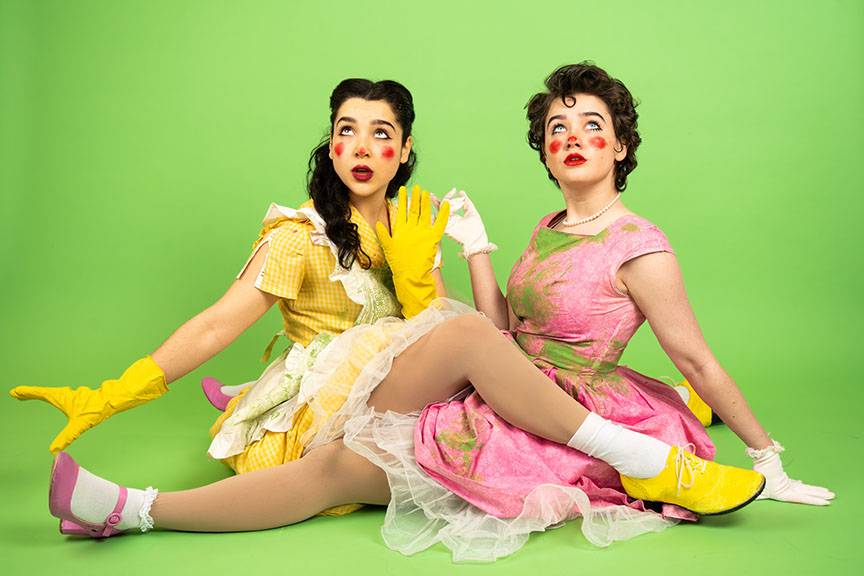
The New York–based performance team of Xhloe Rice and Natasha Roland (billing themselves simply as “Xhloe and Natasha”) has — over the past four years — made tsunami-like splashes at the famed Edinburgh Fringe Festival. The duo has been feted in Scotland for their compelling two-hander dramas, which bring clown play to original texts and reawaken the mid-twentieth-century tradition of Theatre of the Absurd — a movement associated with such playwrights as Samuel Beckett and Eugène Ionesco.
This fall, they bring the U.S. premiere of one of their biggest festival hits, What If They Ate the Baby, to the SoHo Playhouse (November 21 through December 22). They have marketed the show as “a queer cannibal take on the 1950s American Housewife.” Baby has played in Edinburgh in 2023, 2024 and 2025, winning multiple awards as well as the hearts of playgoers who appreciate challenging theatrical scenarios.
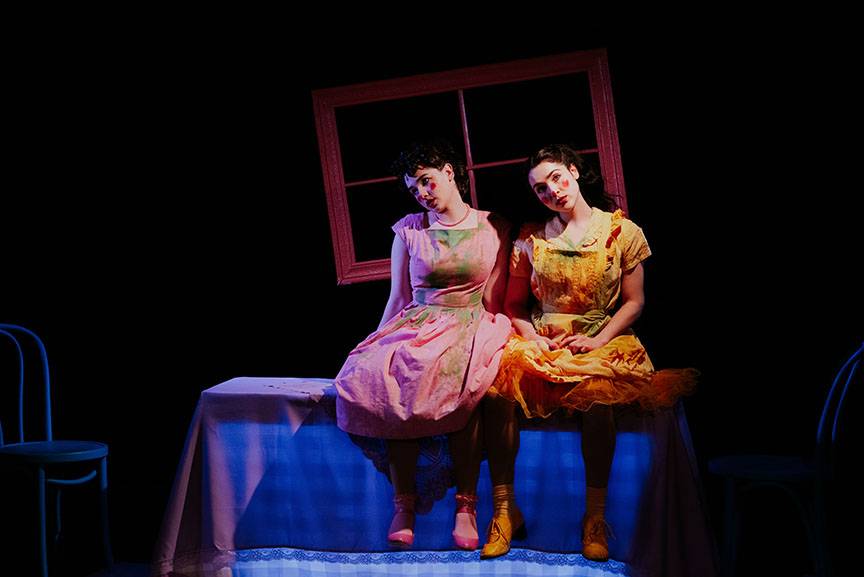
The play opens with a moment that could have been lifted from a scratchy old sitcom like Donna Reed or December Bride. Dotty (Xhloe) comes to the door of her neighbor, Shirley (Natasha), returning an empty casserole dish. They’re both dressed impeccably and have bright red circles affixed to their cheeks, denoting their clown status. In the better part of the ensuing hour, Dotty and Shirley’s inner lives are manifested, through Xhloe and Natasha’s expressionistic movement, wild sound cues and cryptic dialogue. The actors make their bodies move like jerky marionettes at times. They pose and pause. They repeat the same sentences in different contexts. We see the characters’ lesbian imaginings made blazingly real, and we squirm as the two wander into some troubling realms of the psyche.
Issy Cory of Binge Fringe magazine wrote of 2025’s iteration of the play at Edinburgh: “The rumours are true, this is a creative pairing for the ages.”
Common ground
I spoke with Xhloe and Natasha about how they’ve become the toast of Edinburgh.
Both grew up just north of Baltimore. They met about twelve years ago. “Natasha was a year older than me,” Xhloe recalled. “She was my tour guide coming into a brand-new high school.”
They clicked. They found a shared sense of humor and a mutual interest in storytelling through dance and other movement. Xhloe noted that they also had the same work ethic:
“We would stay after school to create things…. We’d have sleepovers, and we would improv and write down our best ideas. We had the same sense of wanting to be generative.”
After graduation, they moved to New York for college: Xhloe at Fordham, Natasha at Marymount Manhattan. Natasha’s venture to Italy to study commedia and other theatrical arts at the Accademia Dell’Arte prompted an interest from both of them in the discipline of “clown,” which they continued to study in New York. They did not ally themselves at first with “queer clown” practitioners. But the subject matter of the work they did steered them into that territory, linking them with the “burlesque clown” and “drag clown” scenes as well.
Blessed nonsense
Their college years also introduced them to the Theatre of the Absurd. That genre, which flourished first in the 1950s, would influence the work of many later writers — Sam Shepard and John Guare among others. But Xhloe and Natasha were particularly entranced by the work of the founding absurdists. Natasha recalled taking a course in which students read Beckett’s Waiting for Godot, a play she found herself defending. “I liked how divided people were on it,” she said.
She is excited about the current version of Godot on Broadway: “It gives me hope for our work…that there is a world in which that form can be commercial.”
We talked about whether the current social and political climate is especially suited to an absurdist spirit — bracing its adherents for a world without meaning. Xhloe mentioned an article she’d read, claiming that art rooted in the surreal precepts of Dadaism emerges in times of political unrest. I asked whether the proliferation of protesters wearing fanciful-creature costumes at recent anti-Trump rallies perhaps jibes with such tendencies.
“I think our last defense against so much seriousness is silliness,” Xhloe said. “People in frog suits is the perfect epitome of when all else fails, just be a clown.”
Whittling things down
Xhloe and Natasha have claimed that they are never short on ideas for a show. Xhloe keeps a phone list of all manner of things that could possibly spark new projects: a TV commercial, a passing bus, a notable dream that one of them has had. Every project on which they embark is its own peculiar creature, but, generally, they tend to wait for a particular idea to rise to the top, then proceed to expand upon it. “Every time we’ve written something, it’s been the idea that we just can’t leave alone,” said Xhloe.
Once they’ve committed to a project, the next step is akin to sculpting in stone: a stripping back rather than a laying on. They will pick away at a bulging-at-the seams concept, determining what will not be in the show, gradually fashioning an outline that can be refined in rehearsal. Their written scripts tend to omit much of the physical movement that will be added as they transform from creators into performers, edging toward opening night.
Because they don’t work with a director, they capture their rehearsals in videos, then figure out together what needs to be adjusted.
Ideally, they would freeze their scripts at a certain point, but they have a “bad habit” of making changes even after a show is up and running. Xhloe recalls that, during a run of their play A Letter to Lyndon B Johnson or God, they argued about whether a pause should happen before or after a certain “beat” in order to fortify a joke. They would alternate the options, one night to the next, testing which choice earned the better audience response.
Home sweet SoHo
What If They Ate the Baby? has had engagements in London as well as in Edinburgh, but Xhloe and Natasha are anticipating the New York run of the show with relish.
“It’s incredibly special,” Natasha stressed. “Because we boomed in the U.K. and we were building a strong audience [there], it would always be this crazy reckoning when we would come back to New York and…have to return to a day job and just grind and grind and grind. And so, to…be recognized in the [New York] theater world…is massive. … And this isn’t necessarily the biggest part, but I get to sleep in my bed and not on a couch somewhere.”
After all the preparation, they treasure the opportunity to hit the boards in front of a crowd, however rigorous the onstage action.
“The most fun we have is when we’re onstage,” said Xhloe, acknowledging that the show can also be exhausting.
“I can be tired after the show,” she added.