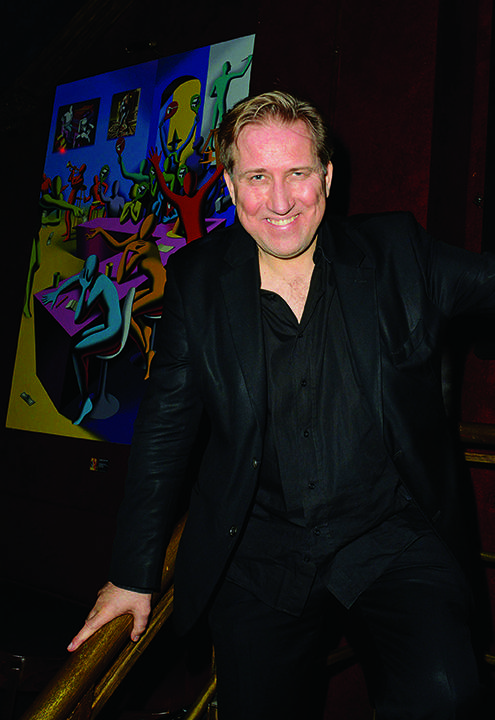
Of the artists who rose from the 1980s East Village to prominence, Mark Kostabi is certainly in the top tier, and among the few survivors who deserve the appellation maestro. There are others of course: Jeff Koons, Kenny Scharf, Julian Schnabel, David Salle, Eric Fischl. Though Kostabi – like Warhol, Picasso or Dali in the past – enjoys the status of wide recognition as a one-name celebrity artist, beyond the art world.
Kostabi arrived in Manhattan in 1982 and quickly became known as an enfant terrible as much as for his faceless, robot-like figures exhibiting contemporary behavior and interacting with technology. He was born in Los Angeles to Estonian immigrants. He left L.A. “because I wanted to escape what was then a provincial outpost of the art scene.”
Towards the end of last month, I paid him a visit at the current iteration of Kostabi World, his studio and home in Chelsea, to talk about his artistic activities. I found out that he’s leaving New York permanently to live full time in Rome, Italy at the end of May. He has maintained a home in Italy six months a year for more than two decades and is as much if not more of an art world icon there than here.
His first iteration of Kostabi World was a 15,000 square foot mega studio located on three floors of a building on West 38th Street, in the Garment District. Then there was a loft on West 36th Street, followed by a brownstone on the Upper East Side. He’s been in his current location for five years. In June, Kostabi’s United States operation, including two assistants who have been with him for twenty-five years, will be relocating to upstate New York. The artist will be relocating to Rome full time.
Park West
Anyone who wishes to see some of Kostabi’s paintings and sculpture can visit Park West Gallery at 411 West Broadway, between now and the middle of this month. Park West is an emporium where one finds the works of name artists past and present. There Kostabi’s work is being presented currently in an exhibit titled “Picasso and Kostabi” alongside previously unseen pieces from the late artist’s estate.
The show is well worth your time. There’s also a room dedicated to Salvador Dali’s series of woodblock prints based on Dante’s Divine Comedy, which I found of particular interest as I am currently re-reading the poetic masterpiece. Though, in truth, I find viewing all the art currently on display there an excellent expenditure of time and have visited multiple times.
Park West Galleries is one of the largest purveyors of art in the world. In addition to the vast combined square footage of their various gallery spaces, which sometimes double as in-house auction venues, Park West Galleries also initiated the art first cruises, where shipboard auctions and exhibits combine with scholarly talks and the chance to meet famous artists. There is also plenty of fine wine and dining.
Kostabi is often an on-board presence, having cruised with Park West twenty-five times, so far, to Australia, South Africa, the Bahamas and throughout the Mediterranean.
Meanwhile, back at Kostabi World, the maestro and I had a wide-ranging conversation covering his activities now and since I first made his acquaintance in the 1980s. Then I lived in the East Village and wrote about “the scene.” That period was a passionate explosion of art that still reverberates throughout the neighborhood today, and throughout art history. Nothing in my lifetime has equaled the innovation and artistic energy of that decade.
Kostabi World now is a brownstone on West 22nd Street, the garden of which is home to a 110-year-old fig tree (that still bears fruit!) and faces the back of the legendary Chelsea Hotel. Kostabi’s art, both finished and in progress, is everywhere throughout. There’s also a music floor with a Steinway Grand piano, seating for a couple of dozen or so, and a bar at the other end.
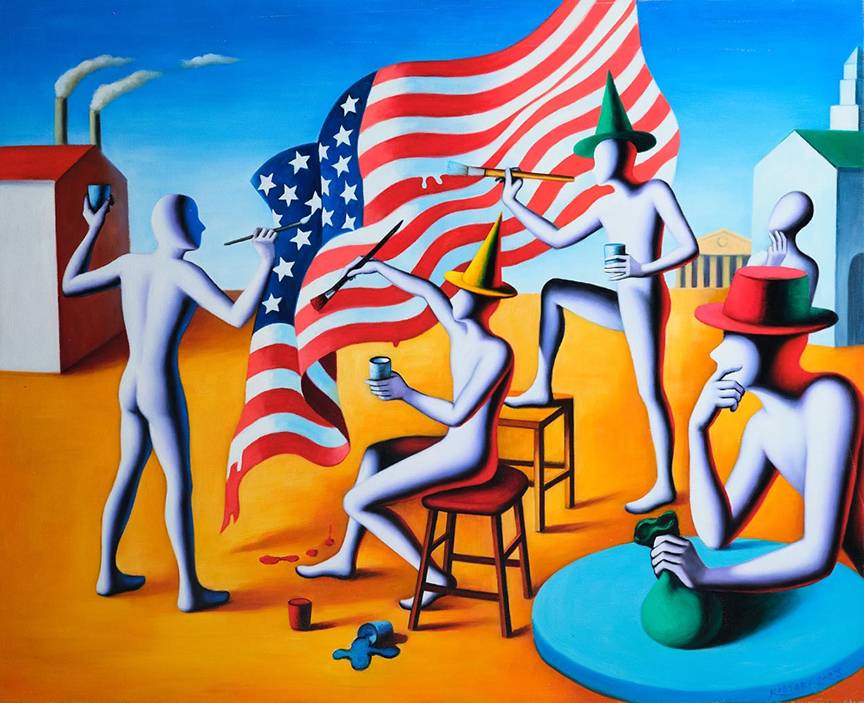
Music and art
Music is a big part of the painter’s life. Kostabi is a pianist and composer who has played with the likes of the late jazz great Ornette Coleman and many others, including his brother Paul Kostabi, who is also a painter and still lives in the East Village. Aside from the maestro’s excellent musicianship, as a painter he did album covers for Guns ‘n Roses and for The Ramones.
He also hosts intimate concerts by others at Kostabi World. Preparation for decamping from Manhattan has not slowed the pace of activity. These days Kostabi is noted for his sharing and generosity. The evening of the day I visited, he was off to The Cutting Room to donate a painting to a charity event hosted by his good friend Billy Amendola, founding member of the 70s combo Mantus and former editor of
Modern Drummer Publications. The following Monday, Gene Pritzker’s Composers Concordance were scheduled to present a concert of new music played by flute, viola, and piano.
We sat in Kostabi’s kitchen overlooking the garden on a warm, spring afternoon. An assistant came in for instructions and the master asked him to photograph certain pieces for his archival record. I asked Kostabi how many works he has painted. “I believe the number just passed thirty thousand,” he said. “I have a system for keeping track and it was 27,000” at the last tally.
“That’s thirty thousand paintings on canvas,” he clarifies. “There are also paintings on paper.” He mentions that one of his galleries in Italy recently brought out a book of his work, edited by prominent Italian art critic and curator Carlo Vanoni. The book is divided by half into paintings and the other half pencil drawings. Kostabi’s work has been auctioned almost 3,000 times, which is a healthy ratio indicating financial liquidity to collectors.
Stable market value aside, his paintings have always reflected his fascination with the latest technology. and how humans interact with it. In the 80s, it was the boom box and the Walkman. Now it’s the iPhone and, well, everything else.
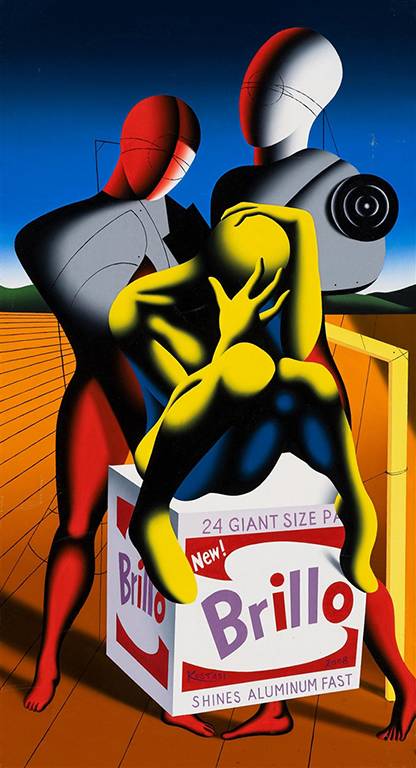
Technology updates
These days technology and Kostabi have joined forces. He told me he now uses AI to suggest titles and backgrounds for his paintings. “I’ve always embraced technology,” he says with marked enthusiasm. “For one thing, it allows human beings to have a longer lifespan.”
When Kostabi’s work first achieved prominence in the 80s, petty and ever-present art world jealousy reared its head and decried his success. Some said the work was “too commercial” and others snickered about it being science fiction. Nowadays, when art has become a marketplace where shares of paintings are sold online (something I do NOT recommend) and society is witnessing the birth of a new age in which robotics and artificial intelligence are experiencing an engineered fusion, Kostabi’s paintings seem like art as prophecy.
An avid chess player, Kostabi sometimes plays against AI now. “Nobody can beat the computer,” he says. “Nobody.” When Kostabi World was on the Upper East Side, the artist studied chess with three-time American champion Grand Master Lev Alburt, who exchanged lessons for paintings. “The sessions turned out to be life lessons for me,” recalls Kostabi with a tone of fondness tinged with nostalgia.
While eating lunch in his kitchen most days, he watches YouTube chess videos on a large flatscreen TV. He says he becomes totally engrossed. He also manages to find a couple of serious games every week, with human opponents.
Not surprisingly, there are a number of Kostabi-centric videos on YouTube. Among them is a TEDx talk about art that the artist gave, in Italy in Italian.
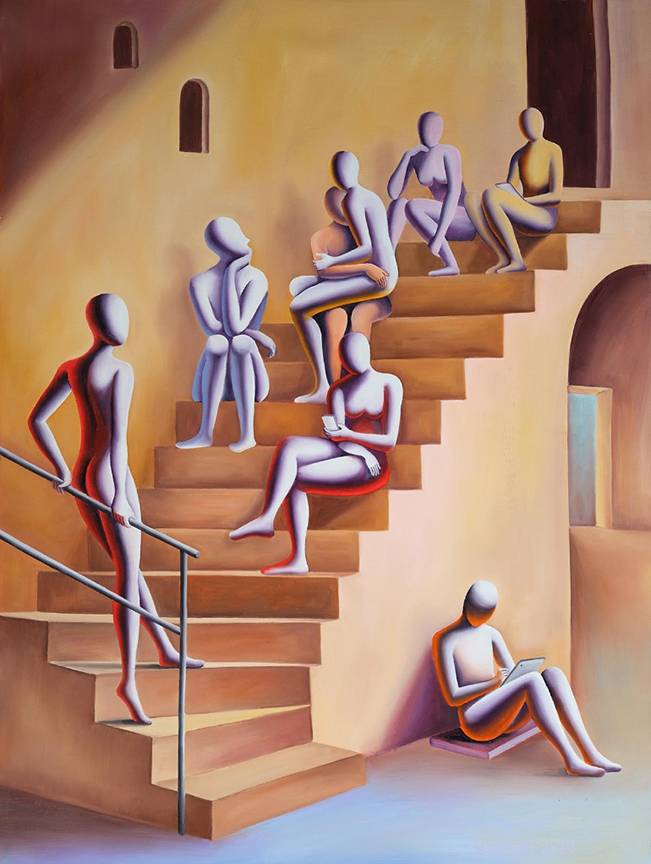
On the tube
The television screen has long been a component of the legend of Kostabi. In the 1980s and 1990s, he was mentioned regularly on Page Six, and often a guest on daytime talk shows. Around 2008 he started his own public access TV program, The Kostabi Show, also known as Title This and Name That Painting. (In some circles it was jokingly referred to as “Welfare for Art Critics.”)
Each week a panel of poets, art critics and others would be asked to choose a title for new works by Kostabi. There was a jury that decided which title worked best. Whoever came up with the winning title received a cash prize on the spot. Lee Klein, my colleague here at The Village Star-Revue, still fondly recalls the night he won $350.00. Other name gamers included songstress Suzanne Vega, poet Max Blagg, and the recently deceased painter, critic and editor Walter Robinson.
Kostabi discontinued the show in 2015. These days his TV connection is with an Italian channel where his paintings are frequently sold. “It’s kind of like the Home Shopping Network for art. Americans don’t get it,” says Kostabi. “But in Italy, million-dollar paintings are sold [on this channel]. Mine don’t go for a million dollars but other do.”
It probably should come as no surprise that Kostabi is abandoning Manhattan for Rome. His art world detractors here, who still exist, must be annoying; though he has had his champions. One of the most prominent was the late Walter Robinson, who was editor of the website Artnet.com. He was quoted in an article on artsy.com: “The art world has this big fetish about novelty, and Mark’s work strikes a lot of people as commercial—they think it’s too conventional,” Robinson stated. “Personally, I like these blank-faced androids. They represent the 21st-century Everyman character in a modern allegory play.”
Success and age have tempered Kostabi’s once-famous outrageousness. He’s no longer the volatile young artist capable of trash-talking the art market, or diving across the sofa and throttling a daytime TV host during a live broadcast. Now he is a gracious and kind gentleman on his way to becoming a grand old man of the international art world. Perhaps nowhere is this stature more evident than in Italy.
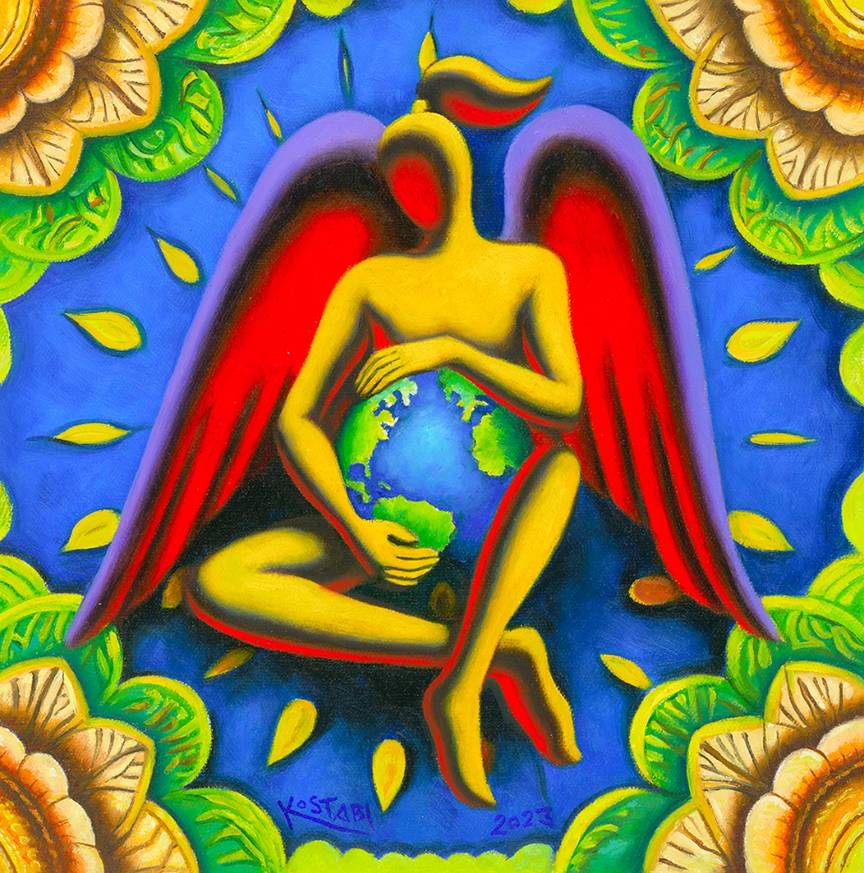
Kostabi was commissioned by the city of Velletri to create a larger-than-life bronze sculpture of Pope John Paul II. Faceless angels make frequent appearances in his work, which indicates a sense of spirituality. With the commission, the late pontiff had to have a face, the artist felt. So, he included three of his faceless angels carrying the Roman Catholic prelate off to heaven, making the piece unmistakably a work by Kostabi. The late Pope Benedict did the unveiling himself.
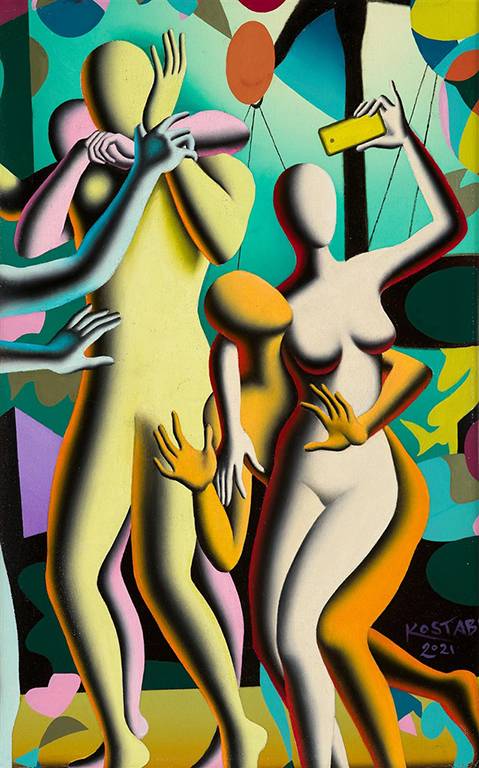
Faceless figures are not unique to Kostabi. In 1982, the year Kostabi arrived in the city, I was commissioned by Rizzoli International to write a catalogue essay about Giancarlo Impiglia. He paints faceless humanoid figures all decked out in fine clothes. His work is in the Art Deco style and can be found in murals downtown and elsewhere. Impiglia is part of the Nassau County Museum’s celebration this summer of the 100th anniversary since Art Deco first emerged. He is still painting in his Bridgehampton studio. Other than facelessness, though, the two artists share little in the way of style. Rather, Kostabi and others point out the obvious similarities to paintings by Giorgio de Chirico and Fernand Leger.
Though known primarily as a painter, Kostabi’s sculptures have become big-ticket items in his oeuvre. He creates them in the foundries and workshops in Pietrasanta, the planetary capital of sculpture production, in the Massa Carrara region where the white marble for Michelangelo’s greatest works was quarried. “Pietra santa” means holy stone, and the white marble is still quarried there.
“My move to Italy is both an artistic and a financial decision,” he says.
“It’s a lifestyle choice, too,” he adds. Now in his mid-60s, travelling back and forth can be wearying for the artist. “And the food and wine there are the best anywhere,” he says, a fact which few can dispute. I certainly didn’t. I’m nearing the end of the five-year process of obtaining my Italian citizenship by descent. Someday I will retire to Sardinia and a life of making new translations of Latin and Italian poetry. Kostabi, coincidentally, is much in demand on the island of Sardinia. “I’ve done art events all around the island. I love it there.” This summer he will be artist-in-residence at the luxury Forte Village Resort on the island’s south coast.
There will be a new Kostabi World in Italy, of course. He recently bought a villa for 2.5 million Euros (nearly USD $2.9 million) in a tranquil, upscale Roman neighborhood. “The same thing here in Manhattan, if you could find it, would be twenty-five million dollars, at least,” says Kostabi. “I don’t have that kind of money for a home. I could go on for hours about why I’m moving there.” Rome may be his
home but “In two or three years,” says Kostabi. “I’ll definitely be back.”
DiLauro is a poet, playwright, and art writer. He lives in the Village.