
Irrititja Kuwarri Tjungu: Contemporary Aboriginal Painting from the Australian Desert. January 22-April 11, 2026. Grey Museum, New York, NY
The paintings are unquestionably beautiful, rich with vibrant colors, precise symmetry, intricate geometric patterns, cross-hatchings and luminescent dots. They are beautiful and I don’t understand them at all. To engage with these paintings is to be confounded.
Fred Myers is trying to enlighten me.
“You’ve got to stand 20 feet back to get the full effect,” he advises.
The full effect is dazzling but that’s just the beginning, or so I learned as we walked through the landmark exhibition of Aboriginal Australian painting at New York University’s Grey Museum. The title in Pintupi, which translates as Past and Present Together, conveys the unique intent of these artists to invoke ancient traditions in a contemporary medium.
Myers is clearly in his element. A Professor Emeritus of Anthropology at NYU and an expert on the work that’s being celebrated here, he was instrumental in organizing the exhibition and in fostering recognition of the exceptional virtuosity of Aboriginal artists. Tall, casually dressed in blue jeans and a favorite tee-shirt, with his shock of thick, white hair he’s been mistaken for Steve Martin, a friend and avid collector of Aboriginal art.
“The shapes and symbols you see in the paintings have been handed down over generations,” he explains. “They’re meant to reveal the Dreaming, the stories of the mythological time when the ancestral beings created the land and the people living there.
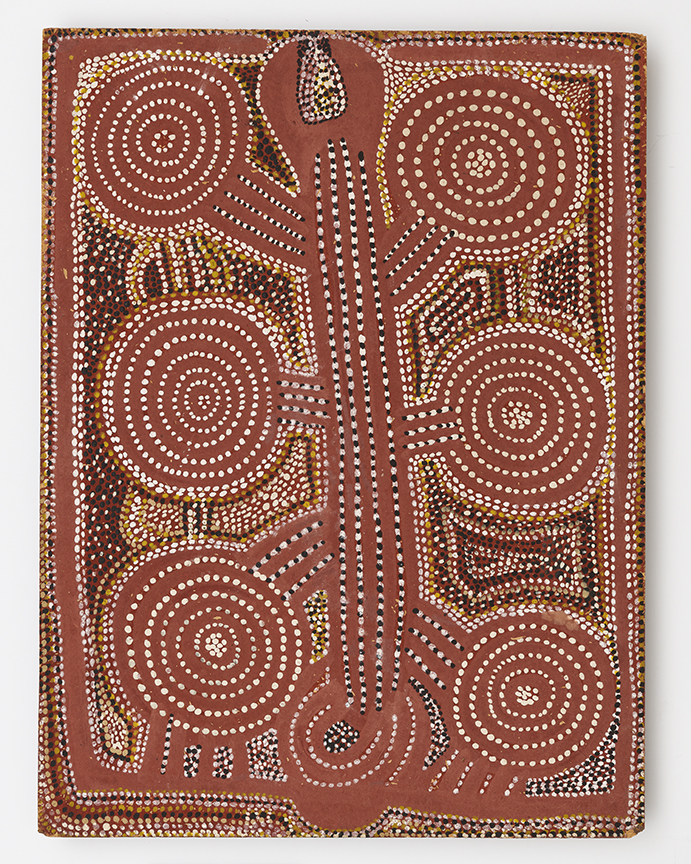
“You don’t dream it,” he stresses. “The Dreaming is a socially transmitted body of knowledge, and it remains the foundation of all Aboriginal customs and culture.”
Recurrent motifs of interlocking circles, wavy lines, animal tracks, and intricately dotted patterns constitute a language of symbols that Myers has been learning since he arrived in the remote outback of the Australian Western Desert to do his graduate school fieldwork in 1973. “My thesis was originally going to be about the individual in the Aboriginal community, but I found something much more interesting.”
Something more interesting
In the settlements of Papunya and Yaiayi, in conditions of extreme poverty, rampant disease, and bleak desolation, Myers observed something remarkable. Groups of men were painting, prodigiously, stunningly; painting with homemade pigments on anything they could find—discarded building materials, fruit crates, plywood, and scraps of cardboard; making paintings like nothing ever seen before.
In time, the designs in the paintings would become more familiar after Myers witnessed ceremonies in which young men learned the stories of the Dreaming. “The men paint their bodies with the same motifs,” he vividly recalls. “The fire is flickering like a strobe light, bullroarers whirling, and the painted dancer leaps out of the darkness. He dances and chants, and as he does that, he’s tracing patterns and symbols in the sand with his finger to illustrate the maps of sacred sites and the journeys of the ancestors.”
The paintings surrounding us employ the same designs but have condensed the complex narratives onto a two-dimensional surface. “That’s their genius,” Myers says. “They’d painted their bodies, their shields, and other ceremonial objects, traced symbols in the sand, but never painted on flat, two-dimensional surfaces before. It was radically new.”
As we walk from painting to painting, he recounts the Dreaming stories they convey. One common theme is Yina, the “Old Man.” “He’s often depicted as a phallus and testicles,” Myers chuckles. “The testicles would sometimes take on a life of their own, and the Old Man would call them back when he woke in the morning.” Charlie Wartuma Tjungurray’s Old Man’s Dreaming at Tjurrpungkuntjanya shows Yina’s testicles racing ahead of him on a rocky rise.
In Travels of Kutungu from Paunnga to Muruntji, the pioneering women painter Unyuwa Nampitjinpa relates the story of how the Snake Woman Ancestor tracked down a group of boys who’d raped her, then killed, cooked, and ate them, before throwing them up, marking the landscape with her vomit.
“I loved the paintings from the beginning,” Myers reflects. “They’re incredibly expressive and I loved their unbalanced balance.”
That quality of fluid asymmetry in Kaapa Tjampitjinpa’s Dreaming at Mikantji evokes the topography of a sacred Water Dreaming site carved by the Storm Ancestors.
Besides symbolic designs, the earliest paintings often also depicted the sacred items used in ceremonies: decorated shields, boomerangs, and oblong objects called chirunga, believed to embody the totemic ancestors’ spirits. “Some of the paintings were considered transgressive,” Myers recounts. “In their enthusiasm, the painters revealed ceremonial details they were forbidden to share with women or outsiders.”
Out of respect, the shapes of ceremonial objects were more generic or hidden in the work that followed. For example, in Johnny Warangkula Tjupurrula’s Water Dreaming at Kalipinypa, chirunga are camouflaged in the subdued background of an elaborate map showing water holes in a vast, geographic patchwork.
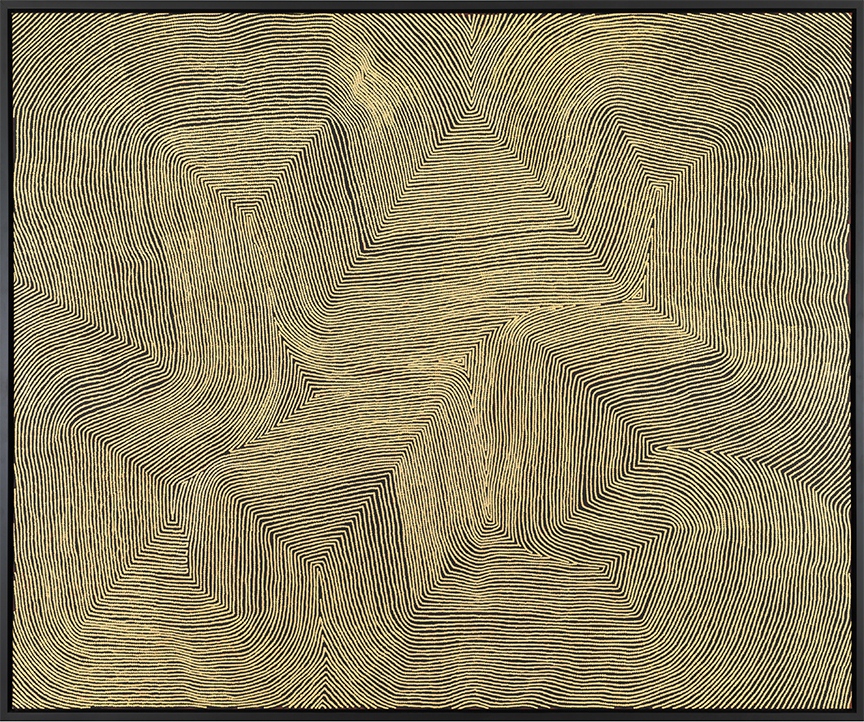
As younger painters began experimenting with forms and colors, their work became more abstract, but no less grounded in the Dreaming. The Op-Art effects used by Warlimpirrnga Tjapaltjarri depict Maruwa, a sacred site in the Western Desert.
“The younger artists are striving to convey the power of the ceremony more than the ritual objects,” Myers notes.
The newborn painting practice originated in Papunya, a settlement near Alice Springs established in 1959 as part of conservative Prime Minster Robert Menzies’s policy of centralizing and assimilating Aboriginals. By the early 1970s, when Myers arrived, the population of Papunya had swelled to over 1,400 people from several Indigenous communities displaced from their traditional homelands by Menzies’s Welfare Managers.
The Papunya painters were working in a large, galvanized steel shed that had once been the town hall, but no one is sure exactly how they got started. Some say the beginning was in 1971 with the arrival of Geoffrey Bardon, a teacher who championed the Aboriginal painters and provided them with acrylic paint, Masonite board, and canvas. But according to others, this artistic blossoming was underway by the time Bardon arrived. Trailblazing painters like Kaapa Tjampitjinpa and Clifford Possum were already selling artwork to tourists, and Kappa had consigned pieces to the District Welfare Officer Jack Cooke, who nominated one of them for an art award. Painted on a battered piece of wood, Men’s Ceremony for the Kangaroo was the unlikely winner, and Kappa’s reputation as a painter began to grow, along with sales of his work.
Inspired, the Papunya painters combined creative drive and entrepreneurial spirit into what Andy Warhol famously called “business art”; and, indeed, in 1972, the group founded a privately owned company the Papunya Tula Artists Pty. Ltd., in which they were the shareholders. Geoffrey Bardon was instrumental in organizing the artists. “He was worried that the government would take over the business and screw them,” Myers added.
The men worked quickly, executing intricate patterns freehand and taking only two or three days to complete each piece. Between 1973 and 1975, they finished upwards of 1,500 paintings.
Money but more
If they could make money by selling their work, they could feed their families and help the community. But Myers says there was also a fierce urgency to record, share and preserve important knowledge about who they were and where they came from. “For them, painting was a way of asserting that their culture was valuable.”
As Indigenous communities relocated outside of Papunya, the Papunya Tula Artists Pty. Ltd. supported painters in far flung outposts scattered across the Western Desert. And, although painting was originally the purview of men, in the 1990s, women artists—often the wives and daughters of the original founders of the group—were reluctantly accepted into the fold. “Those women took no shit,” Myers laughs. “When they weren’t immediately included in the company, they went to Alice Springs and sold their paintings. Eventually the men got the message.”
In 1988, a landmark exhibition at the Asia Society in New York City marked a watershed of global interest in the Papunya Tula painters. Early works were auctioned at Sotheby’s, major collections began acquiring the art, and in time, a multimillion-dollar enterprise would grow out of their efforts.
“The painters saw recognition and money as a revelation of the power of the Dreaming,” says Myers.
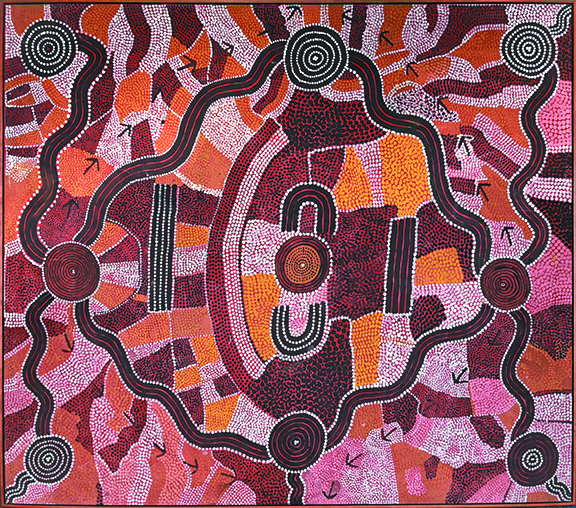
But the money has also provided desperately needed resources for the community. Faced with an epidemic of kidney disease from diabetes, alcoholism, and poor diet, sales from the paintings have raised money for Purple House, a dialysis center in Alice Springs, and the Purple Truck, a mobile unit adorned with the symbolic circles and waves seen in the paintings, that has enabled patients who live in the remote desert to receive care close to home and family.
In the last room of the exhibition, a wall of 50 small, 24 x 22-inch paintings called the Fiftieth Anniversary Suite documents the evolution of Aboriginal art from the 1970s to the present day, a practice spanning generations of artists. Myers knows them all. He’s made the arduous journey back twice in recent years at the invitation of the Papunya Tula Artists, who see him as a trusted elder who knew their grandfathers and fathers and recorded how they performed the ancient ceremonies.
Scanning the wall of paintings by artists living and dead, it’s painfully clear that, even with success and recognition, the lineage represented by these vibrant artworks continues to be plagued by poverty and disease. Many of the artists have died young. And yet, despite the dire outward circumstances, the message of these paintings has touched the entire world, and perhaps more importantly helped preserve a way of life.
Says Myers: “Outsiders love the paintings because they’re beautiful, and because they come from an authentic, profound connection to land and place, which people respect and feel they’ve lost. But for the Aboriginal artists, themselves, painting is a way to sustain their relationships to the land and places they revere and to help perpetuate the stories of the Dreaming.”