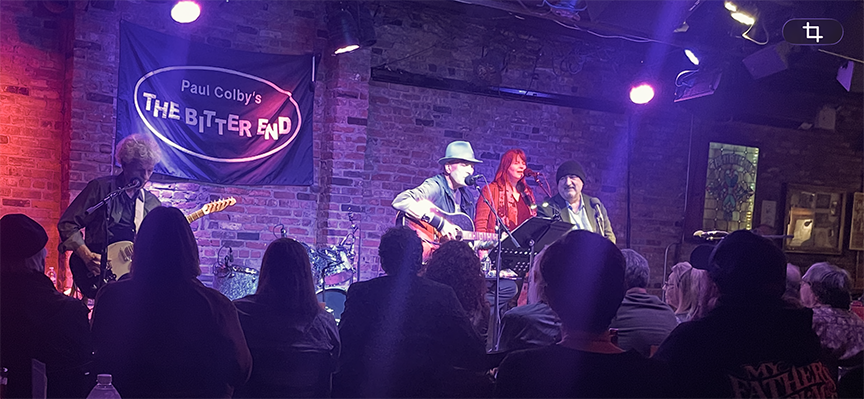
“I was walking down the street with Phil Ochs as we often did,” said singer-songwriter Eric Andersen at The Bitter End recently. “I sang him the chorus, just walking down Bleecker Street. He said the chorus is great. … With his encouragement, I finished the song.” That song was “Thirsty Boots,” probably Andersen’s best-known one, addressed to a civil rights Freedom Rider and released in 1966.
On April 26, Andersen performed that song and others. He also spoke about his life in Greenwich Village in the 1960s. The event was the second installment of Village Nights, hosted by singer-songwriter, producer, professor, and author Richard Barone, formerly the front man of the Bongos. The concert and conversation focused on the Village in the 1960s.
Music journalist and scholar Anthony DeCurtis interviewed Andersen about his life and friendships in the Village during that decade, and he performed several songs with guitarist Steve Addabbo and his wife Inge.
Andersen said he moved to the Village, where Tom Paxton lent him an apartment, in 1964. He soon got to know Phil Ochs, Dylan, and other folk singers. Barone observed, “He was part of a scene that created a whole movement of the singer-songwriter—not just a movement, a genre. It was a very important period for music when the writer took over, became the writer and performer of their music.”
DeCurtis, who grew up here, said he heard Andersen’s songs on the radio on one of the new FM stations, and “was just completely enraptured.”
Andersen said that life in the Village wasn’t easy at first: “It goes up and down. You’re on the street one day, you’re in a nice apartment the next day.” He said he got a record deal through Robert Shelton of the New York Times, who heard him perform at Gerdes’ Folk City. Shelton helped Andersen get a deal with Vanguard Records, and he recorded an album, but it took over a year for it to come out. “So I’m scuffling around, picking dimes off the street. It was a hard time,” Andersen said. During that period, he noted, the clubs in the Village were mainly for comedians and jazz musicians. Now, most of the clubs that featured folk music, including Folk City, are gone. Barone noted that the Gaslight has been gone for many years, as has the Village Gate . But the Village Vanguard is still going strong, as well as The Bitter End, which is celebrating its 65th anniversary this year.
Andersen said that Ochs “was like my big brother.” But as much as he could be supportive, he could also be very direct when assessing other people’s music, Andersen said. “It was great or it sucked.” Dylan, he said, “was always talking about songs and work … mainly it was shop talk. The work, the writing, the lyrical, some stuff he came up with, the free verse thing he was doing.” He added that it was “just beautiful incandescent writing. I mean there was a lot of throwaway stuff too. If he couldn’t think of anything, he’d just think of anything.”
Barone noted, “It says a lot that Dylan covered one of your songs.” Andersen responded, “He did ‘Thirsty Boots,’ and I think he did the best version because he didn’t try to change anything or mess with it. He kept it pure and simple.”
Andersen also spoke about the rivalry between Ochs and Dylan and how Dylan called Ochs “a journalist” as a put-down for writing topical songs, which made Ochs angry. Andersen stuck up for Ochs, saying that he wrote some great songs, including “’When I’m Gone.’”
DeCurtis praised the literary quality of Andersen’s own songs and mentioned that a recent documentary about Eric is titled The Song Poet. Barone said that his cover of Andersen’s “Close the Door Lightly” was one of his most streamed songs on Spotify. Andersen noted that he studied James Joyce before he dropped out of Hobart, and was also influenced by the Beat poets. The college honored him years later; Andersen said, “I think I was given an honorary doctorate for the most accomplished dropout.”
“It seems like we’re still fighting the battles of the ’60s; it never ended,” DeCurtis said. “I don’t think anyone who had any kind of hope in those days thought we’d be where we are now. On the other hand, there are elements of resistance. I try to remain optimistic. I don’t think there’s any point to despair. You take the collective actions you can take, and you hope for the best.”
To Andersen, he said, “You’ve written a new song that seems to draw on the spirit that some of us felt. Andersen played that song, “Stand Up and Resist,” about the need to defy the recent rise of authoritarianism.
Andersen performed his own songs and others from the ’60s. DeCurtis concluded the evening speaking of Andersen, “I am always stunned by the quality of the work he continues to do. It’s such a pleasure to listen to his new material.”
The next events in the series will be on Sept. 27, focusing on the 1970s and featuring Terre Roche, and on Dec. 6, focusing on the 1980s and
featuring Suzanne Vega.