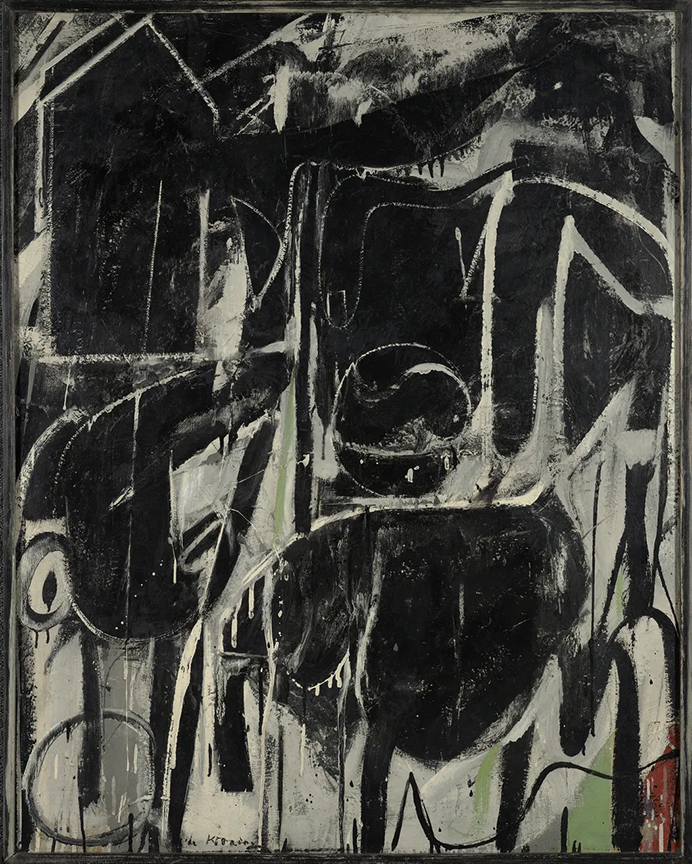
One of the current exhibitions at the newly reopened Princeton University Art Museum, is “Willem de Kooning: The Breakthrough Years. 1945–50.” This compact survey offers a needed reifying of the late longtime downtown artist’s pivotal early abstractions and semi-figurative works including such noted pieces as “Secretary” (1948) and “Black Friday” (1948), the latter work culled from the museum’s own collection.
Conceived and executed by MoMA Chief Curator Emeritus and Princeton Professor John ElderfIeld, it is centered on the period leading up to, during, and immediately following de Kooning’s landmark first solo exhibition at the Charles Egan Gallery in New York (April 12-May 12, 1948), this show presents approximately eighteen paintings that illuminate the artist’s heated journey between the Scylla and Charybdis of figuration and abstraction.
De Kooning, a Dutch-born painter who arrived in the United States in 1926 as a stowaway aboard the British freighter Shelley, disembarking at Newport News, Virginia, embodies a profound transatlantic traffic accident of styles, aesthetics, and ideas. De Kooning makes perfect sense at Princeton precisely because of this Dutch heritage mirroring that of the regal town whose main street is named Nassau.
What thought lays the cement in the cement sidewalk of this viewer's art observing mind is Clement Greenberg, in his review of the Egan show, offered a barbed assessment that has since become canonical. He remarked that “de Kooning, like Gorky, lacks a final incisiveness of composition,” a. Yet this perceived lack of finality may instead reflect de Kooning’s.
A foreshadowing work in the exhibition is Noon (c. 1947), in which strong hints of the later Woman series surface. The canvas features what read like surgical incisions and monstrous truncations and/or contortions of suggested body parts. Rambunctious scraws, including the word “ART” curling in the lower corner, dissolve into layered blacks, whites, and wisps of underlying color, conveying an emergent surge which seemingly presages the painter’s more famous figurative explosions of the early 1950s.
De Kooning’s development during these years can be understood as a collision at the crossroads of influences: standing metaphorically at a corner marked by Edward Hopper’s stark realism and a stop sign, he was “run over” by the automatic gestures and biomorphic abstractions of André Masson and the necessitated Surrealist migration from Europe during the reign of terror against what the Third Reich labeled “Degenerate Art.” The result was quicksilver mercury brush strokes, automatic writing-like marks, and hybrid forms that fused European automatic stream of consciousness with an emerging American muscularity predicted by none less than Thoreau and Emerson.
Critics and historians have long debated whether de Kooning was at his strongest in these breakthrough years or, paradoxically, during the time he rose to international fame or finally in his later, more senile phase—when he painted with a liberated focus on pure shape and color, evoking fruit inlaid like a river into a terrain of vanilla ice cream.
The exhibition also invites reflection on how de Kooning’s reputation and style was shaped. His early status as an illegal alien, his navigation of commercial art and manual labor, and his marriage to Elaine Fried all form part of a complex personal history that predates the clam-digging marsh scenes or Rubenesque figures and the Vagina Dentata of his more grotesque Woman canvases.
Ultimately, “The Breakthrough Years” underscores that de Kooning’s art was and never will be easy to grasp; Whether viewed as historically overrated or genuinely revolutionary, these works remain essential to understanding the radical shifts in modern painting. The Princeton installation, by focusing on process rather than myth, allows contemporary scholars to revisit de Kooning not as a fixed icon of American Abstract Expressionism, but as a continuously revising artist whose “quicksilver” gestures continue to resist final incisiveness.
March 15 to July 26, 2026
The Princeton University Art Museum