
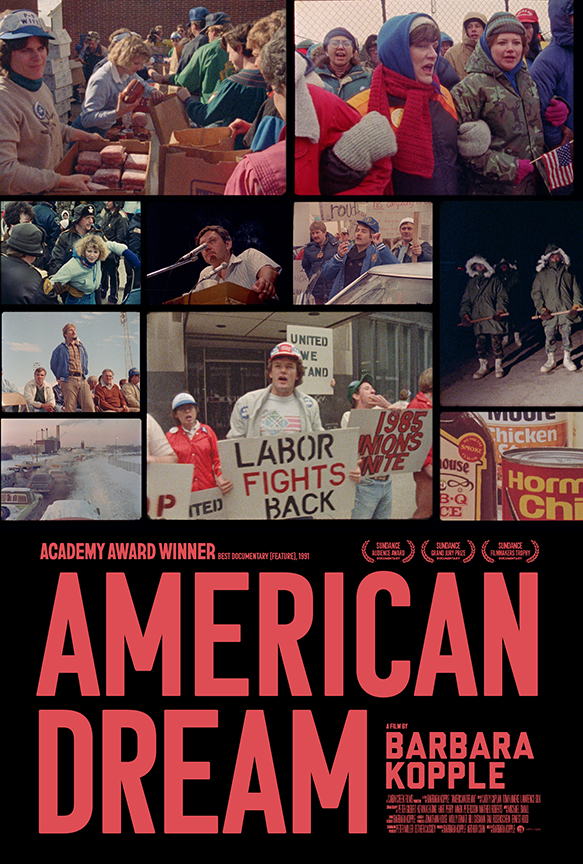
Barbara Kopple’s 1976 film Harlan County, USA, chronicling the literal life-or-death effort to establish a coal miners’ union in rural Kentucky, is a masterpiece of documentary cinema. It’s human and humane and, despite its age, crackles with the urgency of collectivism and class consciousness.
So monumental is the film that her follow-up feature—American Dream from 1990, which also takes unions as its subject, this time the acrimony and rot that take hold after a couple generations—gets overshadowed and crowded out, despite winning the 1991 Oscar for Best Documentary. A long overdue restoration and rerelease, though, helps it shake off its predecessor to be seen as the more important of the two works: a dispatch from the frontlines of Ronald Reagan’s class war; a warning of the bitter exhaustion of Donald Trump’s America, the terminus of Reaganomics; and a bracing chronicle of the degradation, and murder, of the blue-collar, working class experience.
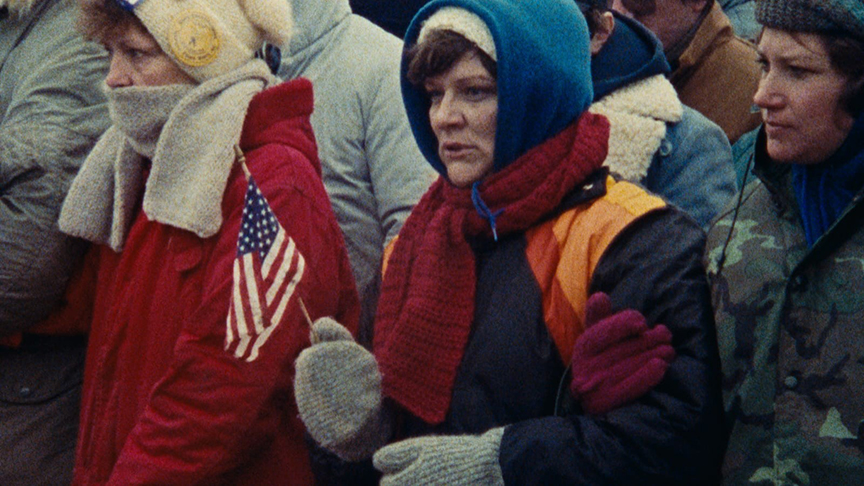
The film chronicles the rancorous 1985-86 Hormel strike in Austin, Minnesota. Four years after Reagan broke the air traffic controllers’ union and comfortably ensconced in the supply-side trickle-down fantasy, corporations like Hormel enthusiastically embraced chasing profits at all costs. In Austin, a company town of 20,000 that lives and dies based on Hormel’s fortunes, that meant cutting wages from $10.69 to $8.25 an hour. (At the start of the film, the company boasts more than $200 million in profits.) In the meatpacking plant, members of the local P-9, fed up with further erosion of their paycheck and benefits, reach their limit. Led by president Jim Guyette and outside consultant Ray Rogers, P-9 walks out.
Says one union member in the film: “We can’t afford to go backwards anymore. We went back far enough. We worked too goddamn hard down there to have to go backwards anymore.” Another adds later: “I don’t begrudge anybody that’s making 30, 40, 50,000 dollars, but let us live in our home.”
Those are the stakes: profit maximization vs. basic human needs.
Of course we know where Hormel stands, but Kopple complicates this narrative. She doesn’t flood the screen with mush-mouthed elected officials — Reagan appears once, at the start, but otherwise is left to haunt the film like a poltergeist. Rather, we see the local and their strike met by national union officials (and some P-9 members) who don’t see the situation in such black and white terms. P-9’s strike was launched against the advice of the parent United Food and Commercial Workers International Union, and there’s vicious tension between Rogers, who runs the Corporate Campaign Project, a kind of professional labor agitation outfit, and UFCW vice president Lewie Anderson. Guyette and Rogers’ only concern is the Austin plant. Anderson’s aperture is much wider: 25 other plants where workers are making $6.50–$7.50 an hour, and just barely holding on to that. P-9 wants to maintain what they have; the UFCW wants to raise the other plants up, even if that means P-9 takes a cut.
Rogers, in his tight polo shirts and obsession with optics, at one point says, “I want to be a union of the 80s.” Anderson, frumpy and bedraggled, seemingly coated in a layer of cigarette ash, embodies a more pragmatic, New Deal unionism. “You don’t throw your whole contract up for grabs,” he says. “You don’t give the company the opportunity to dismantle your contract because you rewrote it. But that’s just exactly what the local P-9 leadership did. They rewrote a whole contract, language that has taken 40 years to negotiate.”
Kopple is not an objective observer. Her sympathies and allegiance clearly lie with the union. But American Dream isn’t as black and white as Harlan County, USA, and she knows it. She did the groundwork. She moved to Austin. She went to the meetings. She lived with the community. She gained everyone’s trust, and then puts us in as many rooms with as many people as possible. We get direct access to the arguments and debates and rationalizations. We also get uncomfortably close to the raw emotions of these workers and this town.
Anyone raised in a union household knows scabs are lower forms of life. Kopple has said, prior to making this film, she would never have shown their faces. Here, we’re at the kitchen table with a group of men struggling with the decision to cross the picket line—not because they’re anti-union, but because they see their lives slipping away as Hormel continues to refuse to negotiate with the P-9. They want to work, yes, but, more, they want to provide for their families. They want to look their children and wives in the eye and know they are doing their part. More than one of them breaks down in tears. These aren’t monsters, but humans trying to do their best, even when that means sacrificing everything they thought they believed. Kopple puts them front and center, without judgment, as they drive across the line. If you think you know how you’ll react to those men and their decision, don’t be so sure.
What unions stand for
This is a hard film, with emotional violence equal to the blood and guts of a Rambo movie. It pits union loyalists against scabs, members against members, locals against the international, workers against the National Guard, brother against brother (symbolically and literally), people against themselves. If Harlan County, USA is about the fight for the right to form a union, American Dream is a fight over what unions stand for. In that way, you can see this film reflected in something like Union, from 2024, which tracked the battle to form a union at Amazon’s Staten Island warehouse. In that case, a grassroots effort was actively discouraged by entrenched national unions; workers persevered; and when they won the battle, the bigger fight over what a union is in the 21st century began.
That’s all present in Kopple’s film, too—surprisingly, because these kinds of internecine conflicts tend to get left out of the larger heroic narrative about labor and collectivism. But there’s more at stake here than backroom politics. Kopple captures America, not just labor, at a moment of transition. Reagan and his University of Chicago economic advisors—mirror universe socialists—redistributed the country’s wealth from the middle and working class up to the wealthiest. They did this through the tax code, but also by breaking the backs of unions, dismantling the nation’s manufacturing infrastructure, and eviscerating blue-collar jobs. The fear, anxiety, and dislocation this inspired in millions of workers and their families are on full display.
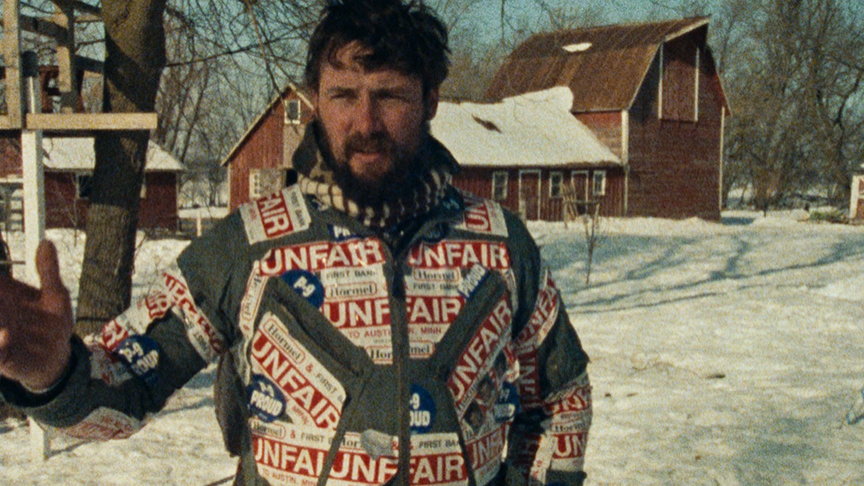
“People in this town believed in the American dream,” Kopple told Studs Terkel in 1992. “They believed in the work ethic. They believed that if you work hard, you can send your kids to college, that you can have a house, and this was making all of their values and everything that they believe in start to become unraveled. So what you’re really seeing here is, in a sense, a microcosm for something that’s so much larger that’s happening in America that makes us stop and think for a moment, are we a humane society? If this continues, what is America becoming?”
More than 30 years later, the question has been answered. The worst of Reaganomics is the backbone of fiscal and social policy. The deprivation it delivers is accepted as the cost of doing business. Fear, anxiety, bigotry, sexism, classism, narcissism, and selfishness are our national values. The social contract is in tatters. The American Dream exists, but only if you can afford it. Everyone else should pay homage, or self-deport. “The compass is broken,” Studs Terkel wrote in his 1988 book The Great Divide: Second Thoughts on the American Dream. It’s still broken. And we see it crack apart in Kopple’s film. She’s bearing witness, and demands we do, too.
In an era where documentaries flood streaming services—typically as what filmmaker Gianfranco Rosi calls “visual Wikipedia”—it’s a bracing experience encountering American Dream. It’s depressingly relevant, as we navigate the sharpening edges of those social fissures and grope our way through the exhaust fumes of a stalled culture. But even if the reality has worsened, what has led us from 1984 to 2026 remains constant. In that way, the documentary is vibrant and alive with the questions and debates and humanity that should have led to change then but still can today. Unions aren’t dead. People are rediscovering the necessity of community. Billionaires have fed too long at the trough of our misery for their own good. What we do from here is up to us, not the oligarchs.
As American Dream so honestly shows, we can’t meet greed with greed, grievance with grievance. Change and solidarity result from sacrifice, dialogue, compromise, and a recognition of our common humanity—and our shared aspirations.
American Dream just finished a run at IFC, but it is available for streaming:
- Rent ($3.99) or Buy ($4.99): Amazon Prime Video or Apple TV
- Rent ($2.99 or $3.99) or Buy ($9.99): Fandango at Home (Note: specific pricing varies by digital storefront)
- Rent ($3.99): Google Play