In 1948 Allen Ginsberg wrote Jack Kerouac “Don’t you see we both suffer. That’s really the basis of our friendship.” The Beats brought suffering to the surface. In the 1970s we were a people defined and united by our pain.
The more you suffered the cooler you were, like those kids in high school who were always going to commit suicide. Having a mental hospital history put you at the top of the class. Pain was our watchword. The pain of the Vietnam war had sunk deep in us. The knowledge of the pain from World War 11 stretched through our lives and infected our childhoods.
We grew up in a time drenched in fear, fear of communists; fear of threatening poverty; fear of the bomb; fear of hell; fear of everything. After WW11 you’d think the government would give its people a ten year break, but no, The Cold War came barreling down the pages of the press and exploded off the TV screen like radiation: The Russians are coming the commies are gonna nuke us! Nuke them!
A military industrial farce
It’s obvious today that there was no cold war, the whole thing was a charade constructed to keep people fixed in fear and warlike. In the long run it ruined everything. It was the beginning of the United States’ brutal endless war economy.
As children of this madness we grew up infected by worry and tension all the time. In our teens, the Beats showed us a counter way of life. The Beatles, Dylan, and Stones took that style and language into the high schools and colleges, multiplying its affect a million times.
Together with Warhol they formed the dramatic cultural–sexual revolution of the sixties, which would really come to fruition in the seventies. We were delighted to follow the bold precepts of punk: raw realism and passion, no fear, determination and clarity to do your best to do what you want, to follow your intuition and make it work.
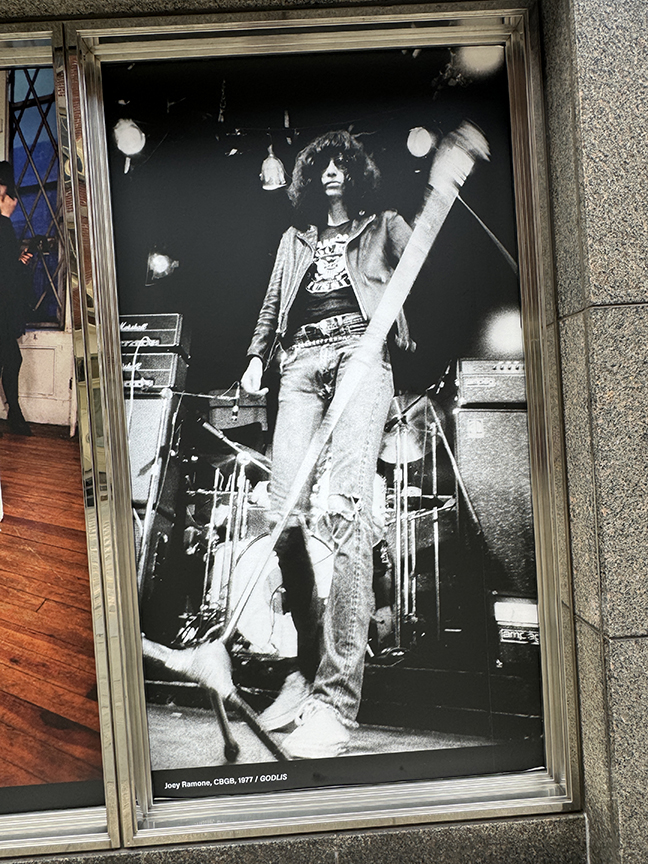
Norman Mailer stood on a tiny cocktail table at CBGB just in front of and to my right. Joey Ramone leaned into the audience on half bended knee in ripped jeans with the microphone cord wrapped around the arm of his black leather jacket making love to the microphone: “Oh oh oh oh oh oh and I luv her” – injecting passion and myth with the thick beauty of his keening voice – “And it’z trew, izz treww.. Ah, Oh oh oh…” Norman stuck his mouth in my ear and yelled, “Heroic!”
Many of us are surprised to find ourselves living alone. At first I embraced the solitude and was rewarded by great joy in the discovery of another universe. My apartment sang to me. I loved its furniture and its utensils.
Then slowly I discovered myself feeling such empathy for the garbage. It became harder and harder to throw anything out.
“No no don’t.”
“You did a good job, you were great, look here are all your buddies.”
I never liked the eggs! (muffled screams). It goes on every day.
We spend our lives watching the same movies over and over again in our minds. The truth is we enjoy doing that more than spending time with the others. We had great lives but lost them and cannot get back in to them, so we invest everything we have in maintaining the past and rejecting the present. Can you catch the humor in that?
THE CRYING EGG
These three peaches had copped a cool pad 2A front left on the second shelf of my refrigerator. They had even been able to retain the bag they were evacuated in which gave them more privacy than the tomatoes who lived across the hall in 2B. Apparently they were grooving with most of the other items. One of the peaches was an exotic dancer who was particularly popular on the bottom shelf in the meat apartment.
Then one day with no forewarning a hairy hand rudely rushed in and grabbed Rita, the tall delicate dancing peach, the baby of the family really, and took her away. At first, big Ralph and his wife Daisy were silent and fearful, but they knew they could not let themselves go that way. By the time the hand returned with half of Rita, all stripped and bleeding, they are bopping and they tried to keep the atmosphere light. “Hey sugar you is all messed up baby,” Ralph chuckled. “What happened to you?”
“Don’t look at me,” she pleaded, “don’t look at me!” But they told her, “No no no, we love you just the same everything be cool.” Soon, however, a quiet desperation invaded the fridge. Soon Ralph started using heroin through his connection with the Haagen Dazs vanilla ice cream in the freezer. I never told this before.
Meanwhile, down in meats, another dispute was arising between the steak and the chicken.
In the bathroom the little toothbrush was making out with the razor. The other brushes did not like it. They laid a trap for the razor.
Abuse
Everybody in America is so frightened and angry and it’s no surprise. The only real solution is in not being badly abused in your first hate years of imprinting. It seems that 95% of people are brutally abused. They cost the world everything. the solution to all hate is to stop injecting your hate into your children during these formative years. Consequently we don’t stand a chance. Back then we thought we did. We had not yet reached this embarrassing level of transparency in the political system. It appears to have completely destroyed the Republican party. After wasting billions of dollars of taxpayers money, money which could have afforded the American people great relief, voting uselessly against the Health Care Act, they became terrified of what would happen if their very damaging waste of money and times succeeded. They told the supreme court to pass it.
What more do you need to know about a party that is equivalent to the Catholic church in its constant and endless abuse of its clientele? I would take the position that there is no Republican party. Yet beware of the Republican party. Its more like a cartel than a business.
I just spent two hours singing that Beatles song John Lennon sings lead on, “I Want You Back Again”, which goes:
“I’m the one who wants you, Yes I’m the one that wants you, ooohooh oohooh, if you could find better things to do than to want me back again.”
And, as I repeated it over and over with tears welling from the burn in Lennon’s voice, I suddenly realized that kids like me, who originally sang this song in 1964, had never had those kinds of feelings towards girls. We were too young to know that kind of pain. We were really singing to our mothers. And I wonder if John Lennon, whose greatest song is “Mother,” was too?
So—Lo & Behold—I see and feel deeply a different side of the celebration of the counterculture’s songs of emotion, and therefore a new way to embrace them, and the culture the songs spawned.
Because when you look back at The Beatles there is a tendency now-a-days to say, well they just wrote love songs. But if you think that, you don’t realize just how much my generation needed love after World War 11, and how little we got from our terrified parents.
Part 2 next month