
Walt Disney’s 1952 film “Fantasia,” a 125-minute abstract interplay between classical music and modern animation, opens with musicians tuning up, silhouetted against a regal blue background. The owlish critic and composer Deems Taylor, in a white-tie tux, introduces us to the proceedings with a mix of cheer and gravitas, before giving way to conductor Leopold Stokowski and the Philadelphia Orchestra, scoring visions of dancing tutued hippos, prehistoric Earth, and Mickey Mouse in a starry sorcerer’s hat.
Nearly 25 years later, Everything “Fantasia”—and, indeed, everything Disney stands for—is summarily mocked by Italian animator and filmmaker Bruno Bozzetto in his 1976 parody, “Allegro Non Troppo.”
Currently screening in a new 2K restoration at Metrograph, the film begins in high-contrast black and white, a waifish, pre-transformation Cinderella (Marialuisa Giovannini) on her hands and knees dragging a metallic bucket across a theater floor as she scrubs it clean. The emcee (Maurizio Micheli) is a young man, installed in a crumbling theater’s loge, wearing a white polka dotted tie and a garish paisley-print sportscoat that clashes with yet becomes one with the ostentatious wallpaper of the box. The conductor (Néstor Garay) is a corpulent, sadistic slob who keeps the orchestra—a gaggle of clucking nonnas—enslaved in some kind of industrial warehouse; he’s had the animator (Maurizio Nichetti) chained up in a medieval dungeon for years. Technicolor visions of a horny, elderly satyr; a march of creatures evolving from leftover Coca-Cola; and the snake from the Book of Genesis, transmuted into a modern creature of consumption and conformity, follow apace.
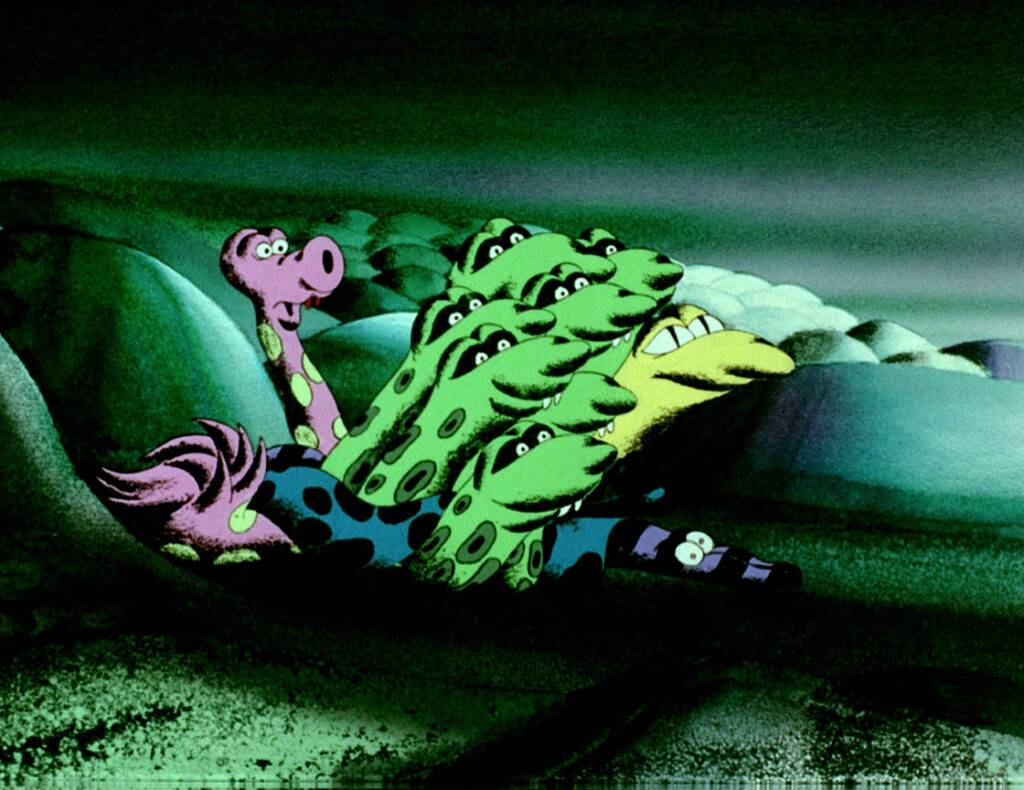
In 75 savagely entertaining minutes, Bozzetto alchemizes the best of underground comix, surrealism, fantasy, and MAD Magazine into a mockery of not only the white elephant quality of “Fantasia” but also the Disney studio itself. In contrast to Disney’s shallow, crowd-pleasing numbers, “Allegro Non Troppo” presents a more emotionally challenging program of animations—by turns ironic and elegiac; mature and puerile—set to and inspired by staples of the classical repertoire. Among the six segments: that elderly satyr looking for action (Debussy’s “Prélude à l’après-midi d’un faune”); a cat scouring the ruins of a bombed-out apartment building for food and reminiscing about all the life that was once there (Sibelius’ “Valse triste”); the biblical reptilian tempter, eating the apple after it’s rejected by Adam and Eve, only to be transported through thousands of years of degradation and rampant consumption by blobby demons (Stravinsky’s “Firebird”).
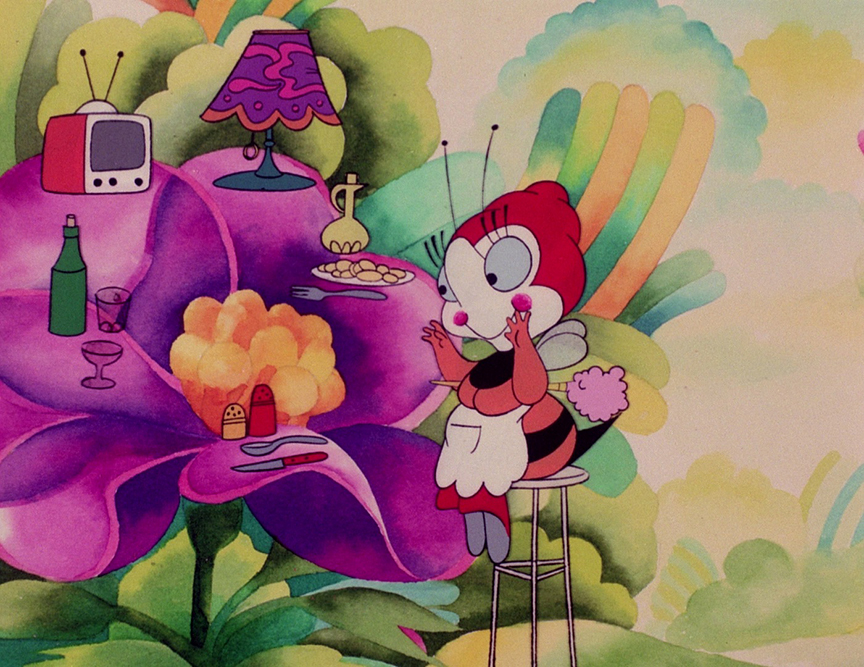
In these segments, Bozzetto brings his style—a kind of handcrafted, less mechanical midcentury cartooning that would be equally at home on Madison Avenue and in Playboy—into conversation with the likes of R. Crumb, Ralph Baksi, and Terry Gilliam, with dashes of Peter Max. Bozzetto deploys those homages sparingly, for the most part, complicating any desire to play Spot the Reference, and they’re always subservient to his own voice. Occasionally, things go out of balance, like in the case of the segment set to Dvorák’s “Slavonic Dance No. 7.” A figure emerges from the cave, is followed by others, and unwittingly creates modern civilization. It ends with everyone mooning the main figure, and it feels too close to Monty Python.
But that segment, arguably the weakest of the film, sets up its masterpiece, a 13-minute showstopping feast of creativity set to Ravel’s “Bolero.”
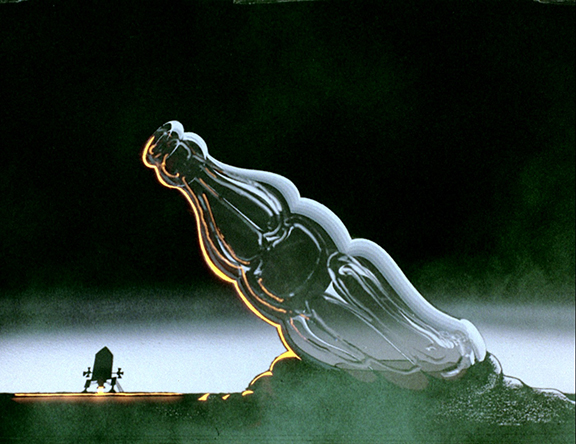
A Coke bottle is tossed from an Apollo 11-like lander as it takes off from an alien surface. The bottle comes to rest in the soil, the remaining liquid begins to slosh around, become sentient, and emerge from its glass prison—a primordial ooze for the American century. The dark-brown glob slithers through the landscape, becoming increasingly more complex forms of life until, suddenly, the world is populated by all manner of creatures: aquatic life, winged beasts, dinosaur-like monsters, aggressive primates. They march endlessly through jungles and deserts to no defined destination before reaching the great pyramids, wrecked highways, and endless cities. Is this Earth in some far-off future, a la Planet of the Apes? Some other distant planet that evolved in a similar way thanks to the human detritus left behind by explorers? Yes. 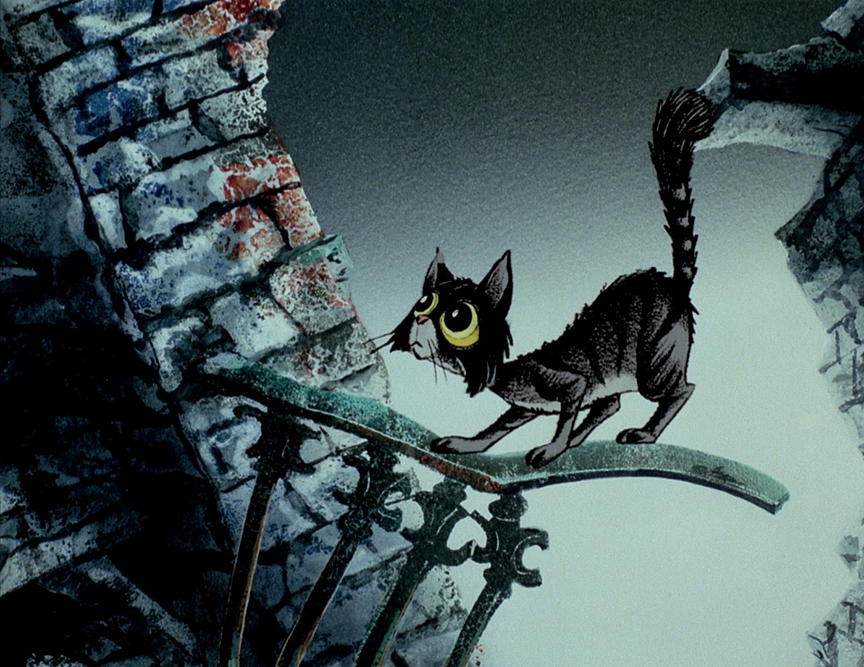
Some have compared this piece of “Allegro Non Troppo” to the one in Fantasia that dramatizes the evolution of life on Earth. That’s woefully inadequate. This 50-year-old piece of film vibrates with possibility, more than anything presented by Disney. Here, Salvador Dalí and Walt Disney and Dr. Seuss collide and Bozzetto emerges, pointing toward a future unconstrained by the limitations of corporate edict and synergy. And, in a similar way, when “Bolero” ends we find ourselves transformed, alive to the boundless possibilities of animation and imagination. In a just culture, it would be as archetypal as “The Sorcerer’s Apprentice.” But, today, even more than five decades ago, we live in Disney’s world, and alternatives and dissent are not tolerated.
Not that Bozzetto cares. His fusillade against the studio includes its ethos as much as its output. Like “Fantasia,” “Allegro Non Troppo” includes live-action segments that serve as interstitials to introduce the cartoons, in a fashion. Really, though, these black-and-white pieces are opportunities for broad slapstick and incisive critiques of Disney and the American system of moviemaking.
 Here’s how our sartorially-challenged presenter opens the film:
“Ladies and gentlemen, you are about to see an unforgettable show: a film destined to become immortal, as immortal as the music that will follow, and which will be interpreted through animation. … With this film we have finally succeeded in achieving this union of animation and classical music, a union we are sure is destined to live on throughout the history of film. A new and original film that has even astonished us, the men responsible, the men who, quite modestly speaking, can be called its creators. A film in which you will “see” the music and “listen” to the drawings. You might call it a film of magic, a fantasia.”
The phone immediately rings. It’s a Hollywood lawyer threatening a lawsuit because, as the presenter tells us, the lawyer claims someone has already made this film, someone named “Pisney or Grisney.” It’s a big windup for an easy gag, but buried in there is a poke at the American industry’s love of remakes—and of appropriation. To paraphrase Trenton, New Jersey, the world makes and America takes. Forever and ever, amen. God help anyone who tries flipping that script.
Sure, the enslaved old ladies serving as the orchestra and the chained-up animator are achingly on the nose. But through word and action, Bozzetto actualizes the darkness and exploitation kept to the fringes of official studio product. Typically, this manifests as the conductor physically assaulting the animator in big, silent movie gestures. Some moments feel like direct descendants of Chaplin’s Keystone shorts, and Bozzetto handles these with grace and an expert sense of timing.

It’s obligatory to spend more time engaging with the cartoons of “Allegro Non Troppo”—at its core it’s an animated film. But shunting a discussion of the live-action segments to the end of the conversation is to give them, and Bozzetto, short shrift. These moments reveal a filmmaker with a command of cinema in all its facets. The black-and-white cinematography of the humans’ bleak, industrial conditions intelligently juxtaposes the vibrantly colorful otherworldly animations, a modernist riff on both The Wizard of Oz and Italian film heritage. He holds the tone in a delicate balance between absurd and menacing: Do we laugh or wince at the conductor’s cruelty? Are we a passive audience to be entertained or actively complicit in these acts of intellectual and human depravity? And he maneuvers between the “real world” of the theater and fantasy of the cartoons with a kind of effortless grace.
“Bolero,” again, captures it all. After the conductor catches the animator with a Coke, he rips it away and begins conducting using the bottle as a baton. He holds it aloft, the soda pours out and down his sleeve, and he turns and chucks it into the theater’s empty audience. Cut to the animator, who sees this and scribbles furiously. Cut to the animated bottle, in midair, ultimately landing in the foreground. The efficient sequence is simple, yet elegant and confident — much like the rest of this monumental fantasia of a film.
“Allegro Non Troppo” is screening at Metrograph, 7 Ludlow Street, in April. Visit metrograph.com for showtimes.