How much should landlords get to profit off rent regulated tenants? And do long-suffering tenants get any say about it?
These are the questions underlying the plight of hundreds of East Villagers, whose current landlord—the $23 billion private equity firm Madison Realty Capital (MRC)—faces foreclosure on its East Village portfolio of fifteen rent-regulated buildings. According to court papers filed by the Community Preservation Corporation (CPC), which manages MRC’s mortgage, MRC has not made payments for over a year. As of March, MRC was said to owe CPC about $76 million including interest and penalties, with $40,000 in interest accumulating each day.
The real estate press has cast this potential foreclosure as an ominous portent, raising “concerns about the future of rent-stabilized housing,” as the publication CRE Daily put it.
By contrast, tenants expressed hope foreclosure presents an opportunity to have their buildings purchased by a nonprofit preservation organization. Their efforts to meet with CPC were rebuffed in May, and in June multiple tenants filed court papers to press for a nonprofit buyer.
Tenants in limbo
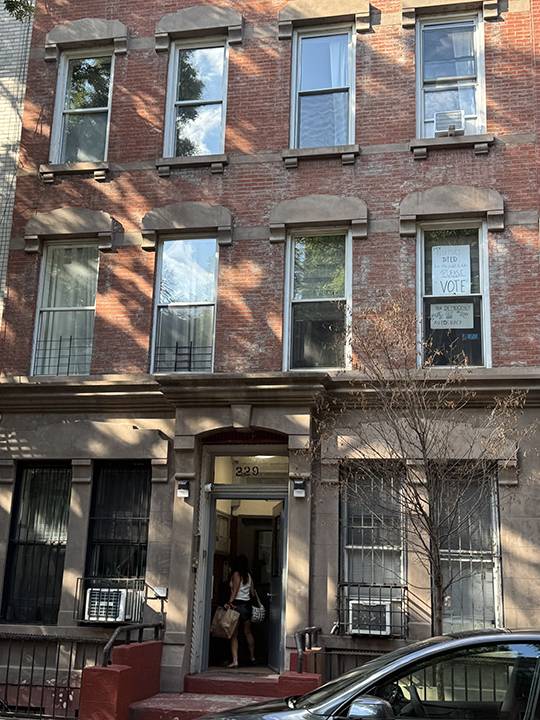
“They don’t want to talk to us,” Holly Slayton, who lives at 229 East 5th Street, complained of CPC. “We just want to make sure we’re protected.”
Tom Corsillo, a spokesperson for CPC, told the Village Star-Revue, it’s “not appropriate for [CPC] to engage directly in conversations with tenants about the foreclosure or about the future of the buildings as it does not own, operate, or maintain the properties.” Yet CPC and its partners can “arrange for a meeting with a third-party facilitator to receive information from tenants,” he added.
The day after the Star-Revue sought comment from CPC, its partner organization, Neighborhood Restore, responded to a weeks-old request from tenants for a meeting.
Corsillo characterized foreclosure as a “preservation tool” that “allows us to eventually transition properties into responsible ownership.”
Tenants fear that MRC’s brinkmanship could instead result in the firm being rewarded with more favorable loan terms. “The turmoil MRC continues to create in the lives of our tenants has been going on for ten years,” tenant leader Georgina Christ said. A resident of 327 East 12th Street for 52 years, she asserted, “We have been through enough!”
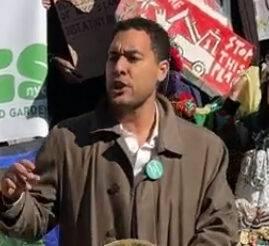
Cate McNider, a tenant leader who has lived in her apartment for 35 years, noted that tenants banded together against harassment to form the Tenants Taking Control Coalition. “We’re defending our homes!” she declared.
A history of harassment and hazards
The MRC East Village portfolio was previously owned by the notorious landlord Rafi Toledano, who purchased the buildings in 2015. Toledano’s campaign of tenant harassment was so egregious, he was prosecuted by New York State Attorney General Letitia James, and banned from the New York real estate industry.
With a securitized loan from Signature Bank, MRC had funded Toledano. Although the AG contended MRC had “aided and abetted tenant harassment,” MRC took ownership in 2021 after Toledano went bankrupt.
Tenants have endured clouds of construction dust—tested and found to contain high levels of lead—as MRC embarked on construction, combining—or “Frankensteining”—multiple rent stabilized apartments, many now renting for $9,000 a month or more. MRC has Frankensteined apartments in all but one of its East Village buildings.
This June, tenants at 325 East 12th Street came home to a notice from Con Ed that the utility is going to cut off gas, plus electricity to common areas, because MRC is $39,000 in arrears. Tenant leader Liz Haak, a 52-year resident, said “We sent it to the management company and we haven’t heard anything back from them. We don’t know who’s going to keep the lights on….What are we going to do when fall comes…and we’re trying to find our way around in the dark, getting up and down a walk-up building?”
“They’re not landlords and anybody they have as a management company is not maintaining the building. I don’t know where the money is going, but it’s not going to maintain this portfolio,” tenant Slayton remarked of MRC.
Madison Realty Capital’s heavy footprint in the Village includes the development of two luxury real estate projects that have destabilized nearby buildings, making rent-stabilized tenants homeless. In 2023, MRC’s construction of luxury condominiums at 14-16 Fifth Avenue led to a vacate order at landmarked 10 Fifth Avenue; the company’s construction of a 24-story residential tower at 14th Street and Avenue C triggered cracks in the walls and an ongoing vacate order at the adjacent building at 642 East 14th Street.
30,000 New York City tenants at risk?
The big picture is that MRC is only one of the landlords in a huge joint venture set up by the Federal Deposit Insurance Corporation (FDIC) when Signature Bank collapsed in 2023, after its cryptocurrency investments went kaput.
The FDIC had been appointed receiver of Signature’s portfolio of real estate loans, which included a substantial concentration of rent-stabilized housing in New York City. In December 2023, the FDIC established Community Stabilization Partners, a joint venture to oversee Signature Bank’s rent-stabilized loan portfolio. Managed by CPC, the portfolio represents about 3 percent of New York City’s rent-regulated housing stock–about 1,140 buildings housing 35,000 tenants, over 80 percent of which are rent-regulated.
The real estate press and others have portrayed MRC as the proverbial canary in a coal mine, the first of what they say is a forthcoming wave of foreclosures on rent-stabilized buildings. The New York Post warned of a soon-to-come “bloodbath.”
They’ve blamed the 2019 Housing Stability and Tenant Protection Act (HSTPA), which restricted rent increases on rent-stabilized apartments. The Real Deal described the loans in the Signature Bank portfolio as “toxic after [HSTPA] devalued some of the deals to next to nothing.”
Tenant advocates have countered that landlords have been making increasing profits for years, excepting a slight dip during COVID. Advocates have also suggested that Signature’s loans—often for amounts far greater than the rent rolls—reflected an illicit bargain between lender and landlord to displace rent-stabilized tenants and create market-rate apartments.
Jodie Leidecker, a tenant organizer with the Cooper Square Committee, observed that MRC’s original loan to landlord Toledano was deliberately outsize and likely to lead to default, “what the Attorney General called ‘a predatory loan to own business model.’” That model, she said, was “disincentivized” by HSTPA, which constrained greedy schemes to undermine rent stabilization. “Because we’ve let predatory equity run wild for decades, we’ve lost staggering amounts of crucial affordable housing,” she lamented.
“It’s clear MRC prioritizes profits over stable affordable housing,” Leidecker continued. Declaring that foreclosures and profiteering are not inevitable, she noted that housing nonprofits such as the Cooper Square Mutual Housing Association “have responsibly managed affordable apartments for many years.”