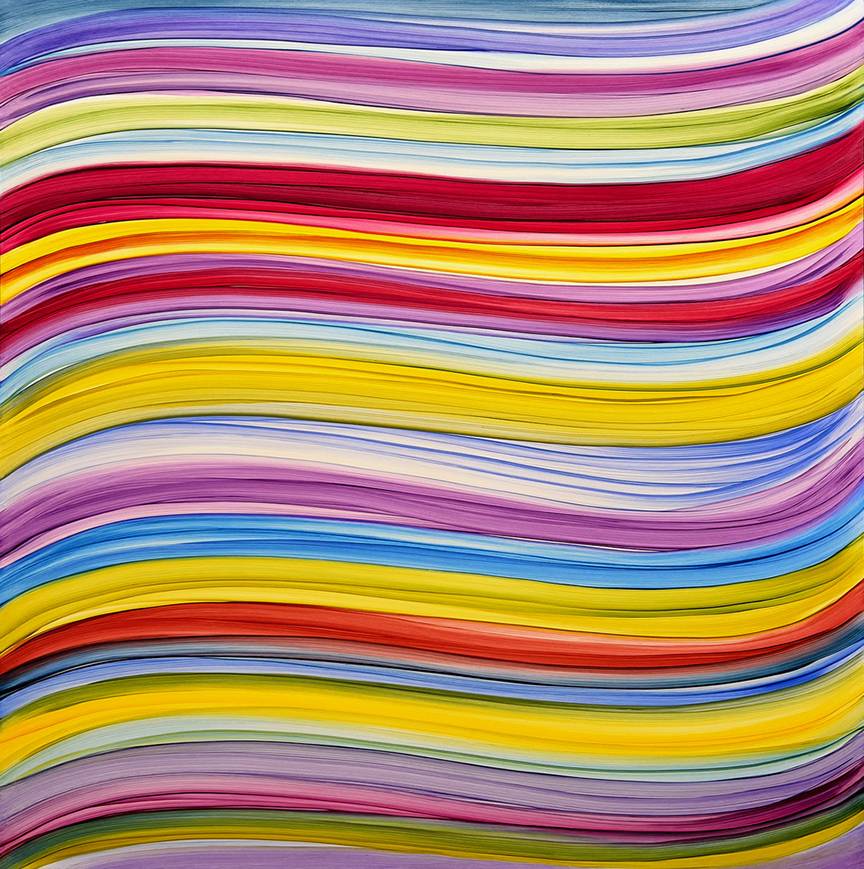
New York City painter Roberto Azank always surprises. Having been called the “chromatic Mozart,” as he can and has harmonized the seemingly most incongruent hues at the pictorial horizon line, he now turns to abstraction to paint waves of chroma, firstly sampling his own still life and pastoral scenes of lotus flowers upon lily pads and other placid bodies of water, and secondly a whole range of the palettes of colorist superstars.
The offerings are sumptuous in the second round of this current trajectory, like a dinner menu at a five-star restaurant with a bounty of delights: Emil Nolde, Franz Marc, Vincent van Gogh, Paul Gauguin, Pierre Bonnard, Holbein the Younger, Henri Matisse, and finally, exuberantly landing upon Zurbarán, which, for this writer, is like a dessert of crème brûlée.
Then, further, he places some of these studies on a slant as diamonds, and thus they begin to become as if op art, expressing themselves in dizzying wavelengths of visual experience a la Bridget Riley or, in a more present moment, Karen Davies. Azank furthers the diamonds with obverse and reverse at angular canvas positionings, stimulating different optical responses in an excavatory manner as in launching a catalyst, which leads to a questioning of other painters’ chromatic abstractions and/or deconstructions.
Azank finds the symphonic in the stop-and-go motion and turns it all around. I was so spurred on by this new development in his work after having followed it for so many years that this prompter par excellence put his own version of the idea to an AI test.
Recently, with the Willem DeKooning retrospective at Gagosian Gallery in Chelsea, the huge, initially linear splurges in some full-blown canvases by the flying, fluid Dutchman in flesh tones or burgundy and/or coloring with a whole host of unexpected slaps and dabs and curves of paint so mysterious except for his indebtedness to Peter Paul Rubens, all of a sudden seem germane in erstwhile broken-down nakedness (though they are really not naked at all). This is where Azank may be going in his discovery process.
As far as this writer can see, there is so much investigation to be done of the ever-rich chromatic vocabulary of painting, so traveling with Azank’s astute sense of the musicality and form within a palette, it will take you on a journey to a country already traversed and another country altogether newly formed.
And yes, there are many more to come.