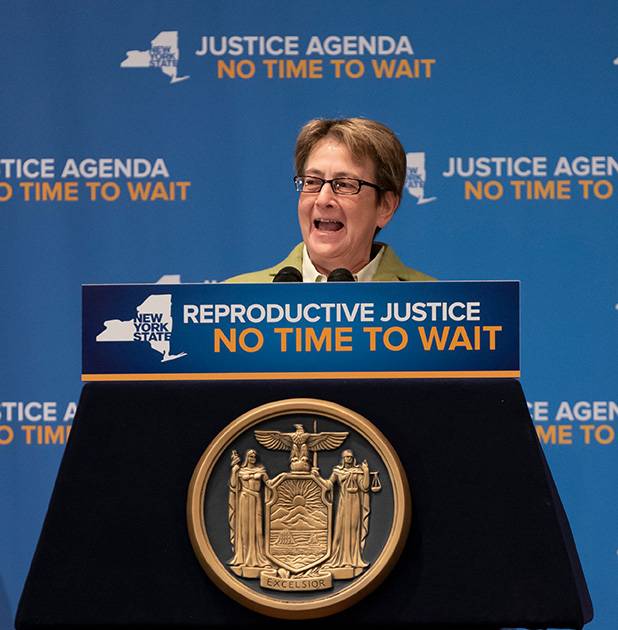
“The end of civilization!” That’s how Deborah Glick caustically characterized the Kraft company’s description of the packaging reduction bill she’s sought unsuccessfully to shepherd through the New York State Assembly for two years.
The downtown Democrat, who chairs the assembly’s Committee on Environmental Conservation, recounted how last year Kraft raised the alarm: Glick’s bill could ban “Lunchables” from public school cafeterias. This spurred Consumer Reports to discover that the popular grab-and-go lunch kits contain lead and cadmium, thus prompting the feds to ban the brand nationwide.
Battle against harmful packaging
Glick, the longtime assembly member whose district encompasses Greenwich Village, this year faced 106 lobbyists “hired to throw up nonsense arguments” against her packaging reduction bill, the Plastics Reduction and Recycling Infrastructure Act (PRRIA). Although PRRIA was passed by the State Senate and supported by a large majority of assembly members, Assembly Speaker Carl Heastie would not bring it to the floor for a vote this session.
PRRIA would reduce plastic packaging by 30 percent incrementally over 12 years and require that all packaging meet a recycling rate of 75% by 2052. It would also prohibit 17 of packaging’s worst toxic chemicals including all PFAS (“forever chemicals”), polyvinyl chloride, lead, mercury, and formaldehyde.
Glick told an audience at New York University Law School last month, “You really don’t want your two-year-old sucking on any packaging that might have formaldehyde….You really don’t want to meet formaldehyde till you’re gone.”
PRRIA’s foes include the American Chemistry Council—“the same people who denigrated Rachel Carson as a lightweight and a dim-witted woman”—and 3M. About 3M, Glick joked, “I love Scotch tape, it fixes all sorts of little mistakes you make…but they are willfully poisoning us with PFAS.” She noted that a more than $10 billion national settlement with 3M will direct funds to Long Island, where 3M poisoned a sole-source aquifer.
“Why are we trying to stop?” these toxic chemicals, she asked rhetorically. And she answered, “Because it’s cheaper than cleanup, which is very expensive and hard to do. We want to turn off the faucet.”
Glick continued, “We also want to get this stuff cleaned up, because all of this is in our water supply. The wastewater treatment industry is really begging us to help them. They want to deliver clean drinking water but it is now so complicated and so difficult and so much more expensive to clean up our water supply of all these different chemicals, for which they aren’t certain they have the right test or the right process for extracting it….There’s a whole new area of emerging contaminants, and these are what we’re finding….You launder your clothes well, and so many of our materials have a plastic component and a chemical treatment that…goes into the wastewater.”
“Companies don’t want to change their formulation,” she observed. “They have inventory, and we don’t want to crater the economy. By the same token, we want them to stop doing what they know is dangerous.” With few exceptions, she declared, “every corporation is creating problems that they should be paying to clean up now.”
Glick underscored that few plastics are recyclable (just #1 and #2) and that “the plastics industry is the fossil fuel industry. Plastic is a byproduct of petroleum.” The fossil fuel industry keeps flacking for plastic “because they’re not going to be selling as much gas and oil.”
Glick did succeed this session with getting the low-impact landscaping rights act through the State Assembly. The act—which would prevent what Glick calls the “mini-tyrants” running homeowners’ associations from prohibiting natural gardens—has already passed the State Senate and awaits the governor’s signature. “Lawns are dead space,” Glick asserted. “Natural gardens—wildflowers—support bees.”
Housing strategies
In response to questions from the NYU audience, the assemblymember shifted gears and riffed thoughtfully on affordable housing.
Problem is price, not quantity
Rejecting the notion that “if you just keep building, you lower the price,” Glick declared, “We have more units in the City of New York than we had thirty years ago; we just don’t have affordable units. We have a lot of luxury units that are empty, or empty half the time or most of the time. So I [proposed, in 2019] a “pied-a-terre” (second home) tax…You have to be here 180 days with your five-million-dollar condo. And if you’re not, you pay a ‘pied-a-terre” tax, which could go into affordable housing.” Glick pointed out that residency requirements are not new; rent-regulated tenants are required to live in their apartments more than half the year.
She also suggested making aggressive use of government power to rescue existing housing stock and make it affordable. “I personally think that all these over-leveraged developments that are in foreclosure, I think the State of New York should be working with the banks…. If there’s a housing crisis, then eminent domain is for the public good, and it is for seizing property, for which [the landlord] gets compensation.”
Assembly Member Glick, who is 74 and who was elected as the first openly gay New York State legislator in 1990, has announced she will not seek re-election when her current term ends in 2026.