
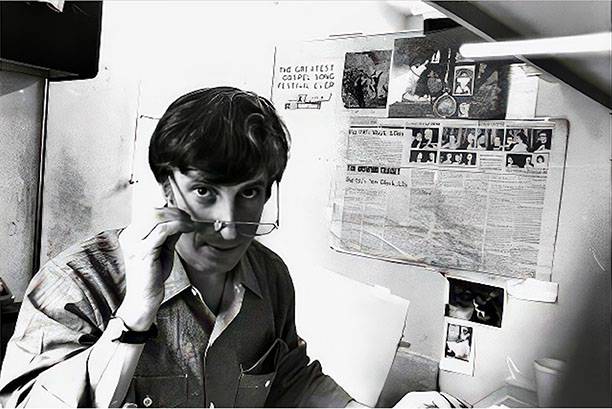
At a time when newspapers and magazines were central to American life, Stan Mack was part of the revolution of how news and feature stories were told. As art director at some of the country’s most influential publications during the golden age of print journalism, he helped unite words and photojournalism of 1960s newsrooms with art and illustration.
Throughout the 1960s and 1970s, Mack worked as an art director at The New York Herald Tribune and The New York Times, and as a reporter/cartoonist at The Village Voice, National Lampoon, and later in the ’80s and ’90s, Adweek—a résumé that is a roll call of peak American print media.
At the Trib and the Times, before it became common to pair in-depth reporting with illustrations, Mack commissioned artists to do just that. and decades before today’s multimedia reporting, Mack treated illustrators as essential storytellers—people who could illuminate complex ideas with more depth than a photograph or written word alone.
He was art director of The New York Times Magazine from 1969 to 1973. Because the magazine was bundled inside the Sunday Times and not reliant on newsstand sales, Mack had freedom to be bold—as long as he didn’t offend the alcohol, travel, and tobacco advertisers that regularly ballooned the magazine to over 100 pages each week.
A look back at his Sunday Times covers makes clear that Mack was a pioneer in blending written-word journalism with visual storytelling in ways that were groundbreaking then, and indispensable now.
“Talk about being fortunate,” Mack said. “I was coming up when some of the biggest names in graphic design were revolutionizing the presentation of news and magazines.” Mack was influenced by the work of design giants like Peter Palazzo of the Herald Tribune, Esquire’s Henry Wolf, Herb Lubalin, Milton Glaser, and George Lois, the maestro of bold Esquire covers.
But Mack wasn’t just interpreting or commissioning other people’s work—he had something to say too. His medium was comics. “I arrived at the influential Village Voice just when Milton Glaser was looking for new ways to tell stories.”
A 20 year run
In 1974, Mack conceived Real Life Funnies, a weekly comic strip that ran in the Voice for two decades. The idea was simple: he would eavesdrop on everyday conversations—on the street, in bars, or at parties—and turn what he heard into verbatim comics. His tagline—“Guarantee: All Dialogue Reported Verbatim”—became his signature.
When the strip debuted, it was unlike anything else in the press. It blurred the lines of documentary, journalism, and art—tapping into a raw, unfiltered realism. “Editors didn’t consider it journalism because it was in comics format,” Mack laughed. “They were at first frustrated that my comics with verbatim conversations couldn’t be fact checked. They had to trust me.”
And trust in him they did: “I realized, to do it right I had to go places where I didn’t belong, places that reflected the times,” he remembered. “I hung out at Plato’s Retreat, with the homeless, with squatters, at singles bars, at CBGB, at gatherings of New York intellectuals, at community board meetings, at an illegal porn shoot in Central Park, settings that would make for compelling storytelling.”
With Real Life Funnies, Mack established a unique place in nonfiction sequential storytelling. Though names like Harvey Pekar and R. Crumb are most often cited as the forebears of autobiographical and nonfiction comics, Mack was innovating right alongside them—often with a broader audience than underground comics could reach.
His work belongs among the pioneers of nonfiction comics—alongside Art Spiegelman, Bill Griffith, Justin Green, Trina Robbins, and Barbara “Willy” Mendes. Together, they laid the foundation for later creators such as Joe Sacco, Marjane Satrapi, Alison Bechdel, Julia Wertz, David Collier, and Josh Neufeld. It’s easy to see Real Life Funnies as a prototype for today’s celebrated wave of memoir and nonfiction graphic storytelling.
Despite his groundbreaking contributions, Mack is often left out of the conversation about the evolution of nonfiction comics as serious narrative art. Perhaps it’s because his visual reportage straddled journalism and ironic humor? His approach for sure was early—if not the very first example of what Mack himself called “documentary comics.”
Whatever the reason, it’s time to insert Mack into the story of how image-based storytelling—today it’s evolved to video and social media—came to dominate American culture. He was not only a pioneer of graphic journalism but also an early champion of using comics to document real life. In today’s era where journalism, memoir, art, social media, and reality TV overlap more than ever, Mack’s contributions are especially relevant. According to Stan, his guiding principle was: “to be as accurate as possible while never being afraid to make the reader uncomfortable.” Given the increasing trepidation of today’s current mainstream media, society could use him now more than ever.
Mack’s story is much more than his career at America’s most prestigious publications. It’s about a turning point in American media, when sequential storytelling and illustration began to stand alongside the written word in reporting the news. Long before graphic novels filled bookstore shelves or were adapted by Hollywood, Stan Mack was already there—drawing life as he overheard it, and showing the rest of us how to read it and see it.