
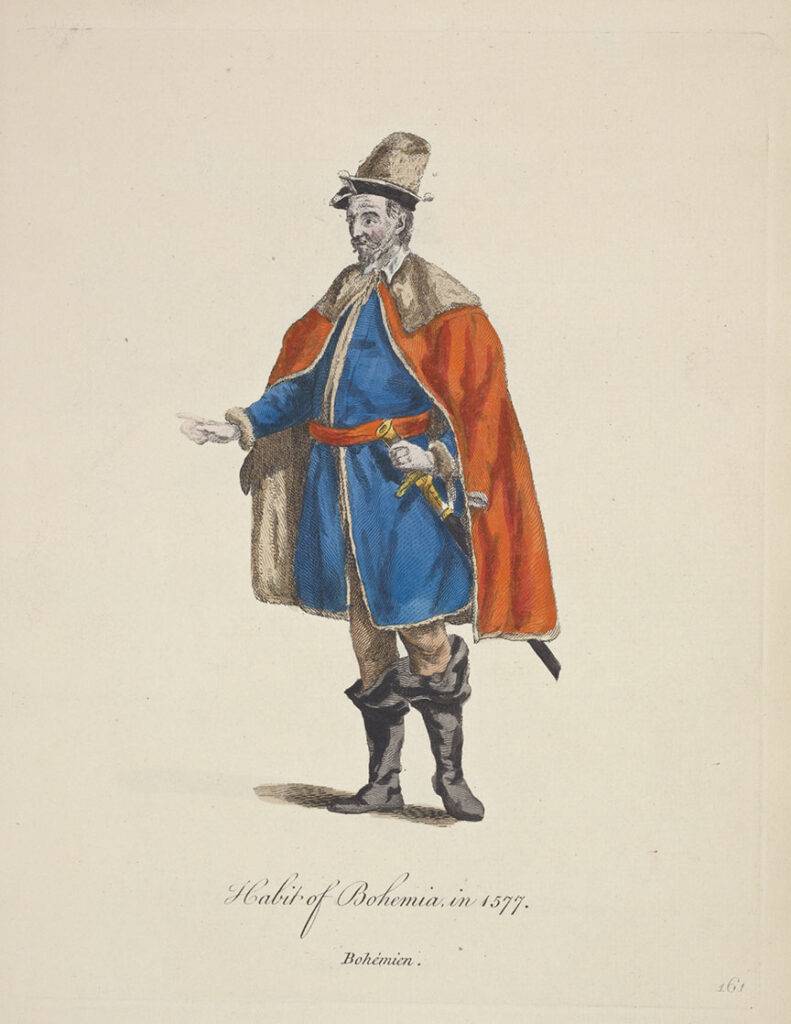
I used to be half of a musical act named Working Class Bohemians. The name choice was mine. I got it from a line in Judith Thurman’s excellent biography of the French writer Colette. Whenever I did a gig as part of a duet, it was as Working Class Bohemians. Often it would be with Johnny Peppercraft on bass saxophone. Lenny Kaye of Patti Smith’s band and I did some duo charity gigs with him on lap steel and me on resophonic ukulele. If the gig was in Miami, it would be with Nick Newman on keyboards and handpan drum.
Whoever or whomever, and wherever, the duo was always Working Class Bohemians. My free monthly Substack newsletter is Bohemian Times Gazette (bohemiantimes.substack.com). I live on MacDougal Street in the heart of Greenwich Village, a place some might classify as “bohemian central.” I write for the Village Star-Revue. So, yeah, I’m a bohemian, for sure.
The bohemian lifestyle, or bohemianism, is an enduring element of life in the arts, pretty much anywhere you go. In Dublin, Ireland, the bohemian quarter is still called Baggotonia, though it’s a bit chichi these days. In Paris, it used to be Montmartre. Maybe it still is. I haven’t been there in decades. And downtown Manhattan has a storied history of bohemians who became household, or at least storied, names – Bob Dylan, Richie Havens, and Tiny Tim to name three from music; Andy Warhol, Man Ray, Arturo DiModica (whose Charging Bull sculpture is known worldwide, even if his name might be a bit obscure); Grace Paley, Donald Barrthelme, and Anais Nin lived on the same street within two blocks of each other.
Young artists, musicians and writers arrive in cities everywhere on the planet and, usually out of necessity, embrace the bohemian lifestyle. So, for the month of October, I decided to investigate the idea that there are still some bohemian scenes to be found in the downtown continuum, regardless of rents, inflation, corporate shininess, and wayward government.
The opening of the satellite branch of the International Fusionism Museum at 57 Stanton Street kicked off the month in full blown bohemian style. The IF Museum’s founder and driving force, Shalom Neuman, was born in Prague, Czechia. One of the two main branches of the IF Museum is located there. (The other is in Easton, Pennsylvania.) Geographically, the actual Bohemia is located in Czechia. Gallerist Loni Efron is running the Stanton Street location. (FULL DISCLOSURE: some of my “By a poet’s hand” series, fusing my pencil drawings with handwritten versions of my sonnets, are currently on display as part of the opening group exhibition at the Stanton Street IF.) Also in attendance at the new IF were architect Daniel Goldner, poet Michael Carter, painter Todd Monaghan, painter Sue Strande, sculptor Ian Crofts, artist Colette Lumiere, and many others.
Thanks to my old friend Gregorius Maximus (aka Greg Moss), I also went to the 50th anniversary party Libra Studios, at the Cutting Room. It was a night for bohemia and rock ‘n’ roll to converge. Steve Marshall, Libra’s proprietor, and his band took the stage. They were joined by various musicians, including Simon Kirke on drums. Co-founder of the supergroup Bad Company, Kirke was inducted into the Rock & Roll Hall of Fame a few days later. Sirus XM host and longtime rock impresario John Richard was there. Julie Harvey was there in her usual glory. Likewise fashion designer Cara Cognilio made the scene more stylish. Los Angeles photographer Ana Gibert was there snapping everyone and everything for posterity. I think she said she’s moving to Brooklyn. It was loud. There was a cool after party at Libra.
Thanks to Jeff Wright, I discovered that there is an occasional pop-up series called “Bohemian Nights.” I attended one at Common Ground on Gansevoort Street in the Meatpacking District. There was poetry, and music by a decidedly world music bohemian combo consisting of a Bulgarian bagpiper, a saxophonist, and a conga drummer. Of the poets who read, I was impressed by Monique Erickson, who read a poem about growing up in a family that favored vans for transportation; David Aaron Greenberg who was the most outré reader of the evening and who I recommend seeing at any opportunity; and of course, Jeffrey Cyphers Wright, who is always worth seeing and hearing. Sadly, I cannot share information on upcoming Bohemian Nights because the organizer, in typical boho style, failed to send me anything, despite repeated requests.
Atanasio Di Felice, just back from reading his poetry in Mexico City, tipped me to the month’s most bohemian poetry reading, at KGB Bar. The readers were Bob Holman, Charles Bernstein, and Anne Waldman – three living legends. The place was packed, and pretty much everyone there had the bohemian aura. I met the poet Stephen Bluestone while I was there.
Also, on another evening at KGB in the Red Room, the Star-Revue’s Queen of the Theater Scene, Kathryn Reiber, treated me to a seat for an entertaining show by the ever-amazing performance artist Zero Boy, produced by Victoria Linchong, who provides a side of eggs sunny-side up as part of the performance. The theme was 1920s gangsters and most of the audience dressed to suit that theme. Nov. 16 at 7 p.m., this troupe, including the bountiful Stephanie Sinclair and Darrius the Magician, will be back in the Red Room. Film noir is the next theme. Expect plenty of va-va-voom!
The bohemian vibes were throbbing at Village Works on St. Mark’s Place when they presented a group show of artists. I received a call from the artist Brian Gormley, across the pond in Dublin, Ireland, encouraging me to visit the exhibit. The art will be up until late November.
While there, I had an interesting conversation with Joseph Sheridan, one of the Village Works’ founders. I also ran into the lovely Natalia Jackson, soft sculptor and educator. Dana Costantino, who writes the Star-Revue’s Coffee Corner column, was also there. What’s more bohemian than someone who writes about coffee?
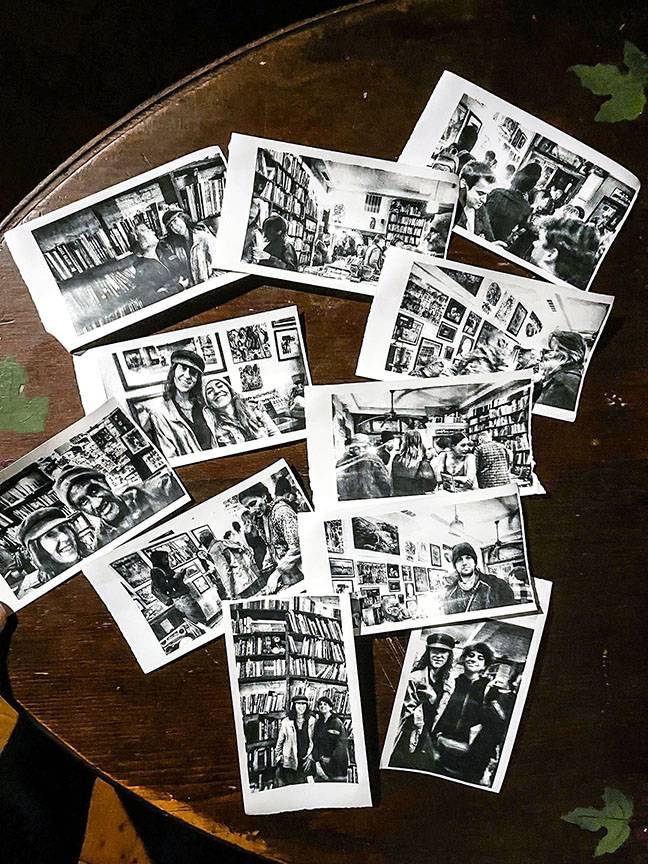
Costantino had this pink camera that made her the sweetheart of the rodeo that evening. It’s called a JPVERLY Kids Instant Print Camera and it prints out pictures as soon as she takes them, kind of like a receipt from a waiter with one of those mobile credit card doodads. It may be sold as a toy for children but it’s great for party favors, too.
Finally, the boho energy of the month coalesced in a lovely evening at the visually stunning home of Manhattan’s legendary bohemian salonierre Clara Aich. The occasion was a book launch party for David Szauder, who is considered by many to be the foremost artist in the world working with artificial intelligence. Aich, like the artist Szauder, is a native of Hungary. Bohemian or what?
Szauder’s lavishly illustrated book is titled Glitches and Glory. While I still have reservations about AI as an artistic medium, there’s no question that what Szauder creates is art. It was quite pleasurable to hear him being interviewed amidst the tasteful, sprawling, and arresting collection Clara Aich has assembled over the years. I was there at the invitation of the Star-Revue’s art critic Lee Klein.
Check out Szauder’s videos on Instagram, where he has more than a million followers. He is obviously influenced by Busby Berkeley, and perhaps military drill maneuvers. In any case, a native of Budapest who now lives in Berlin, Szauder is here for the book launch and for an exhibit of his painting and sculpture at the Elza Kayal Gallery, curated by gallery director Eriko Imre.
The gallery is open from 1 p.m. to 5 p.m., Wednesday-Friday. It’s located at 368 Broadway, Suite 409, in Tribeca. The exhibit is on display until Nov. 21.
Also upcoming from Michele Herman, another brilliant Star-Revue contributor: the Hudson Guild Theater is presenting 150 Moments 150 Years: 1875-2025 on November 7, 8, and 9. The 75-minute show will likely be sold out by the time you read this. It sounds fascinating and fun. I’ll be there for the Saturday matinee. Maybe if enough people contact the theater, the show will be extended.
Herman and her co-author, Jim Furlong, have put together what must be a rollicking 75-minute survey of modern drama. Furlong directed. He is also the Director of the Arts at the Hudson Guild Theater, 441 West 26th St. The show is being staged in the Murray Haber Theatre.
Is there still a vibrant touch of bohemia to be found downtown? Oh yeah. Oh yeah Oh yeah.
Stephen DiLauro is a playwright and poet. His most recent chapbook, a collection of romantic sonnets and love song lyrics, is Undue Romance – available everywhere Amazon delivers.


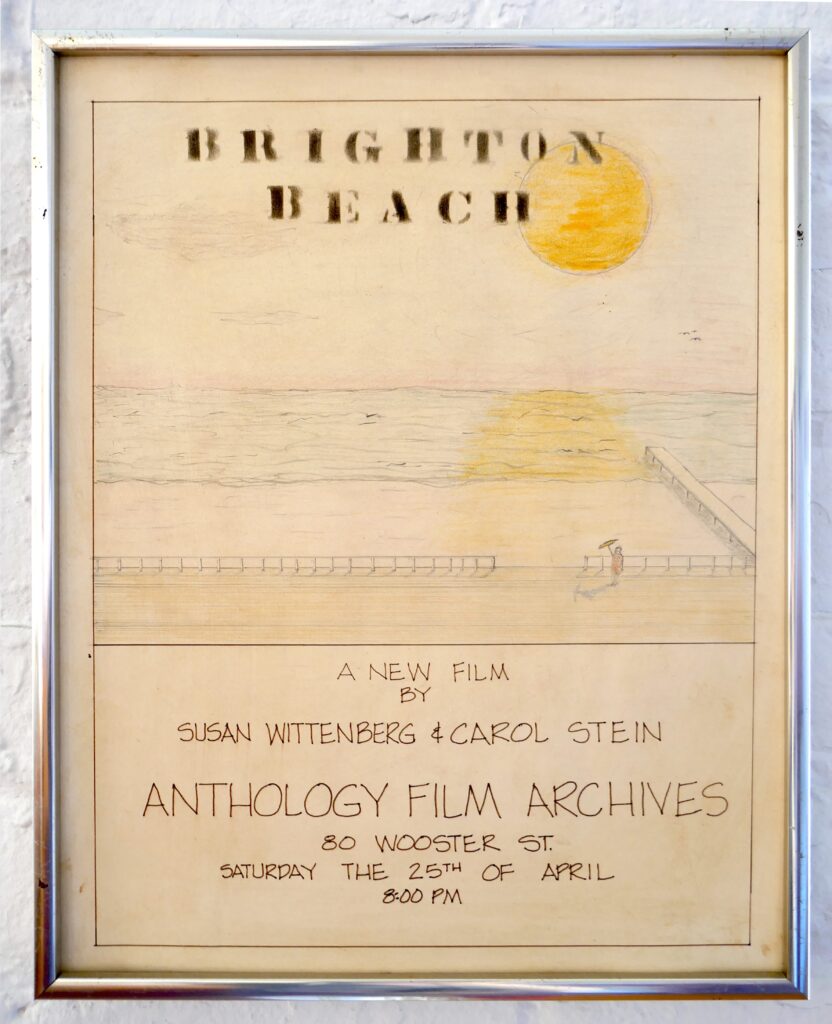
….Bohemia is alive and well at Westbeth.
See westbeth.org for a constant flow of multi-disciplined plays, performances, discussions, classes and openings.
By and large, Bohemia is de facto dead if not impossible, by definition, Downtown. Class is inseparable from incubation of ideas. Folks are too rich to be desperate for meaning and understanding. Westbeth may be the last nyc man standing