
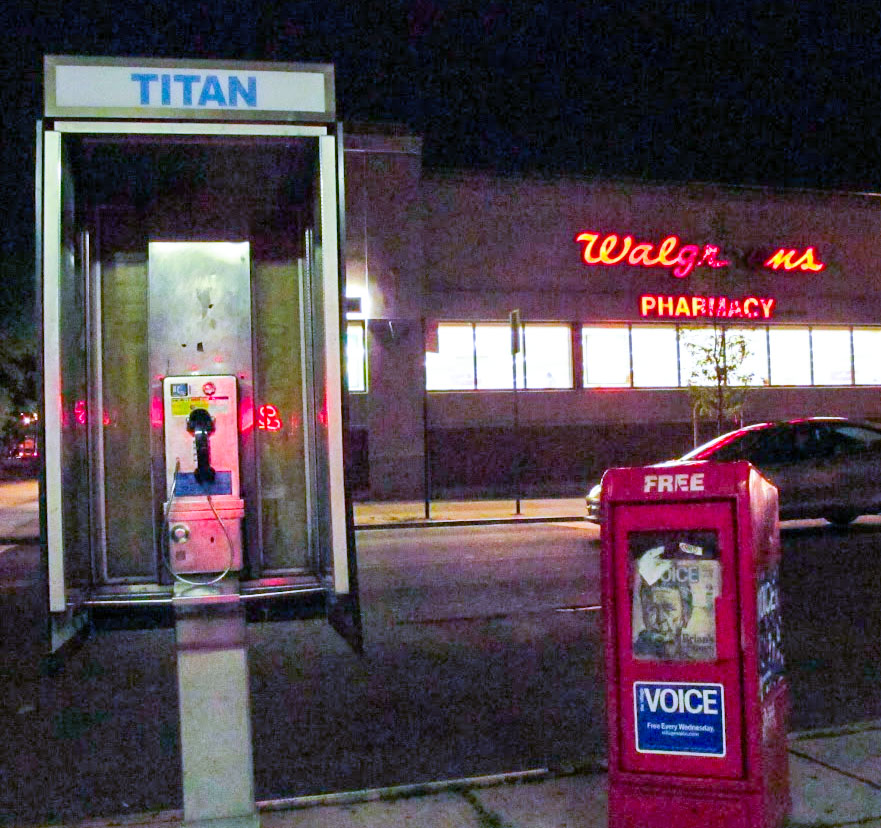
Not all that long ago, an editor at a website that covers green architecture and sustainable design called me about doing some writing for them. We had a pleasant conversation, and then, before saying goodbye, I asked for her phone number. Awkward pause. Just use this number, she said. Awkward pause. I’m on a landline without a readout, I explained. Oh, of course, she replied, and gave me the number.
This is what life is like now for a person without a smartphone. When the 10 percent of us Americans who haven’t fully bought in to the digitalization of daily life communicate with the vast majority who have, the days are filled with little clashes of technological assumptions and faux pas. In my conversation with the editor, I tried to imply that it was a fluke that a landline had fallen into my hand; she tried to be gracious and nondiscriminatory, the way you are when you learn that the person you’re talking to has a disability, the kind for which treatment is readily available.
I never thought my telephones would define me. I never thought I would have to make an excuse for the way I live. The way I live—what a strange phrase. Technologically speaking, I used to live the same way most middle-class families lived, with a desktop computer and ink-jet printer, fax machine, answering machine, stereo, clock radio, and several phones plugged into jacks strategically located in different rooms.
I hesitate even to say what I’m about to say, because I don’t want to sound like one of those self-satisfied people who try to reverse-impress everyone else with their purity. But here goes…. we still have those things (except for the fax machine) and not much more. It’s the phones I want to talk about, during this strange, short era in which the majority of American lives are shaped—enhanced? totally dominated?—by the dense but slippery object in their palm.
It so happens that I grew up in a family with an unusually close relationship to phones and to forward-thinking communication in general, which makes me an odd candidate for the rear guard I now choose to occupy. We were four people but, thanks to my gadget-besotted father, we had eight phones. I don’t think I’m making up my memory of hiding half of them when the company guy came to inspect—Ma Bell, as we called the phone company, controlled distribution and each household was granted a quota. The identical twins, white office-style rotary phones, sat side by side by side on the kitchen counter: the house line and my father’s work line, because he was a doctor often on call for emergencies. In the master bedroom stood the Ericofon, a one-piece space-age gadget designed by the Ericsson Company of Sweden that resembled a long-necked gourd, but plastic, with its bottom cut off. My father also mounted a wall phone in the grease pit he had dug in our garage, where he descended the platform elevator he had built to service the family cars, his idea of leisure.
For years my father, chafing at the phone company’s monopoly combined with its poor service, shaved 10 percent off his monthly bill and paid the rest. In 1975 he picketed the regional phone company headquarters in New Haven and got himself written up in the local papers. When the company finally sued him, he read up on the law and represented himself in court. Eventually he made such a pest of himself that they dropped the charges.
In the early 1980s, around the time he diagnosed himself with incurable lymphoma, my father returned to his childhood ham radio hobby. He had built his own crystal set receiver and taught himself Morse code in the 1930s. Now he bought a second-hand teletype machine and installed it in the spare room. It was big as a desk, with keys as round and springy as a trumpet’s. Evenings he would go up and type witty messages to his new friends around the world. While my geekier peers were flirting with other geeks via rubber-banded stacks of punch cards, my father had made his own Internet.
It used to be you had to do something drastic to become a radical—break laws, occupy buildings, overthrow governments. Now all you have to do is stop buying new gadgets when the old ones are still working. I did get a flip phone for emergencies in 2009, only because pay phones, which hadn’t yet disappeared, had become unviable for calling long-distance cell numbers and because the owners of our annual vacation rental stopped supplying landline service. That flip phone’s second successor (the previous ones replaced only because they couldn’t handle the latest G) sits at the bottom of my bag turned off most of the time. When my mother sold her condo and moved to assisted living, I took two of her perfectly good corded phones to hold in reserve for our apartment.
So why did I stop buying new electronics just when they started to get really smart and small? I have seven reasons. I’m not sure how to rank them because while it’s easy to ascribe meaning to other people’s motives, our own remain tangled and unknowable. First, as I said, the old electronics still work. Second, the new ones cost a lot more. Three is a big one: I don’t want to spend more time on the Internet than I already do, which is why, when my last computer gave out, I replaced it with another immobile desktop.
Four, I don’t want to blur the boundaries between work and leisure any more than they have already blurred and I want to conduct my relationships as much as possible with humans and not just sloppy words tapped by their thumbs, and if I come across something pretty or funny or weird on my travels through the day, I really don’t mind if I can’t snap a picture of it, and I don’t need to listen to podcasts while out walking, play games or watch TikTok videos to pass the time in waiting rooms. As annoying as it is to get lost occasionally or to miss a connection with someone, there are worse things, and the experience may even make the eventual safe arrival and the get-together that much sweeter.
Five: I don’t want to become distracted and jumpy and never satisfied.
Six: without a smartphone, I can worry less than others about having my habits and whereabouts tracked by marketers or the government. Quaint, right? Not because we now have a system in place to protect our privacy. No, just because most people have given up on the very concept.
Finally, reason seven: the environment. Americans on average replace their phones every 2.5 years. I measure my kitchen wall phone’s life in decades. The weighty metal rotary phone in our bedroom is from the 1950s.
Sure, a smartphone is an elegant smidgeon of glass and metals housing as much capability as my lumpish three-piece desktop, and maybe it’s moving us closer to that old goal of the paperless office. But when I think of the collective impact of all those phones with their rare metals in landfills, when I weigh the peer pressure it would alleviate and the convenience I would gain against the hidden costs to the planet, I just don’t see that my social comfort and ease are all that important.
After I hung up with the editor of the website whose mission statement talks about green design saving the planet, I thought: shame on me for apologizing for my landline. But things are moving fast. Nanotechnology is poised to eliminate half the analog methods we used to need to live and work among other humans on planet Earth. Humans and machines are on the cusp of merging in ways that are fantastic (inexpensive fully functional artificial limbs), and terrifying (cyborgs with more know-how than humans, unimpeded by morality). We don’t know the half of it yet.
Those of us who have been living just fine without a smartphone are nearing a crossroads. Before long we will be not just judged and marginalized but unable to function. For now, my obsolescence shows most while traveling—I can’t do things others take for granted, such as call up GPS or order an Uber or look up restaurant reviews or read a menu from a QR code. There’s no place to buy paper maps. Many New York City apartment buildings no longer provide front-door keys because most people can just use an app, and courts have ruled against non-smartphone-owning residents on the grounds that they can just purchase one like everybody else (a very expensive key).
This hasn’t happened yet in my building. So, until my household runs out of working landline phones and the wiring in the walls gives out, I have no plans to switch. Maybe that makes me a tiny bit admirable; I take solace from acquaintances who tell me how they envy my freedom. Or maybe it makes me the worst kind of small-minded Muggle. I don’t know—as I said, it’s hard to parse one’s own motivations. Meanwhile, there on the oak coffee table sits our black AT&T slimline phone, so dumb, but also so blessedly unobtrusive.



….in a way your piece describes my resistance to bluetooth, rechargeable hearing aids. I don’t want phone calls, music, audio books to interfere with my desire to fully engage with sights, smells, small delights as I walk for walking’s sake. -Your former French teacher