
Christmas Eve. A snowy night. A distraught man stands on a bridge, staring down at the icy water. Suddenly he hears a splash and another man’s cries for help. He dives in to save him. That stranger turns out to be his guardian angel. What follows is one of cinema’s most enduring parables of despair and redemption: Frank Capra’s “It’s a Wonderful Life.”
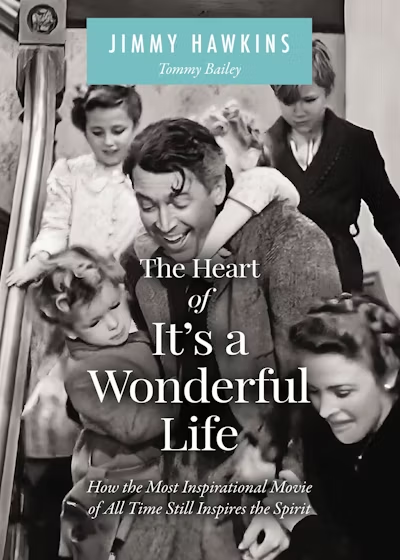
Now, just in time for the holidays, a lovely little book by Jimmy Hawkins—who played the main character’s youngest son—revisits the 1946 classic from the inside out. In “The Heart of ‘It’s a Wonderful Life,’” Hawkins draws on lifelong friendships with the cast and crew, offers behind-the-scenes stories and reflections on key scenes, and explores why the film continues to resonate almost eighty years later. It’s a warm, meditative companion to the film, rooted in the same faith in human goodness that gives “Wonderful Life” its enduring emotional power.
Hawkins recounts the film’s origin as a short story, “The Greatest Gift,” self-published by Philip Van Doren Stern as a Christmas card. RKO bought the rights as a possible vehicle for Cary Grant. Before Capra took it on, the script passed through several hands. Newly returned from World War II and eager to escape the studio system, he founded Liberty Films and made the film his own. His goal was “to tell the weary, the disheartened, and the disillusioned; the wino, the junkie, the prostitute; those behind prison walls and those behind Iron Curtains, that no man is a failure!”
George Bailey (James Stewart) dreams of building skyscrapers and traveling the world. Instead, he inherits his father’s struggling Building and Loan and, duty-bound, becomes trapped in Bedford Falls. Mr. Potter (Lionel Barrymore), the richest, meanest man in town, controls the bank and relishes putting George through his paces. Each night George comes home, exhausted and deflated, to his devoted wife, Mary (Donna Reed), and four lively children: Pete, Janie, Zuzu, and Tommy. And each time the banister’s wobbly knob comes off in his hand on his way upstairs, he looks ready to hurl it across the room.
Hawkins helps us appreciate how Capra’s film is darker than its reputation as a holiday classic would suggest. Its emotional center is George’s Christmas Eve breakdown. Mary and the kids are excited about having people over and pepper him with questions. Hearing Janie play the same carol over and over, he goes berserk, smashing his architectural models and terrifying his children. Then he tries to get them to carry on as if nothing happened. “Oh, Daddy,” Janie cries, bursting into tears. It’s a moment of startling emotional violence. My own father, prone to such outbursts, never failed to cry while watching it. He called movies like this “tearjerkers.”
Despite five Oscar nominations, the film received mixed reviews and was hardly a blockbuster. Decades later—after frequent television airings turned it into a seasonal staple—“Wonderful Life” finally found its audience.
Now that my father has passed, watching the film has become part of my holiday ritual. Hawkins’s book helped me reflect on the humility and forgiveness the film asks of its characters—and of its viewers. Now I see my father in George and George in my father. Not just his rages but also his prayers and love for family, however imperfectly expressed.
If you’ve never seen the film, or never seen it on the big screen, head to the IFC Center in Greenwich Village for its annual run of screenings. Seen today, the film’s belief in decency feels almost countercultural. Maybe that’s why those of us who love it still find an emotional home in Bedford Falls. We don’t love George in spite of his flaws—his impatience, his sarcasm, his quick temper—but because of them. And in doing so, we recognize our own failings and forgive something in ourselves. “Wonderful Life” is the rare film that makes you appreciate your life exactly as it is.
What greater gift could you ask for?