Review of “Green Lankton: Could It Be Love,” edited by Francis Schichtel, Jordan Weitzman, and Nan Goldin
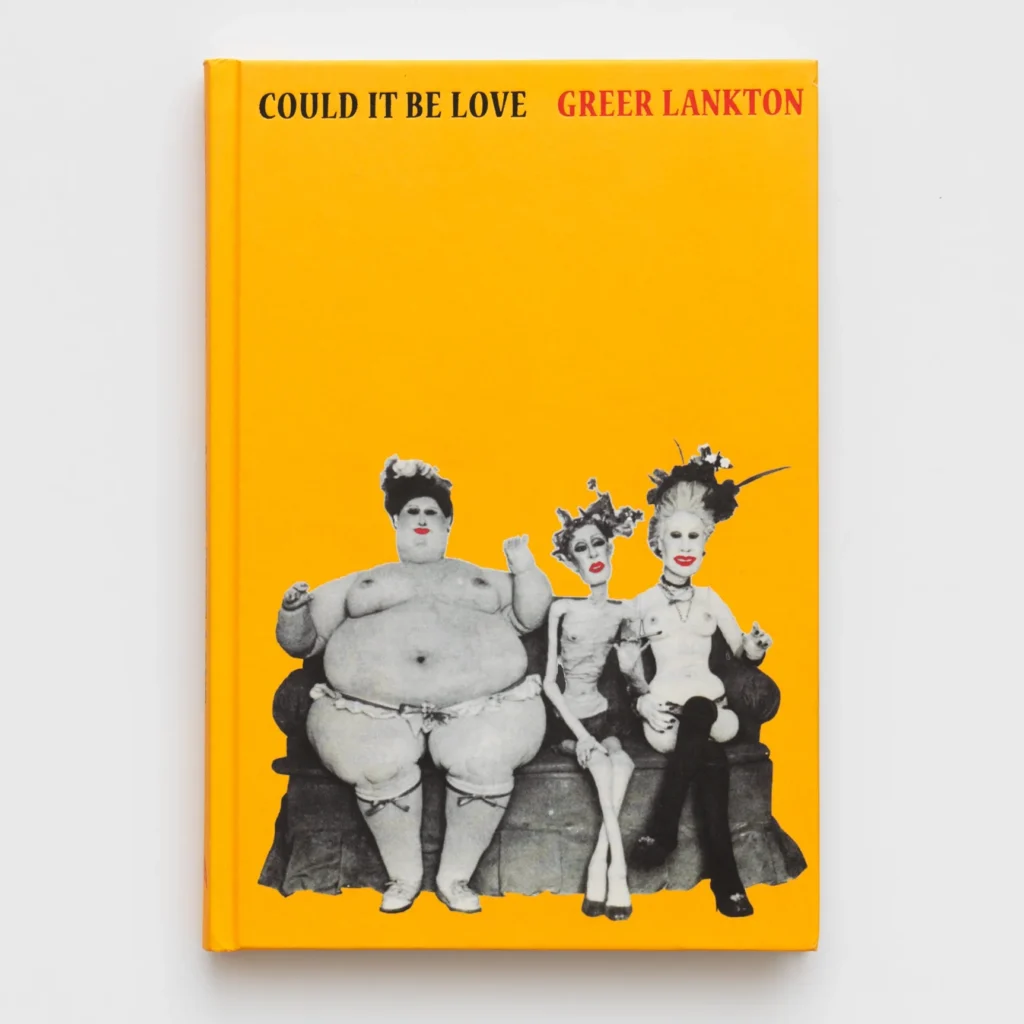
A photograph shows three women sitting on a couch: one fat, one emaciated, one somewhere in between. They are topless, wearing a coquettish combination of heels, ribboned stockings, and flowers in their hair. Are they waving at us, the viewer, or at the photographer, their maker? For these three are life-size dolls.
Dolls, like clowns, inspire strong reactions. Their human qualities can fascinate, captivate, unsettle, and repel. The artist Greer Lankton (1958–1996) was obsessed with making them from the time she was a child in Illinois. Many were life-size and poseable; she used everyday materials like pantyhose and wire. None of Lankton’s dolls are what you would call pretty. They are glamorous and grotesque. Their beauty lies in their distinct personalities, discernible at a glance.
Part of the 1980s East Village art scene, Lankton exhibited her work at places like PS1 and the Pyramid Club. Her career was gaining momentum when she died of a drug overdose. Her first full-scale installation, “It’s All About ME, Not You,” remains on permanent display at Pittsburgh’s Mattress Factory.
A new book, “Could It Be Love,” collects 100 photographs Lankton took of her work. Some dolls are shot in the studio; others are staged in and around the city. While many are her own characters, some portray famous figures, including Divine and Coco Chanel. Some wear the swept-back hair and jewelry of 1960s society matrons. Others look drawn and bedraggled, like junkies. Many have painted fingernails and cigarettes jammed between clawed fingers. We see sagging breasts, big bellies, jutting ribs. Up close, some faces are shiny and shellacked, with pencil-thin painted eyebrows. Lankton wrote, “They’re all freaks. Outsiders, untouchables. They’re like biographies, the kind of people you’d like to know about.”
Most of Lankton’s dolls were female—or, like the artist herself, female-presenting. Much work by trans artists wrestles with the question of being born in the wrong body. Lankton’s work makes every body a possibility for expression. A character named Sissy appears repeatedly as the artist’s alter ego. In one image, she stands outside the Prince Street N and R stop in Soho. She wears a black wig cap and an open cardigan, her skirt yanked down to reveal a pink and somewhat bruised-looking penis. In another, she’s curled on the floor, cradling an armless, legless torso like a pillow.
Lankton also wrestles with the duality of the body through her series of conjoined twins. One pair, Timmy and Tommy, lift the bottom of their sweater to show where the split begins. Whether physically connected or not, Lankton often depicts her dolls reaching toward connection. In one photograph, a hand is about to squeeze another’s leg—a small but unmistakable gesture of intimacy.
The book’s end pages show a grid of the dolls’ belly buttons: different shapes, different skin tones. It’s an unusual form of cataloguing, suggesting both creation and record-keeping. In this smallest of details, the belly button becomes a point of connection: between the artist and her work, and between the dolls and us.