November 19 2026 marks the 10th anniversary of the death, at age 84, of philosopher & novelist Umberto Eco. For a guy like me at least, Umberto Eco was a fun guy to be around with his amazingly encyclopedic mind, and flrehose delivery of information complete with extensive quotes from memory from a varied selection of philosophical & literary works.
He was a polymath whose book-based mind allowed him to synthesize disparate fields instantly. Eco himself called this “memoria vegetale” or vegetable memory (because books are made of paper made from plants). Thus the famous personal library of 30,000 books at his main home in Milan, plus an additional 20,000 volumes at his summer place near Urbino (a former monastery of course).
I was fortunate to enjoy drinking martinis with Umberto Eco in New York City, Bologna & Philadelphia (in which latter town he insisted that only the now defunct Latham Hotel Bar knew how to properly make his favorite cocktail). I’m sure he declared many more individuals than me to be fellow “martiniani”. Cocchi Vermouth di Torino Extra Dry is the vermouth of choice for the mixologists among you.
Eco was not yet famous when I first met him, not yet having finished penning In The Name Of The Rose . He was an academic, but an academic who was always fun & interesting to be around. In New York I saw him being picketed by nutty Lyndon LaRouche followers who accused him of serving the interests of the Knights of Malta. Not even Eco could quite figure that one out.
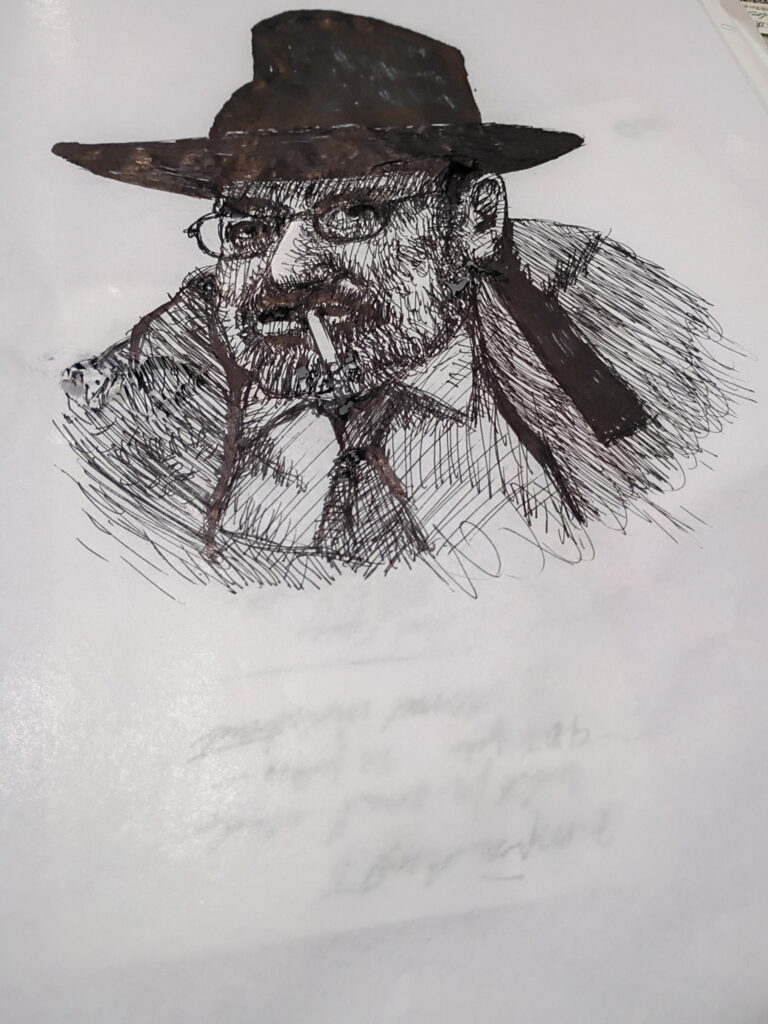
Copping a smoke
The chain-smoking Eco was out of cigarettes in Philly where he jumped out of our cab on 13th Street, declaring “Prostitutes always have cigarettes”, as he ran over to a couple of scantily clad women and bummed a smoke before we continued on our way to dinner.
Most welcome were the martinis we drank together in Bologna where I was couch-surfing at the hide-out of Felix Guattari & Franco Berardi (BIFO) at a time when the latter (Eco’s former student) was purportedly in exile in Paris in order to avoid arrest and imprisonment for supposed terrorist activities.
After the all-night political diatribes of Guattari, the purely intellectual fulminations of Eco, over a couple of martinis, were positively refreshing.
Not that Eco was always scrupulously intellectually honest. Eco, an Italian poet & I were chatting in a NYC taxi, when the aged driver, of immigrant Neapolitan parentage, turned around to ask what dialect we were speaking.
Eco spoke up first, explaining that he was from Piemonte and that we were talking his native Piemontese together. It struck me at the time as a perfect example of the saying “Piemontese falso e cortese” (Piemontese, false & courteous), one of the more condemnatory traditional sayings about an Italian region.
And that driver was probably happier with Eco diplomatic quick thinking than with being told that we were simply speaking something called Italian which conveyed a concept of Italy beyond his ken.
A collection of 3 essays, How To Spot A Fascist, is the most pertinent of Umberto Eco books right now.