
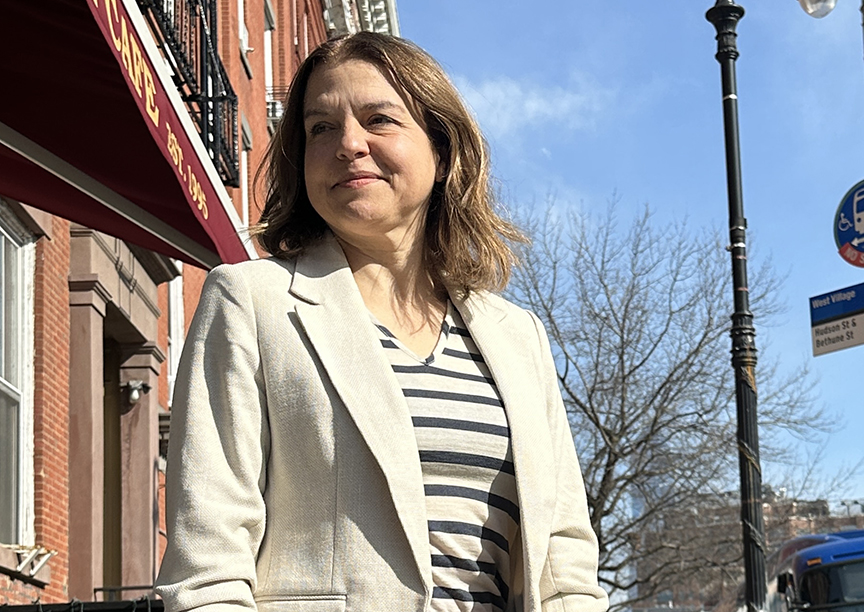
Layla Law-Gisiko has spent the past two decades enmeshing herself in the hard-nosed and oftentimes shady world of Manhattan land use, and she doesn’t like what she’s seen.
“I’ve seen up-close how the sausage gets made,” Law-Gisiko told the Village Star-Revue. “And I really just think we should be doing better for our community.”
That belief, she said, is part of what has driven her to enter the April 28 race to replace Erik Bottcher as City Council member for District 3.
Over the years, Law-Gisiko has built a reputation as a staunch advocate for public and affordable housing and someone willing to charge headfirst into fights that many consider politically fraught.
“I’m fairly new to electoral politics, but I can see that there’s not much of an incentive to take risks because you’re likely to attract a lot of criticism,” she said. “As far as I’m concerned, I don’t give a fuck. It’s not about me. It’s not about my career. So I will never shy away from a fight that I think is important.”
Land use expert
Over the course of her career Law-Gisiko has found herself on the steep side of many uphill battles, including as an early advocate for congestion pricing, opposing Gov. Kathy Hochul’s proposal to redevelop several blocks surrounding Penn Station, and most recently leading the push to halt the planned demolition of the Fulton & Elliot-Chelsea NYCHA complex.
“Public housing disinvestment is 30 years in the making and I can’t name more than 5 people who are in office who actually care about public housing in the entire country,” she said. “It’s a tragedy rooted in racism and classism and it’s just so incredibly obvious. There’s been a conscious decision not to fund Section-9 public housing and it’s shameful. And I’m getting a lot of heat for making these comments, but I don’t care. I’m not going to stop.”
Law-Gisiko’s spent 19 years on Manhattan Community Board 5, where she chaired the Land Use, Housing, and Zoning Committee, as well as the Landmarks Committee. She currently serves as District Leader for AD75 in Chelsea and as president of the City Club of New York.
Her path into local government began unexpectedly. In 2004, frustrated by late-night noise near her apartment from the now-defunct club, Limelight, she attended a community board meeting looking for help. She left without a solution, but was nonetheless determined to make sure her voice was heard. Soon after, she joined the board and discovered it had more influence than she was first led to believe.
“I realized that, as a community board member, there are all these mechanisms we can use to shape our district,” she said. “We can improve quality of life. We can bring in more sanitation. We can make sure nightclubs don’t keep people up in the morning.”
Journalism background
Law-Gisiko was born in Paris and came to New York in the 1990s after earning master’s degrees in French literature from the Sorbonne and in journalism from the French Press Institute. As journalism jobs dried up amid a broader economic downturn, she looked abroad for opportunities.
With support from a German television network she worked for at the time, she applied for a six-month visa to work in the United States. Two weeks later, she was shocked to find she had been granted a five-year visa.
“I remember that day. I packed up everything I could fit into two very large duffel bags and I sold everything else in my apartment,” she recalled. “I sold all my books, my microwave, my blender and I booked a one-way flight to New York.”
She arrived at her new home in the West Village—a fifth-floor walk-up on Tenth Street—eager to get to work. But shortly after she arrived, her editor told her the network no longer needed her in the US.
What followed were months of hustling: emailing pitches, chasing freelance assignments, and trying to hang on to her visa while living off the money from selling her belongings.
Her persistence eventually paid off. She built a career for herself as a US correspondent for outlets across Europe, including in France, Belgium, Germany, and Sweden. Later, she moved on to documentary filmmaking, traveling across the United States to cover subjects ranging from Amish communities in Pennsylvania to polygamous Mormon sects in Utah and Arizona.
It’s about the listening
“To me, it’s the same job,” Law-Gisiko said of the connection between journalism and politics. “I think that we’re better off when we take the time to listen. I’m not going to tell you that I don’t have any biases. No one ever convinced me that becoming a polygamous Mormon was great, but I really approached it with an open mind that facilitated good conversations.”
Her interest in land use took shape during her early years on the Community Board. She approached the topic the same way she approached journalism: by teaching herself how to navigate dense, technical information and extract what mattered. Without a formal background in planning or architecture, she said, she learned by combing through zoning documents and development proposals.
Her thinking was also shaped by her upbringing in Europe, where she saw models of urban planning that differed sharply from New York’s. Here, she said, development is largely governed by an “as-of-right” system that defines density according to a building’s size rather than the number of people it houses. Meanwhile, in European cities like Vincennes, city officials have much more discretion when it comes to what kind of developments get approved, leading to more efficient design, she said.
Wrong conversation
“When we talk about density in New York, the only metric we look at is floor-area ratio, which measures bulk,” she said. “It doesn’t measure how many people will live there or how many apartments are created. We’re having the wrong conversation about density, and as a new council member, I want to change that.”
Because of this, she argues that the city’s housing crisis can not be chalked up to a lack of space but rather the need for true affordability and smarter planning. She is skeptical of the “Abundance” or “YIMBY” movements—popularized by commentators Ezra Klein and Derek Thompson—which promotes large-scale deregulation as a solution to the housing shortage.
Supporters of the YIMBY approach argue that loosening zoning will increase supply and ease rents; critics, including Law-Gisiko, contend that deregulation alone will not produce deeply affordable units.
“Markets are agnostic, and believing otherwise is going to get us into a really, really bad place,” she said. “Believing that developers are here to solve our public-policy issues is also going to get us into a bad situation. That’s the challenge I see.”