As part of my voracious reading as a teen, I enjoyed Somerset Maugham’s The Moon And Sixpence, loosely based upon the character of Paul Gauguin, in which an English painter removes himself to a remote Pacific island in his ruthless pursuit of creativity.
I also read Thomas Mann’s Death In Venice, about a composer loosely based upon Gustav Mahler, attracted to these tales as I was because they are good reads and because of my youthful aspiration to be a creative type myself.
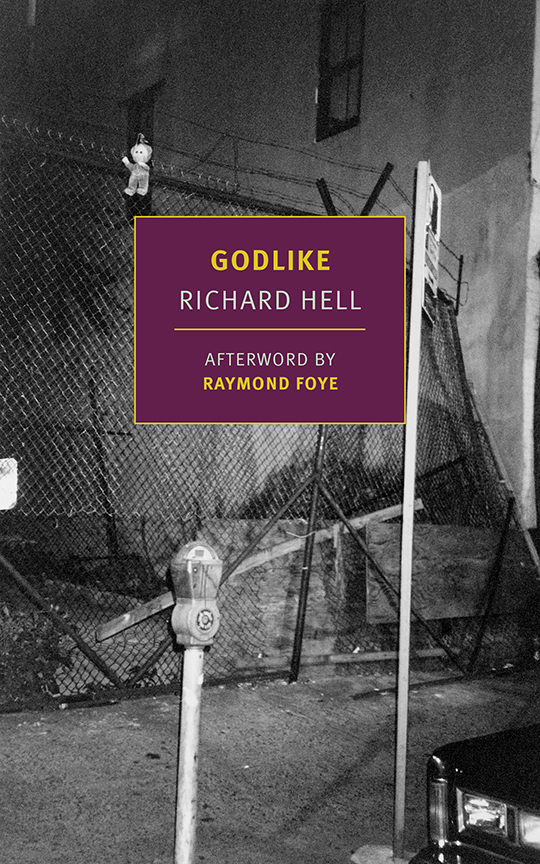
As a teen today, I would avidly read the novel Godlike (NYRB) by Richard Hell, especially since it purports to portray not only a pair of poets, but a legendary place and a time: 1970s Downtown Manhattan, very much in vogue among a certain segment of today’s youth.
As with the tales by Mann and by Maugham, a certain atmosphere of doomed genius pervades Godlike.
And doom’s exactly what we want, apparently, in our fictional tales of creative ambition, alongside the glories of the creativity itself.
All this seemed to come to life in the Punk Rock scene of 1970s Downtown Manhattan, especially as heroin use took hold and seemed to spread from the music scene to the art scene and so on.
It pains me more than I can say that my friend Jean-Michel Basquiat combined a feverish creativity on canvas with an equally feverish pursuit of what might mitigate his intense emotional suffering, namely the narcotics that killed him at age 27. A similar dynamic powers Godlike.
While Hell is clearly inspired by the tumultuous sexual relationship between 19th century French poets Paul Verlaine and Arthur Rimbaud, that just provides a convenient armature upon which to mold his dynamic tale of two latter-day poètes maudits.
And rather than simply telling a dramatic tale, with historic overtones that includes much of the atmosphere of that whole Downtown scene through the lens of the NYC poetry world, Hell’s novel is itself a celebration of language.
Godlike makes a highly original use of lyricism, diction, tropes and all the other tricks of the poetic trade. It is a dynamically poetic tale about poets.
As a teen now, I would probably eat up Godlike, and revel in its wordplay. And I might think that I’m getting an historically accurate depiction of the old Downtown scene.
As a good novelist, Hell uses all the tried-and-true novelistic tricks of compressing time, of moving real places, people, and events around to best suit the tale.
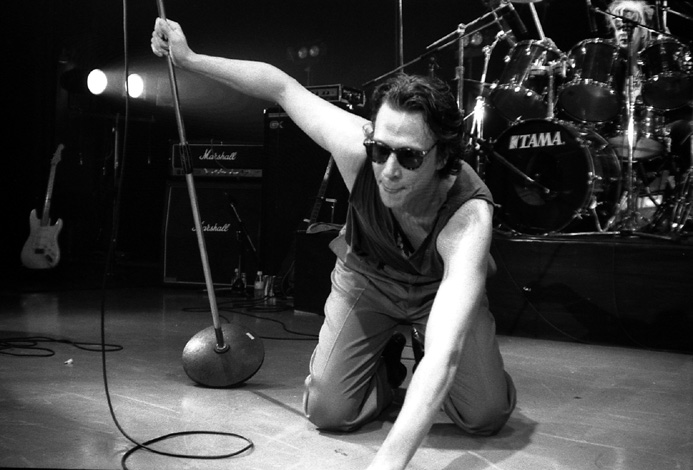
And that includes some conflating of his two poet protagonists, Paul Vaughn and R.T. Wode, with not only the poets Verlaine and Rimbaud, but with Hell himself and his old friend and fellow Punk Rocker known by his stage name of Tom Verlaine. Like Hell, hellfire protagonist R.T. Wode is a native Kentuckian.
For those of you who like to read about their favorite authors, there is of course Hell’s own entertaining memoir, I Dreamed I Was A Very Clean Tramp (Ecco), covering his early life up to 1984 when he essentially left the music world for that of literature.
In lieu of a full-length biography of Hell is a curiosity called A Year On Earth With Mr. Hell (Fashionbeast Editions), a memoir by one Young Kim, Hell’s romantic partner during a ten-month period in 2015-2016, and described by novelist Brett Easton Ellis as “engrossing.” Young Kim states that Hell urged her to begin writing about their sexual relationship.
And sex is prominent in Godlike, where a sexual relationship between the two male protagonists fuels the narrative.
But more prominent yet is poetry. The prose of Godlike is not only word drunk, and full of inventive phrases, but the novel contains much poetry, in one form or another, by scads of poets, whether French (Mallarmé, Valéry, Verlaine, Rimbaud) or NY School (O’Hara, Schuyler, Ashbery, Berrigan, Padgett), et al.
Hell’s love of literature, of writing, and of poetry is one of the joys of this 2005 novel, which is now republished (with a felicitous Afterword by Raymond Foye) under the prestigious New York Review of Books imprint headed by Edwin Frank, author of the brilliant 2024 book Stranger Than Fiction: Lives Of The Twentieth-Century Novel (FSG).
At the 2021 NY Poetry festival on Governor’s Island, I saw Edwin Frank reciting and talking about his unpublished translation of the Baudelaire poem, The Albatross, from Flowers Of Evil.
This is the poem that ends (in a translation by Richard Wilbur):
The poet is like this monarch of the clouds, Familiar of storms, of stars, and of all high things; Exiled on earth amidst its hooting crowds, He cannot walk, borne down by his giant wings.
It is Baudelaire’s take on the poet, helping us to understand the wisdom of Hell’s decision to have poets instead of Punk rockers or painters or filmmakers as protagonists of his novel about NYC’s doomed last Bohemia.