For fifteen years we had a dog, which meant that for fifteen years my days were meted out in companionable, purpose-driven walks. Then, in early 2020, the dog—bless his wiry coat and big dachshund heart—began an excruciating decline. He grew so thin he became almost luminous. We had to put him down that August.
I had happily cracked my routine wide open to make room for him. Now I would have to learn anew how to organize my days. I joined all the other stir-crazy pandemic humans out walking alone, my many short walks consolidating into one more open-ended one.
The new routine stuck and my solitary walks now number in the thousands. At some point on each one I find myself thinking—perhaps a little anal-retentively—that this walk will soon be stirred into the big pot with all the others and I will not remember anything about it.
So I’m trying to capture some moments, or maybe an essence, of this most common, modest human activity.
One of my favorite occasional encounters happens right on my West 12th Street block, when the erudite, bilingual custodian of the building next door happens to be outside. He asks me about my writing and tells me what he’s reading, maybe Neruda, maybe Garcia Lorca. Last time we talked he had dug up documents from the 1500s translated from native languages of the Americas to Spanish. These, he explained with satisfaction, definitively trace the origins of the link between Christianity and racism.
Edified, I move on, usually Hudson Street-bound. The main drag of the far West Village sets me on the path of most places I want to go. For nine happy years it took me to PS 3 to drop off and pick up my kids. For decades it took me to Carmine Street Rec until the pool closed for repairs in 2018 and never reopened. It still takes me to the Hudson Park Library, though it’s currently closed for renovations. (Still spooked by the loss of the pool, I pray to the municipal gods: may the library reopen when it’s supposed to after a couple of months of necessary renovations.)
I’ve been walking Hudson Street since the Gourmet Garage was a Sloan’s and the charming Bus Stop Café, where I often meet up with students, was Benny’s Bus Stop greasy spoon. I walked it when we had secondhand furniture stores, an early iteration of Fish’s Eddy, and Minter’s ice cream (ice cream places never last). I walked it that thrilling season when my boys were small and the derelict gas station at the corner of Charles (now the wiggly brick building that houses our current ice cream mecca, Salt & Straw) was home to a litter of feral pit bull puppies.
Some walks do stand out from the crowd, like this recent eerie one. While heading across 12th Street, I noticed a man in front of me. He looked like Phil, who was my longtime writing teacher. Phil lives on Long Island now, but has roots in the West Village, so this was plausible. I did reconnaissance: he was walking a dog, and Phil is a dog person. But this dog was a small red doodle, not a Phil kind of dog; Phil goes in for big hounds and border-collie mixes. Still, the man had an athletic bounce in his step, like Phil. He wore a Phil sort of dark parka. Every time he turned his head a little, his features looked like Phil’s.
He came to a red light at Hudson Street. “Phil?” I called with that mingled anticipation and nervousness at the thought of running into a teacher out in the world.
The man instantly turned around and looked me in the face. Right age, right crags and laugh lines (Phil has a mighty laugh). The whole package, with the exception of the bespoke dog, still looked like Phil, remarkably so. But now I could see that he didn’t quite tip into actually being Phil the writing teacher.
With a confused look, the man answered, “Yes, I’m Phil.” I guess the world is full of Phils.
Speaking of writing, other days random words from passersby float into my ears and I think: therein lies a story. One day I heard two words that I hope were good news and not wishful thinking: “clean scans.” Another day a defense or a boast, I’m not sure which: “I’m actually a great photographer.”
Living in a tourist destination, I tune in to the languages of the people I pass, usually western European. Or else Russian or Polish; my ear isn’t educated enough to know the difference. If I see a family or two with young kids and they’re speaking French, I think: it must be une semaine de vacances in France.
When I’m rehearsing for a show, I run my lines. Sometimes I practice solfege. Some days for fun I practice my British accent by quietly narrating my walk: and now I shall step around a rather large puddle. I hope that one day I will be called upon to use this skill.
I’ve been taking piano lessons from a jazz master for a few years, and I’ve discovered that my footfalls make a reliable human-powered metronome. My teacher is always insisting I know more than I think I do, and occasionally I believe him. I walk down the street singing whatever song we’re currently working on and I realize that my body understands pickups and dotted quarter notes and triplets better than my brain.
One frigid December afternoon I did a dogged tour of every cobbler in the Village and Chelsea in search of galoshes for my husband to replace the ones that were flopping around his feet like clown shoes. There are a lot of cobblers in the area, but no one had a selection of galoshes, or any galoshes at all. Apparently men don’t wear them anymore. The already stingy sun was falling fast. I was almost to 34th Street when I cried uncle and turned around. I ducked into the gallery at FIT to get some feeling back in my fingers. The show was a dazzler: Africa’s Fashion Diaspora. I now make it a habit to stop by when I’m in the vicinity. I also check out whatever’s on view at the two Hudson Guild galleries in Chelsea. I recently discovered the storefront Pratt Gallery on West 14th, with a museum-worthy exhibit of art rugs.
I don’t wear galoshes myself. On rainy days I look down at my Blundstone boots, built as if for a badass elf. Then I look back up and watch an annoying phenomenon play out: when I pass another pedestrian and we’re both carrying an umbrella, I’m the one who moves mine out of the way. Every time. They just keep walking while I’m maneuvering, turning it sideways, getting wet. Maybe it’s because the populace is oblivious and rude. Or I’m hyperaware and too nice. Or just lower to the ground.
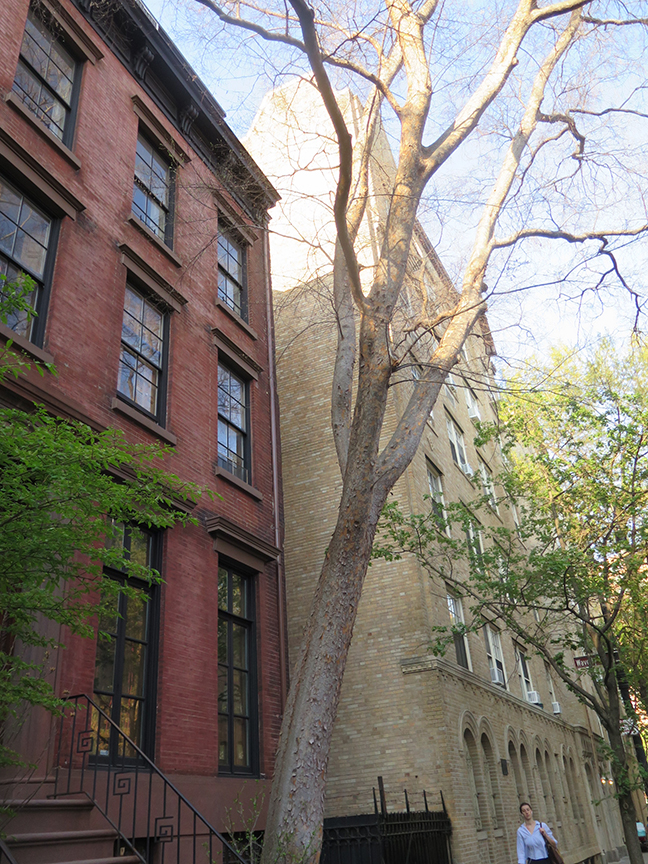
One sunny afternoon I turned the corner from the Waverly Inn onto Bank Street and was stopped in my tracks by a tree I had never noticed before. There it was in the small fenced-in front yard on the north side of Bank, leaning outward as if trying to break out of confinement. The sun seemed not to be trained on the trunk so much as lighting it from within. I fell in love.
My best guess was that it was sycamore-adjacent, because its bark was shaggy. But the skin peeking out was orange. I backed into the street and took in its equally fetching top half, whose multiple boughs curve skyward every which way.
A sycamore’s outer bark peels off in large patches from its inner, leaving a tricolor camouflage pattern of creams, grays and greens. But this tree’s outer skin is more intact than not, scored in small, delicate, interlocking patterns. It’s hard not to compare it to a jigsaw puzzle in the latter stages of being put together, if jigsaw puzzle pieces were designed by an abstract artist intent on exploring all the ways a line can wiggle, beyond the basic jigsaw innie and outie: the scoring makes fanciful animals and continents. Its outer bark is silver-gray trimmed with small orange dots. If it has rained recently, the inner bark peeking through is as orange as a ripe tangerine.
I have learned that it’s a lacebark elm: medium to fast-growing, 40-50 feet high with a strong, rounded crown, good for cities, produces a lot of seed which makes it somewhat invasive, Drake and allée varieties. Flood tolerant, drought resistant. Likes full sun. Phototropism is the term for the way it leans toward the light.
I’m always busy pondering human nature and human creation, but I realized there’s a whole world of trees out there to start tuning into, and that we are part of the same great ecosystem: they drink sunshine to grow, which creates oxygen for us to breathe, which of course I learned in school but took for granted. Increasingly on my walks I’m trying to get the hell away from what may be humanity’s most insidious creation: AI. Forming a friendship with a tree is an excellent antidote.
On my way across Bank Street to snap some photos of my elm, I got stuck behind a mom and her two blond daughters. One had had just taken a swipe at the other, both girls were crying, and the mom was in no mood. With mingled annoyance and sympathy (for I too used to be an exhausted sidewalk mom of two very physical kids), I maneuvered around them, but then we all slowed down at the same time. They opened the gate and went up the steps of the very townhouse I was heading to. The girls forgot their grievances and chatted me up, proudly telling me their apartment faces both the front and the back and, what’s more, is the only one with a door to the basement. I told them I liked their tree so much I was going to write a column featuring it. They didn’t seem to think I was nuts. All in a day’s walk.