
Robert Leslie’s audience is typically transient. They’ll pause to take in a song or two, maybe shoot a quick video, or take a moment to dance. But eventually they move on, quickly replaced by a new set of curious faces.
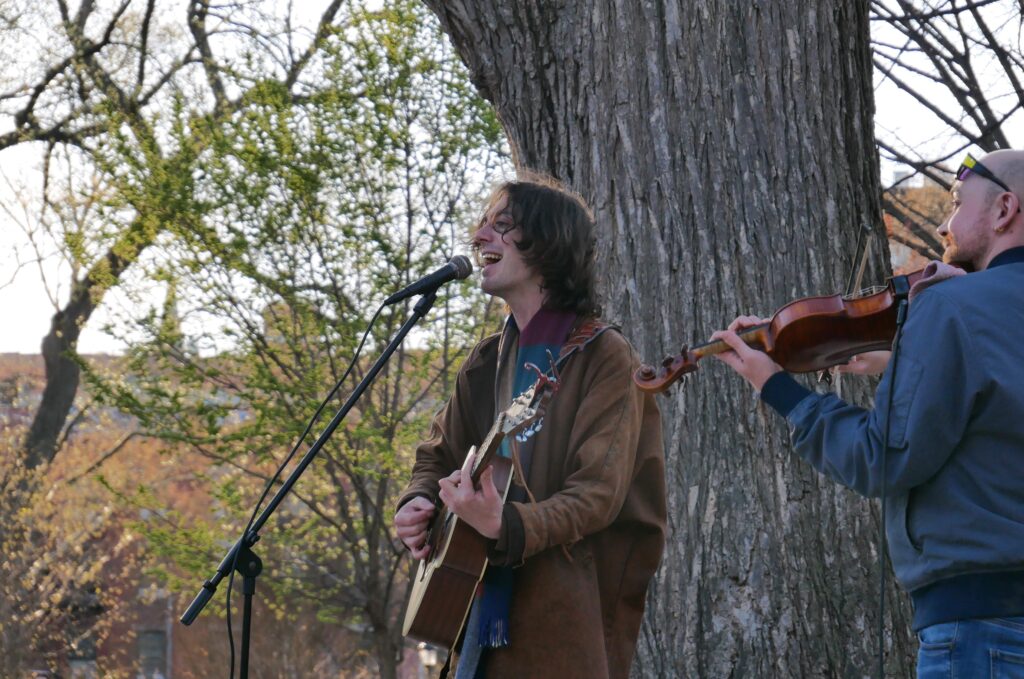
As the sun sank in the sky over Tompkins Square Park on April 11, however, dozens of people sat on the cobbled ground with their attention fixed on Leslie as he played an hour of original tunes and covers, his gentle voice accompanied by his guitar and the droning fiddle of Rili Xavier Newman.
Leslie was the final act of the day at BuskerBall, a festival where street musicians, who usually stand to the side of the city’s well-trodden paths, are the center of attention. The acts that preceded him included a jazz ensemble, performance art, a set featuring found objects and a didgeridoo, and a lively performance of the kora, a West African harp-lute strummed by Senegalese-Gambian performer Malang Jobarteh.
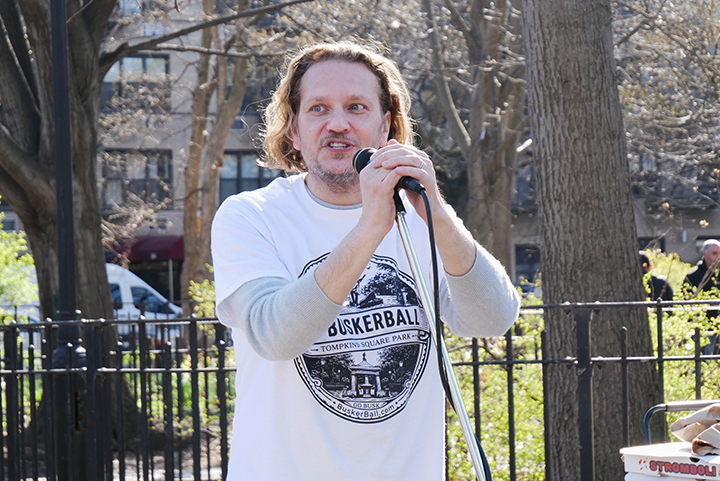
“BuskerBall is a celebration of subway and street musicians—of freedom of speech and public spaces,” said founder Theo Eastwind, a longtime busker who started the festival in 2013.
Overlooked but vital
“Buskers are very important. They’re like coral reefs—often overlooked, but vital survival for our society,” Eastwind said, pausing for a moment to gather another metaphor: “Buskers are the Jedi of free expression. As long as you see a busker in a public space, you know you’re still free.”
Exhibits encircling the mainstage told the story of busking, from its origins to the ways buskers earn a living and the issues they face, like getting run out of parks by police.
The exhibits had a central message: Buskers are serious, talented musicians who have chosen the city’s bustling streets as their main stage.
Leslie is one of them. He lives in Seattle now, but for years, his ballads were the soundtrack of sundown at Tompkins Square Park.
In warm months, he’d set up shop two hours before sunset to catch golden hour, serenading families, solo strollers and lovers until the sun set behind the brick tenements on Avenue A.
“I’ve got a few love songs that I do, and I’ve got the kind of voice that tends to lend itself more to soft crooning than energetic rock and roll, although I do try to put in a mean little trumpet solo every now and again,” he said, pursing his lips to produce a dead-accurate trumpet jazz lick.
Leslie described his sound as psychedelic folk with influences ranging from Bob Dylan and Nick Drake to contemporary Indie stars like Bon Iver. Love is a theme in many of his songs, as are animals: birds, mice and cats are just a few of his protagonists.
When Leslie moved to New York City from Amsterdam at age 19, he viewed busking as a launching pad to a career on the road, performing in venues across America and beyond.
He had been busking on and off since age nine, when he sang The Beatles’ “Yesterday” on repeat for two hours to help sell his toys. Years later, he busked his way around Europe and North Africa before crossing the Atlantic.
But as Leslie gained his footing playing in New York City’s parks, he realized the outdoors made for the perfect venue, offering far more creative control than the path of record labels and tours.
“I was a little bit hipstery, a little bit aloof,” he said. “I was like, I’d rather be in the park.”
Plus, he realized he could make a decent income from the whole busking thing. Many people think of busking as a way to earn a couple bucks, perhaps enough to buy a bus ticket to the next town over—but those dollar bills can really add up, Leslie said.
“If you get enough people around you and they all give $1, you’re going to do fine, but you do start to depend on those occasional 20s,” he said. The generosity of strangers takes many forms, from handcrafted trinkets to bags of weed, he added.
When temperatures dropped, Leslie, like many buskers, took his show underground. On his latest record, he worked with a producer whose assistant found him playing at the Second Avenue station. But over time, he became more selective.
“I figured out that if I saved up during the summer, I could kind of coast during the winter,” he said. He’d play occasional shows at venues and rooftop parties, but the bulk of his income came from those warm nights in the park.
Now, Leslie’s main gig is at a farmers market in north Seattle, where he can cover rent with a few three-hour sets every month.
“There’s plenty of times when I thought, you know, maybe I should get a real job. But it’s just not as good, is it?’ he said. “Both in terms of money—unless I went and got a degree in something, I don’t think I could beat the money—and it just feels like honest work, doesn’t it?”
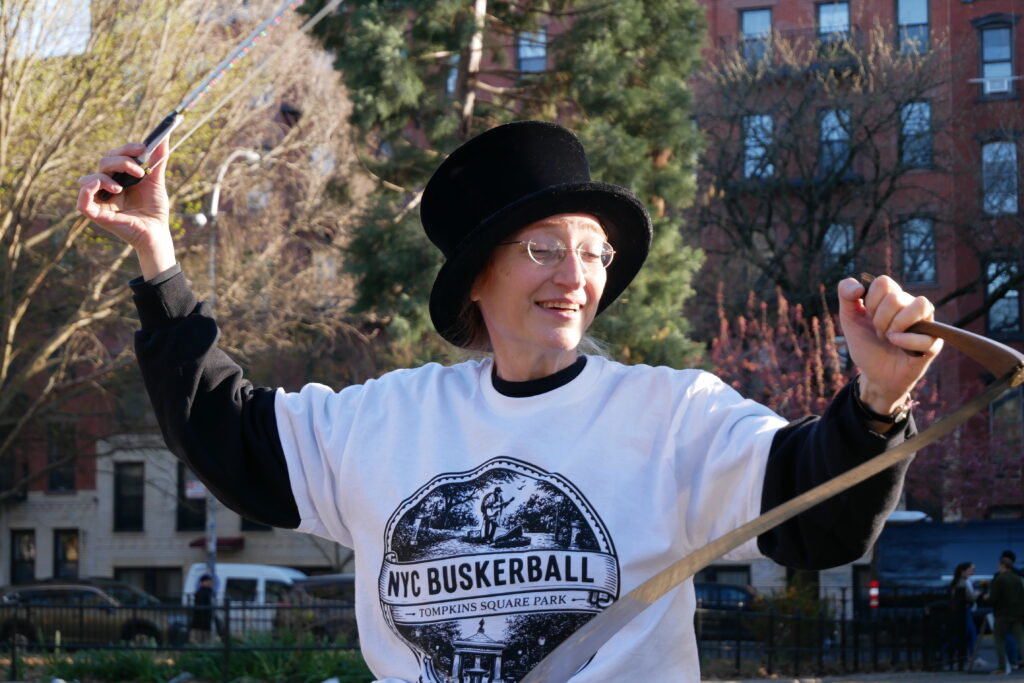
For Natalia “Saw Lady” Paruz, who played her musical saw in between BuskerBall’s mainstage performances, busking offers not just a livelihood, but a much richer experience than playing indoor venues.
“When you play at a venue, there’s this disconnect,” she said. “It’s almost as if there’s a glass wall between you and the audience. You sit on the stage with lights in your eyes, and you don’t even see them.” On the subway platform, Paruz shares a moment with everyone who stops, or even slows down, to watch her play.
“I see their faces and their smiles, and it’s like there is an exchange of energy that you don’t get on a so-called legitimate stage,” she said. “That’s why busking is so addictive to me.”
Paruz’s favorite venues are the passageways of subway stations at Times Square, Herald Square and Union Square. With the stroke of a bow and bend of the saw, she produces an ethereal tone resembling the voice of a soprano. She’s played Carnegie Hall and Madison Square Garden, but nothing beats the natural amplification and reverb of a subway station, she said —“it’s like playing inside of a cave!”
Wherever Paruz travels for a show, she always finds a street corner to play on. “It’s the quickest way to get to know a place,” she said. “Immediately you make friends. People come to talk to you. People invite you places. And even if you don’t speak the language, you start learning it as people talk to you.”
Busking offers novice and professional musicians alike a stage whenever they want it, Paruz said. “You don’t have to sit around at home waiting for a gig you feel like performing, all you have to do is leave your house and that’s it, you have an audience.”
When music venues shut down in the pandemic, busking gave local musicians a way to keep playing and surviving off of their art, Leslie said. He recommends that artists at all stages of their craft find a park near them, grab their instrument, and give busking a shot.
“If you’re a musician and you’re looking at becoming a barista as your day job to support your music career, you could just be a busker,” he said.