NYC Parks conducts preservation project of the Washington Square Arch
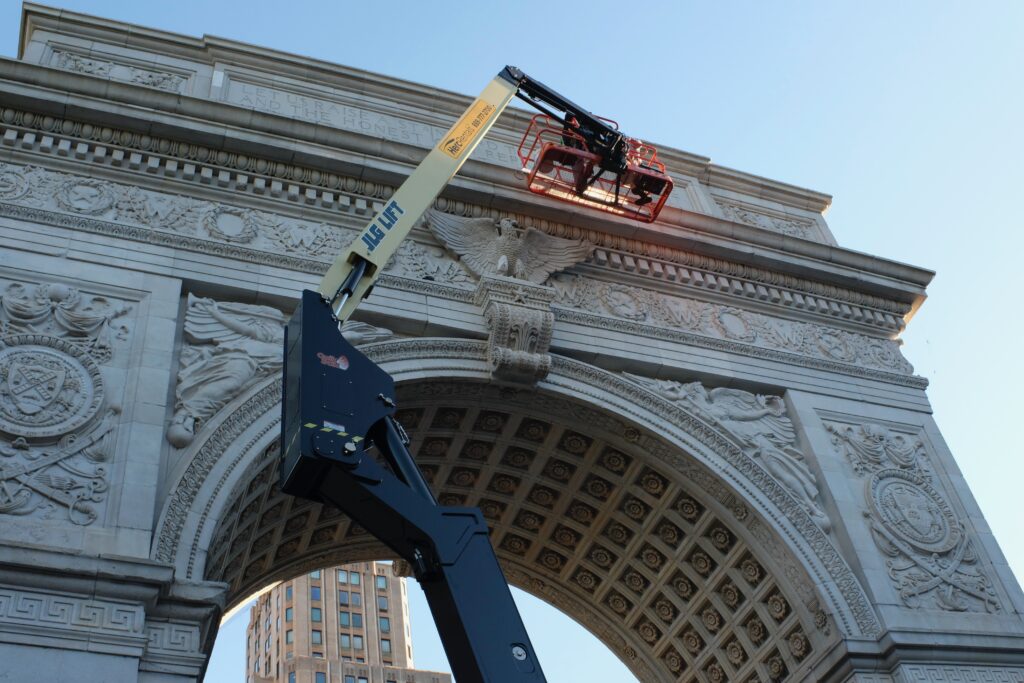
A significant conservation effort has taken place on the Washington Square Arch since the middle of September, giving the imposing, 131-year-old monument some well-deserved tender loving care.
While the arch is maintained every year, the scope of this preservation project went beyond the regular cleaning and minor masonry repairs that usually are done, said Jonathan Kuhn, director of Art and Antiquities at the New York City Department of Parks and Recreation.
“You can never stop Father Time. But we can address these conditions and that’s what preservation is about,” he said.
The bulk of the work consisted of stone consolidation. To protect the delicate Tuckahoe marble from the elements, the entire arch was cleaned and then the sculptural and decorative components were treated with four applications of stone consolidants—which followed an initial pre-consolidation treatment—to strengthen the granular surface and prevent moisture from pooling in recesses in the stone.
Workers have also installed replacement LED lights, and bird proofing will be replaced through November.
This is the most significant preservation project on the arch since 2003-2004, when the city conducted a multi-million capital project that restored the entire masonry, replaced the roof, and removed decades worth of graffiti—some painted as far back as the Cuban Missile Crisis, according to Kuhn. They also replaced the leg of the eagle on the south side of the arch, which had fallen off and disappeared.
At the arch, stone consolidation should be performed every 20-25 years, Kuhn said.
Standing at the southern end of Fifth Avenue, the Washington Square Arch is a New York City icon. And it has been, really, since it was first dedicated in 1895.
Six years earlier, New Yorkers had celebrated the centennial of the 1789 presidential inauguration of George Washington—which took place at Federal Hall in Manhattan—by building a temporary arch out of wood and plaster. It became so popular that $130,000 (about $5.2 million today) was raised to build the permanent structure, which was designed by architect Stanford White.
For decades, traffic continued to pass through and around the arch. In 1958, cars were banned from entering Washington Square Park, and in 1963, so were buses. But that wasn’t before Robert Moses got the chance to propose a four-lane sunken roadway past the arch as part of one of his many ill-fated developments. (The road never gained traction, thanks to pushback from local Village residents.)
But 131 years of exposure to traffic pollution, acid rain and temperature changes, has left its mark on the marble.
It is a delicate balance, said Kuhn, of preserving what can be preserved without diminishing its age.
“When you recarve a missing piece like the eagle’s leg, or a cornice where a corner is damaged, you sometimes cut out a piece of stone and match the profile of the stone and insert it with a pin and epoxy. But if it’s shallow, it’s actually harder and it’s seen as intrusive in the field of conservation to cut out more stone than you need to if you can help it. So we leave those alone and live with that aged appearance,” he said.
The point, Kuhn added, is that “you don’t mess with something that’s very old. This is somewhere in between, as it’s not an ancient object, but it’s a historical object that we’ve inherited, and we’re doing our best to preserve it with the technologies of our time.”
Major restoration projects like this one are costly—Kuhn’s office raised $250,000 on its own for the current project in interest as part of the Arch maintenance endowment—making the regular maintenance even more important.
“You’re day in, day out, year in, year out. That’s the most important work. If you really want to preserve things, you can’t just walk away and show up once a generation,” Kuhn said.
If all goes well, most passersby will never notice the restoration work, and it will remain the East Coast’s most recognizable arch for years to come.
“Its sheer size and complexity and artistry argue in favor of it being noticed and appreciated both as an artwork and as a historic relic of another time,” Kuhn said.