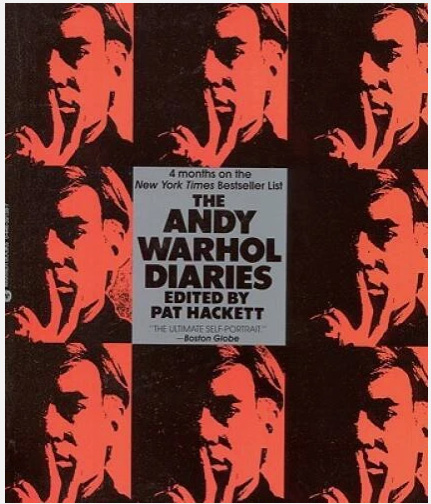
This piece covers the career of Andy’s most successful book, the explosive Andy Warhol Diaries edited by Pat Hackett.
Originally published in 1989. Highly recommended!
I am discovering something new and chilling in the Andy Warhol Diaries I had not seen before. There is a photo shoot in which Andy stabs a girl with black panties on her face. It was easy he said. A lot of fun. It’s strange because violence against women upset him greatly. I sense that Jon may have brought out in Andy the violent sex bashing he engaged in with Rod La Rod.
I don’t mean that Jon did anything physically to harm Andy, but once when they were riding a skimobile and Andy was thrown off he thought Jon was trying to kill him. On another occasion when Christopher slapped Jon in the face Andy was sure Jon had liked it.
Initially Jon’s presence gave Andy a lot of energy. Later his failure to take the relationship beyond a writing collaboration on scripts depressed him enough to blur his focus. One of the outstanding strengths Andy had was to work though anything and keep going was evident in a show at the Brooklyn Museum that emphasized the extraordinary variety of his painting techniques and the extraordinary variety of subjects. He was on one of the hottest painting streaks of his life.
His extraordinary energy level came from a strong body and constitution. A lot of that energy also came from being inside history. Millions of people around the world looked up to Andy as the greatest and most radical artist in the world. If he was a superman he was also very human. A line of sensitivity plays constantly in the back ground.
The Diaries are much like A in that there’s a enormous amount of information about Andy that is not always immediately noticeable on first reading. I have only just read for example a short phrase buried in a long sentence, “I am sick in the head.”
The Diaries could make him vulnerable to a heap of criticism. Why for example did he never look into the disastrous breakdown of Fred Hughes.
There’s no doubt Andy’s life was made a lot harder by Fred’s breakdown, yet on every occasion he brushes it aside. The fact that he did nothing to save the collapsing social world Andy, Fred, and Bob had so carefully woven around themselves lead to disastrous results.
It’s shocking to see the Warhol team in Paris in 1981 with not a single social engagement. They called around but nobody answers their phones. Clearly the numerous episodes on which Fred took his pants down, yelled and screamed at people who worked for him, got robbed by drunks on the way home or simply was not there on foreign trips multiplied by voice of mouth did the rest of it.
There has always been a seamy underbelly at the factory, but by the mid seventies it had been all but eradicated. Once one sees a split, too many people could see the horror inside the Warhol operation. Andy was still Andy. His painting was on a long hot streak, he was increasingly celebrated year by year and yet…
Then there are of course the things he choses to ignore. On the day his retrospective with Rauschenberg, Twombly, and Beuys opened at a major museum in Berlin, a vital step in rebuilding his reputation as a painter —he writes only about the museum.
On the one hand, that’s Warhol’s style that’s his mark, but I don’t know. I think there’s much more to him than we’re seeing . The underlying violence in his sexual relationship with Jon (pictured in the book in mock combat) is something unknown.
Why did he enjoy being photographed killing that girl with the black panties over her face. Why did he let that be printed in Italian Vogue? Then again, Andy’s affair with Jon as he describes it here illustrates that he was torn between the juvenile emotions of a person whose mood is violently changed by his lover’s whims. A word of affection sends him into a rhapsody, a negative remark makes him want to kill himself.
When Andy exclaim on several occasions I want to kill myself I took him more seriously each time. I finally came away shaking from these insights.
And yet in conclusion for the moment I sense a hint of finding something even greater about Andy even from his lowest depths. There’s an interview with a high school paper in the 1960s where the teenage hipster from New Jersey said: “I don’t understand all this criticism of you because really you just want to help everybody.”
There’s much sweet truth in the boy’s remark, but there’s so much pain beneath that silver exterior, by the time Andy entered his last decade he was getting desperate to fix himself. “Thirty more years to live,” he muses then leaves the question hanging in the air.
Where to look
If we want to plum the depths of the diary in our search for a better understanding of his emotional life there’s no better place to start than in A, A Novel, the origins of his diary form. A is focused on Ondine and some five or six other people who play close supporting roles, like Brigid Polk, but it also contains the most accurate self portrait of Warhol in those silver years.
By the mid 1970’s, Andy had moved into business art (which means making an art out of business). We can see this clearly in The Philosophy of Andy Warhol, his second classic book. Here the raw emotions of A have been modified into a more polished sellable frame. No crit intended. The Philosophy of A.W. is a classic book that has helped a lot of people learn how to live. It’s good in every way, but in this case particularly it’s good as the second book in the trilogy of A, A Novel, The Philosophy of Andy Warhol and Andy Warhol Diaries. All three books share in common being accounts of Andy’s life and work in Andy’s inimitable voice.
The Diaries are the easiest of the three books to read. Diaries often get boring and bog down after an active start. It’s amazing that Andy’s Diaries never do despite the triviality of some of the people and his own judgement of how “boring they are.” I think this is because his voice is so appealing, and not just the nutty cartoon voice that prattles on with a humorous tug, but the vulnerable nervous sick in the head voice that bubbles underneath the surface throughout all of Andy’s work.
The Diaries start off on a very high ride heading down to the Wyeth’s place in Pennsylvania where Andy is to hook up with Jamie Wyeth and meet the family. This connection to the Wyeth’s was a step in business art towards broadening his market. Everything goes admirably well and everybody is happy. This is followed by a gigantic Odyssey through Warhol’s Wonderland. At first, due to the careful matriculations of Fred Hughes, Andy is royally accepted by the French, particularly in the fashion world of Yves St Laurent. Indeed the house of St Laurent had a lot in common with the House of Warhol.
The early to mid seventies were a great period for Andy, in part because he had around him the best team possible for his business art period.
Fred Hughes, the suave well connected manager; Bob Colacello, the diplomatic editor of Interview and Warhol’s social secretary; Jed Johnson, his film director and companion who shared and designed the interior of his house on East 66th Street, and Vincent Fremont his most trusted reliable and efficient office manager and bookkeeper. Between them these four men helped to keep Andy protected, industrious, and successful. Through the Seventies and early Eighties. Only Andy broke up this booming operation.
So far as movement in the Diaries is concerned, death grips its last three years as more and more of his associates or acquaintances pass away, or as so many of his key working relationships break down.
Between 82-87 he loses Cutrone, Colacello, Guinness, Hughes in part, Jon G. Jean Michel, Makos in part, and on and on. He is reduced to spending his last years with his young factory workers trying to mess up and get involved in their love or sex lives.
It was terribly sad. On the other hand, when he was at his peak and for many years thereafter he was often so tongue tied or freaked out he often found nothing to say. The thing is in talking about Andy Warhol we should never forget what he gave us and what it cost him.