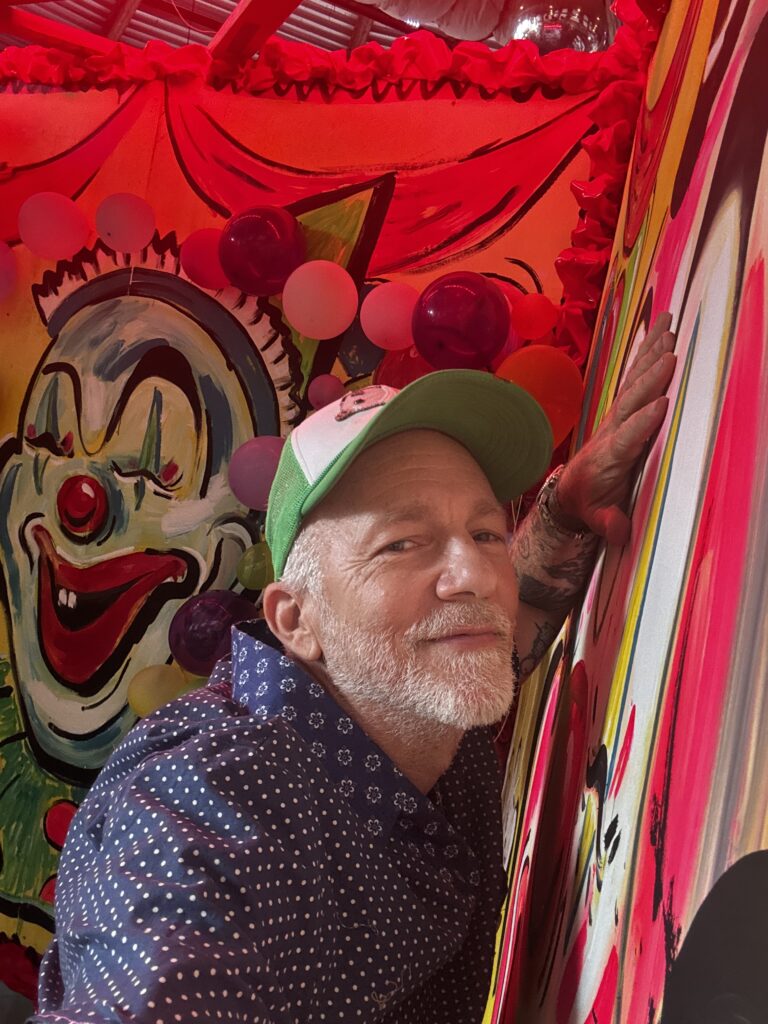
I met the artist Scooter LaForge years ago at an art opening (not his), where I was struck by how open and approachable he was. A short while later, I visited him in his Manhattan studio, which was my introduction to his visual world. Scooter’s hand-painted garments—splotchy compositions featuring Marilyn Monroe, Disney characters, aliens, and the like—have a huge fan base, thanks in no small part to legendary costume designer Patricia Field, an early champion. Scooter recently collaborated with Jason Haaf on Wasteland, a book that combines melancholic confessions about aging and desire with images of the Manhattan skyline, naked men, recognizable cartoon characters, and clowns. The approach is playful, punk, and a little perverse—in other words, totally Scooter.
How did Wasteland come about?
I saw Jason’s book at the Strand. I was attracted to the cover because it had two guys on it. I was looking for a gay romance. This was almost like a diary. I wrote him a message on Instagram to tell him how much I liked it. We became friends, and he asked if I wanted to collaborate.
He came to me with very personal confessions. I encouraged him to handwrite them. I was inspired by Frida Kahlo’s diary, which I turned him on to. I love all the imagery Frida did. It was dangerous, guttural, not the prettiest. Blood and veins and hearts.
I would then lay the pages in my studio and paint on them, add text, collage, glitter, stickers, spray paint, ink—anything I could get my hands on. Rip them apart and tape them back together so they became really abstract. Then he would take those pieces and work on them again. It became a very natural, effortless flow.
What did you discover about working together?
He’s a good generation younger than me, but he was writing things that I feel at this age and stage of my life. It felt like the heart never grows old. That was very attractive and inspiring to me.
I just let my imagery and painting flow out, very raw. It could be unattractive, ugly. I just didn’t care. It was a free-for-all with no rules or expectations. The subtraction of the ego equals magic.
Is that generally how you approach your painting?
My goal is to paint what I’m feeling, not show off or paint something pretty that somebody’s going to buy. I want it to be the essence of what’s coming out of me. I think the viewer senses that, if it works.
You often have cartoon characters and clowns in your work. Where do those come from?
These are the first images I fell in love with when I was little, from television. The Pink Panther, Popeye, all these cartoons I watched. They’ve always stuck with me. They’re my babysitters, my best friends, my comfort. Clowns are sexy to me because they have a mask. You don’t know what’s under there. At a masquerade ball, you see a man with a Venetian clown mask on, and you kiss. There’s something sexy about that.
Patricia Field has been an important figure in your life. How did you come to know her?
I moved to New York in 2001 and didn’t know anyone. I went to a nightclub one night, and after 20 minutes, I was over it. I saw this lady with flaming red hair and asked, “How do I get out of here?” She walked me to the door. It was only later, when someone approached me about selling my shirts at Patricia Field’s store, that I put two and two together.
Over the years, we became very good friends, neighbors, collaborators. She has worked with a lot of artists who painted on clothes, like Keith Haring, Jean-Michel Basquiat, and many more.
She saw something in my painted garments that she loved. Next thing you know, they’re being worn onstage by all these famous singers: Beyoncé, Rihanna, Miley Cyrus. People shopping at the store would buy the shirts, and then you’d see them onstage or on the street, in TV shows and in films. It was exciting, and it continues to be exciting.
How did you find your way into the East Village art scene?
I would hang my paintings anywhere I could hang them. I had a show in a laundromat, shows in restaurants. Pounding the pavement, trying to get in, because I didn’t know anyone. How do I do this? You meet a few people and start getting your tribe together. You support other artists and they support you. Baby steps add up, one after another.
Coming here is daunting because you don’t know what to do or how the city works. You can’t come here and be a superstar overnight. Writing, dancing, singing, making art—whatever it is. You’ve got to wait your turn.
Did you ever feel discouraged? How did you keep going?
I did feel discouraged a lot. Crying, depressed, jealous. “Why isn’t that happening to me? Look at them. Why is she touring the world?” But I had just gotten here. That’s the ego talking.
I remember having a friend here who was in a very famous band. They were touring the world, on Saturday Night Live, having hits. I thought, “Why is this happening for them? Why not me?” I’d only been here a year. But that jealousy fell away once I figured out how the city works and realized those people had put a lot of work into their craft. I didn’t know that.
At this point in your life and career, what’s a dream project?
There are a lot of dream projects. Making crazy ballet costumes, like the Ballets Russes. Or painting an airplane—with help, of course. Doing sculptures, taking one of my little characters and making it huge, in metal, and putting it somewhere public.
See more of Scooter’s work at scooterlaforgestudio.com.