
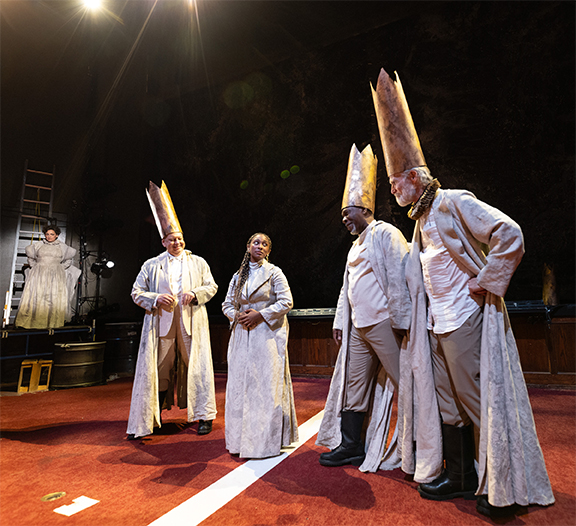
Having first premiered in 2024, Compagnia de’ Colombari’s production of King Lear triumphantly returned to the stage at La MaMa Etc.’s Ellen Stewart Theatre from January 23 to February 8, 2026. A masterclass in classical text, the production features Paul Pryce (Kent), Tony Torn (Oswald), Julian Elijah Martinez (Edmund), Michael Potts (Gloucester), Tom Nelis (France), Abigail Killeen (Goneril), Jo Mei (Regan), Celeste Sena (Cordelia), Lukas Papenfusscline (The Fool), and Abigail C. Onwunali (Edgar)—a muscular and unified cast of performers.
Director Karin Coonrod doubles all ten actors as the titular Lear, each adorned in paper crowns designed by Tine Kindermann. The condensed two-hour performance begins with ten Lears; gradually, nine crowns are shed, revealing a final Lear (Tom Nelis), both anguished and enlightened. Of course, the royal “we” is underscored through the iconic manifestation of Lear in his multitudes, acting from a place of divine political authority in his personal relationships. While this mechanism alone serves the narrative evolution of Lear towards mental and physical collapse, Coonrod unassumingly furthers its function in her meticulous use of space.
What begins as a private negotiation—the division of Lear’s kingdom—unfolds within and among the audience. As the Lears engage in hyperbolic exchanges with his daughters, spectators are implicated in the action, positioned as subjects to his outward-facing authority. Actors move through the aisles, forcing viewers to physically track the action, until some surrender to listening rather than seeing. When Cordelia is cast out, Celeste Sena meekly takes a seat among the audience and remains there for much of the performance.
With scenic design by Riccardo Hernández, the staging later expands to encompass the entirety of the stage in a subversion of expectations—the plastic curtain falling to reveal the vast depth of the space. Performers occupy both the immediate proscenium and the farthest reaches of the stage, appearing as silhouettes against the back wall or engaging in close dialogue downstage. As Lear descends into madness and his authority dwindles, his public declarations give way to private contemplation. The audience is cleverly repositioned as witnesses of his internal collapse from behind the fourth wall, rather than subjects within his domain.
Ultimately, Lear’s reckoning emerges through the magnitude of his greatest loss: Cordelia. Nelis’ embodiment of Lear conjures simultaneous feelings of devastation for a man who used to be King, as well as contempt. In Coonrod’s expert spatial dramaturgy, Lear and Cordelia’s reunion is marked by a physical union front and center. We see a final alignment between private grief and public spectacle—albeit too late. A cautionary tale about the transience of power; love endures.