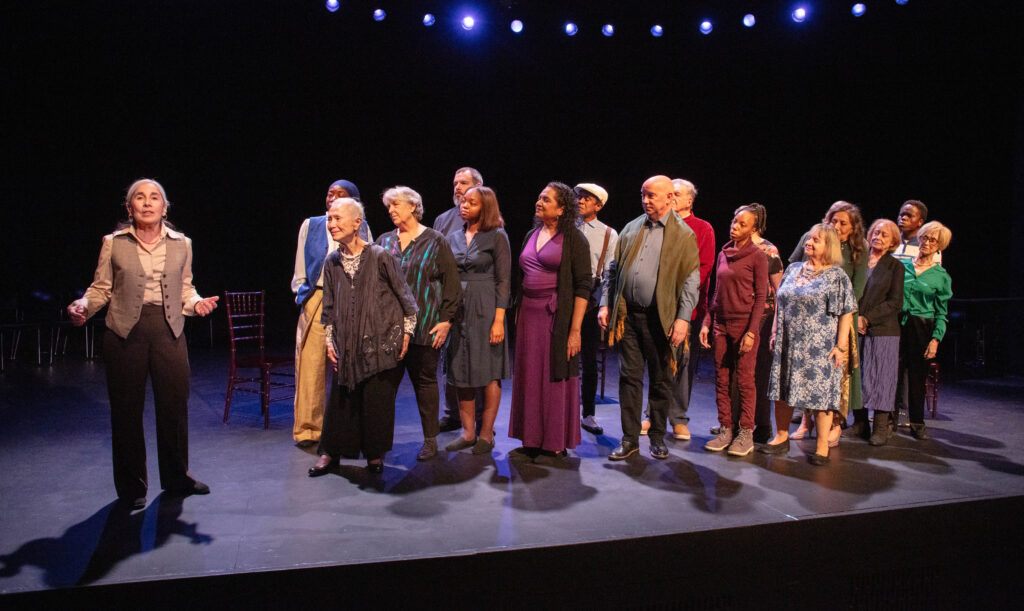
The well-made theater at Hudson Guild hides unassumingly inside the Community Center in the NYCHA Elliott-Chelsea Houses on West 26th Street. It has professional lights and sound booth, a deep and well-proportioned stage, men’s and women’s dressing rooms, 100 comfortable orange upholstered seats, and not a bad sight line in the house. I didn’t know it existed until fairly recently, and now it’s one of my favorite places anywhere.
Under Jim Furlong, the Guild’s director of arts since 1994, its productions have been crazily varied: new takes on the classics and Shakespeare; collaborations with circus performers, dance troupes, musicians, and kids in the Guild’s afterschool programs; original revues, obscure gems, contemporary dramas both traditional and avant garde. The shows are ambitious but not intimidating, entertaining but not pandering.
The most beautiful thing of all is that Jim and his crew make most of this happen with an informal, ever-shifting company of amateur players, many of whom have never performed before. I got in the door by having a piece of writing accepted for a revue called “New York Ladies” (2013). Others find their way to the stage via one of Jim’s free summer workshops, each on a different theme; the workshops often serve as incubators for the fall show, and anyone who participates is entitled to be in the cast.
As of last summer, I was a happy veteran of five of Jim’s productions. Now I’m just about bursting with pride about the unexpected events of the second half of the year. It started in June when I ran into Jim in Hudson River Park. We had a lively chat about the sorry state of the union, and before I knew it I had signed up for his 2025 summer workshop on modern drama, which would help him think through his conception of the fall show, “150 Years, 150 Moments,” a collage of scenes representing modern drama from 1875 to the present.
We discussed chapters he assigned us from Richard Gilman’s The Making of Modern Drama, and we read plays on our own, picking out our own monologues to try out in class. We shared images of modernist visual art that shocked us, and talked about why. I thought harder about modernity than I had since college. Along the way, we got to know and like and trust each other, a group ranging in age from their 20s to their 80s and experience level from newbie to Actors’ Equity member.
Then Jim floored me by asking me to co-write the show with him. And while I was pondering whether I might stay behind the scenes this time or have a small role, he asked me to narrate the show. That’s how a lifelong theater groupie who was long too shy to imagine being in a show, let alone co-writing and anchoring one, got to be a very small star for a weekend in a very big theater city.
And this was not just any show, but likely the last one to be mounted in the perfect little theater with the orange seats. The whole Community Center, Hudson Guild headquarters and the residential tower above it are about to get torn down as part of a massive demolition and reconstruction of the low-income projects and the Guild, a redevelopment led by the private developer the Related Companies. In the interim, Jim will be keeping up his usual packed schedule, working out of rented theater spaces.
Writing being a lonely pursuit, I had always vaguely imagined collaborating on a writing project, like Rose Marie and Morey Amsterdam on “The Dick Van Dyke Show.” That’s exactly what came to pass, except that Jim and I did most of our bantering and exchanging of ideas via email. First he handed me a long list of playwrights and I delivered quotations, monologues, or short scenes to represent each one’s work. When he decided to organize the vast amount of material thematically (marriage, comedy, gay themes, experimental theater, etc.) rather than chronologically, it became my job to write the intros. There were a lot of them. And I was determined to be off book.
I signed the contract in late July. The show would run the second weekend of November. I would lose two weeks during my annual August vacation. That gave us not quite three months to compress 150 years of modern drama history into 75 lively minutes (Jim’s preferred length) and to get the finished product on its feet.
Sounds daunting, right? But Jim and I had so much fun and worked so harmoniously that it never felt like work. Jim would say: give me an intro about Jewish identity. I would do some research and draft something. He would tell me to cut it in half. I would “kill my darlings,” as all seasoned writers know they must, and email it back, and into the script it would go. Sometimes I pushed him, and sometimes he pushed me, always respectfully. I angled for a scene from Caryl Churchill’s “Fen,” a play I loved. He said no. He said I should stop complaining about the solipsistic protagonist of Arthur Miller’s “After the Fall,” one of the plays I had read during the workshop.
Our final selections were quirky, sometimes a little subversive. Edward Albee, one of Jim’s idols, gets a lot of well-deserved love. A group scene from “Anna in the Tropics” from 2003 gets surprising pride of place in the “Working” section, while Miller is relegated to only Linda’s famous “Attention must be paid…” speech from “Death of a Salesman.” Eugene O’Neill doesn’t end up making the cut at all. It was our show, and we both felt the Great White men had had their time in the spotlight.
Hudson Guild’s players and audience represent the broadest imaginable slice of the New York City public. Some make their way to the Guild with little arts education, others are as sophisticated as they come, but I think we found the sweet spot: everyone involved and everyone who came to watch learned something interesting. For instance, I had no idea that European theater went through a long stagnant age in the 19th century. I now understand how radical Ibsen was, and why he’s having such a moment lately, with new productions of “An Enemy of the People” and “The Wild Duck” (also the Hudson Guild spring show) getting raves, along with the new movie “Hedda.”
Our cast of 18, on stage for the duration of the show, was a harmonious team, too. And we all learned hard-won lessons during rehearsals. This was the big one for me: the mind lags behind the director’s notes like a soundtrack out of sync. The director tells you to slow down, for instance, and you nod in understanding and willingness, but half your brain is still processing whatever you were trying to do five minutes earlier. I watched all of us, newbies and veterans alike, do this. The trick is to stop apologizing and banging your palm on your forehead. Each mistake made, acknowledged and moved on from is a mistake less likely to recur. Repetition eventually does its job.
I felt particularly proud of my smallest gesture, which appeared with no conscious thought in the last rehearsal. The challenge was to signal a mood change from some lines of Tom Stoppard’s “Leopoldstadt,” specifically this downer: “Barbarism will not be eradicated by culture,” to the Mae West chapter of the show. As if narrating weren’t privilege/responsibility enough, Jim gave me some acting bits too, and I happened to be part of the Leopoldstadt group, standing downstage center facing the audience. The others dispersed, leaving me to somehow signal a shift from somber to sexy. I did a quarter turn so that my shoulder was facing the audience. I found myself pausing, rolling that shoulder ever so slightly and—I hope—seductively, and I began my intro, in my best New Yawk nasal-ese: “Mae West wrote a play called ‘Sex’ that was produced on Broadway in 1926. It landed her in jail for obscenity….” I strutted to my narrating chair stage right.
Another favorite scene: During an homage to downtown experimental theater, the fine cast member who plays Wozzeck, the deranged proto-antihero in the opening monologue and later the “Our Town” stage manager, becomes the downtown experimental director and writer Richard Foreman. He sits alone on the dark stage slowly intoning into a mike, as though his battery is about to run out of juice, his theories: “Human beings are to a great extent UNKNOWABLE to themselves…” Dramatic lights come up on all 18 of us each doing our own silent, spontaneous movements. Each time he says the word “impulse,” which he does eight times, we freeze in mid-gesture. When he says the word RHYTHM, we vibrate in unison.
As I knew all too well from taking improv, spontaneity doesn’t come so easily. How I tried to let my body surprise me, and how my mind raced ahead planning interesting moves. I eventually realized that that’s exactly what Foreman was talking about.
As for the one-weekend, three-show run itself, I knew this already, but boy is a “live” live audience a powerful engine. On our Friday opening night they were silent, which could mean stony, or could mean focused. Jim gave me one note before the Saturday matinee: more vocal energy. I had an epiphany: I’d been conflating energy and speed, and when I sped up I inevitably stumbled. Knowing this made all the difference. On Saturday they were palpably on our side from the start. What a symbiotic relationship narrator and audience is, even if it lasts only an hour and a quarter. Maybe they were “live” because they sensed that I was “live,” by which I mean that I was relaxed and confident; I knew I could do this thing; I was reveling in doing it. By Sunday’s closing show I was already back in my head trying to recapture the magic of Saturday.
Foreman stuck with me afterward. I’d seen the forbidding pictures: wild Einsteinian hair, staring down the camera as if in no mood. I decided to spend some time with him on YouTube, and found he was not only unpretentious, he was funny and clear, wearing a zippered fleece like any regular guy. Even when he dismissed theater that merely entertains, he wasn’t mean about it. His lifelong groping toward a new kind of theater that strips bare all received ideas and ready-made gestures and sentimentality made perfect sense to me. “I’m a fallible, mixed-up human being like every single one of you,” he said to an audience at the University of Pennsylvania. “I haven’t figured out how best to use my mechanism. You haven’t either, I can guarantee you…What I am trying to do is to get back in art, in my theater, to the building blocks of experience.”
Just one of the hundreds of things I learned, fond memories I carry, and new friends I made in the theater at Hudson Guild.