In July I set out to discover what exactly is the state of poetry in downtown Manhattan. NY Poetry Fest was taking place, and several interesting invitations to book launch events landed in my inbox. It appeared I was in for a total immersion.
The first event that caught my attention was a book launch at the Tompkins Square Library in the East Village, hosted by Jeffrey Cyphers Wright. Wright is a sometimes contributor to the Village Star-Revue and considered by some in the downtown poetry continuum to be the unofficial mayor. He frequently arranges and curates readings at both Tompkins Square and the Jefferson Market Library on Sixth Avenue in the West Village.
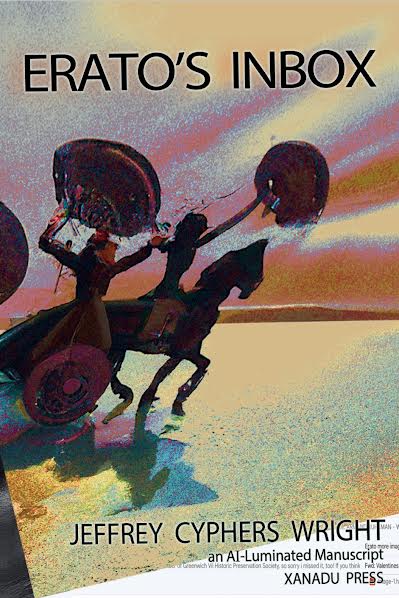
The Tompkins Square event was a dual book launch for Cyphers’ AI-illuminated, full-color book Erato’s Inbox and How to Live Under Fascism by the estimable Andrei Codrescu, of National Public Radio fame. Having been born and raised in Romania during the reign of communist dictator Nicolae Ceausescu, Codrescu’s poems carry the weight of history. Both poets were supposed to read. Sadly, Codrescu was hospitalized with a health emergency. Poets Michael Andre, Greg Masters, Elaine Equi and Jerome Sala stepped to the microphone and read pieces from Codrescu’s book, which also includes his photographs. Wright treated the audience to a reading from his new Erato’s Inbox, which is a delightful confection of word and image.
The Countess Alex Zapak, one of my favorite people, came to meet me at the library. When the reading ended, we went to Hekate’s, a nonalcoholic bar around the corner on Avenue B. We were joined by the star of the show Jeff Wright, the artist Shalom Neuman, and Lee Klein. The Countess was in town from London to collect her cat. She was leaving two or three days hence and I was pleased she took the time to join us.
The First Nautical Outing
The next day I hied down to South Street and caught the ferry to Governor’s Island for the 14th edition of New York Poetry Festival, which was a mixed bag. First, I encountered a genuine control-freak attitude on the part of the organizers: NY Poetry Society. I was stopped at the entry to the festival and surrendered to a demand for my name and email. It was already in their system. I had registered to attend online.
Registration was required so they can bombard you with daily promotional and fund-raising emails. For example, I received a begging email from someone identifying as the CEO of NY Poetry Society. To me, the idea of a hierarchy corporatizing poetics is oxymoronic at best. Then there are ongoing emails extending the deadline to register for a somewhat silly sounding, and pricey, “poetry camp” taking place in August.
Personally, I got enough camp at the tent for New Words Press, which caters to readers and poets from the transgender community. There I was presented with a bookmark carrying their motto “be trans – do poetry,” which I found a somewhat tortured juxtapositional notion. I did not say so to the amiable person under the shade of the tent. I have a collection of bookmarks, and this one is a keeper.
One delightful experience was stopping by the New School tent and engaging with Laura Cronk, who holds the title of Poetry Chair of the creative writing faculty. She was there handing out prescriptive poetry, based on micro-analyses of visitors’ personal revelations. (NY Poetry Festival was founded as a graduate student’s master’s thesis, according to Cronk.)
By way of my own micro-analysis, I explained that these days people are so sure of themselves and rigid in their political positions that I often find myself not engaging at any level. I summed up by quoting W.B. Yeats’s last line of the first stanza of The Second Coming: “While the worst are full of passionate intensity.”
Cronk searched through a selection of previously prepared prescription slips and gave me the following quote by Bernadette Mayer: “I’ve nothing at all to say but to exercise / my freedom to speak about everything / now that poems’ve got everything in them / even rhetoric and dailiness plus the names of things again.” Cronk told me to read it twice a day for two weeks, then repeat as needed. I have been and must admit it helped give me the gumption to write parts of this article, regardless of any backlash that may result.
The heat was sweltering. I made my way along the shady pathways between tent-tops sheltering publishers of poetry and other poetry-adjacent organizations: Vona is an organization that presents writers’ workshops. At their table I was given ginger candies and a sticker bearing the James Baldwin quote “Write. Find a way to keep alive and write. There is nothing else to say.”
CavanKerry Press is focused on autobiography. Pen and Brush is a 130-year-old art gallery and independent publishing endeavor. Their slogan is: “Until It’s Just About The Art.” That notion seems to me to be undermined by its exclusionary, contemporary, gender-focused mission statement. The crew under the tent for Black Lawrence Press were generous enough to hand me a business card with no explanation.
Linda Kleinbub was there with her Pink Trees Press. Scientists and Poets is a micro-press in Brooklyn. There were tents offering food and drink at festival prices, which were beyond my means as a writer for the Village Star-Revue.
I had an engaging chat with Dominika Wrozynski, the program director of the Hudson Valley Writers Center in Sleepy Hollow, NY. She told me that the center is also the home to Slapering Hol Press. “Slapering hol” is old Dutch for Sleepy Hollow. Wrozynski gave me a copy of their most recent chapbook Running With The Hare by Jemma Leigh Roe. I read it.
I also met the artist Heide Hatry. She gave me a copy of Flacofolio, her book collaboration with Leonard Schwartz. Their effort is all about Flaco, the Eurasian eagle owl that escaped from the Central Park Zoo and lived and hunted in the park and environs for a year before it died after colliding with a building on the Upper West Side. Flacfolio consists of “micro essays,” some of which could be called prose poems and illustrative material by Hatry.
Ivy Brown Gallery has an exhibit of Hatry’s work derived from her obsession with the owl. The artist has a background in the rare book trade. Many of her assemblages reflect this. There’s also a painting by the poet e.e. cummings on display, from the artist’s personal collection. The exhibit can be seen by appointment and runs through August 7.
I made my way around to the various stages where “poetry” was being read, or performed if you prefer. It was rather bleak. Hate and anger were rampant. Hate, whether for President Trump, Israel, or former paramours, is NOT poetic, no matter how much emotion it contains. The content of much that I heard and saw, along with the heat, enervated me to the point where I left before seeing the headliners.
I am a free speech absolutist. I don’t believe in banning disinformation, misinformation, conspiracy theories, or “hate speech.” Say and write whatever you want, and people’s feelings be damned. The First Amendment is sacrosanct. The exceptions to my stance are incitement to violence against any individuals or groups, support for terrorism, and the proverbial shouting “fire” in a crowded theater (unless it really is on fire).
However, the creative writing programs that churn out some of these folks striving to fulfill Yeats’s definition of the worst might do well to emphasize Wordsworth’s definition: “Poetry is the spontaneous overflow of powerful feelings: it takes its origin from emotion recollected in tranquility.” The emphasis these days seems to be on emotion, and immediacy.
Since several of the readers I heard were introduced with references to their academic credentials my overall response to their efforts is as follows: the now-commonly accepted grammar-school-soccer custom of “everyone gets a trophy” seems to have morphed into a grown-up version that says, “everyone is a poet.” (As long as they pay their tuition?)
Poetic Cinema
Before I departed the island, I was asked to be part of a video being produced by Pandora’s Garden Studio, a YouTube channel created by Rose Bryant and Jordan Resnick. It was supposed to be a silent 15-second clip. I insisted on speaking, and afterward they said it would be the closing segment of their effort. Pandora’s Garden Studio’s big hit thus far is It Starts With Darkness, which won Best Short Film at the East Village New York Film Festival.
Speaking of short films, my pal Bret Roberts arrived in Manhattan from Italy the day after my festival experience, and that evening we had dinner along with our mutual friend the actress Anna Maria Cianciulli. Roberts is a poet, painter, and acclaimed actor. The short film JDM Twenty Seven was released on Amazon Prime the week before. He plays America’s rock & roll poet Jim Morrison. The piece is dark, poetic, hallucinatory and thoroughly mesmerizing – everything I love in a short. The acting, direction, and editing are all spot on. It’s a pay-per-view release, but well worth $2.99. Roberts publishes his poetry in very limited, bespoke editions hand-tailored for each individual patron.
Westbeth and Xanadu
I had a day off before jumping back into the fray. This time it was a multiple-book launch for titles published by prominent writer and multi-media artist Barbara Rosenthal’s Xanadu Press and eMedia Loft. The location was the Westbeth community room.
A THC-infused beverage was served. That made me extra happy that I decided to attend. There was also wine for anyone so inclined. The company included the notable literary light Victor Bockris, who is in town for a couple of months from his home in Philadelphia. He has the sad but worthy task of archiving the works of his recently deceased lady friend Marcia Resnick.
The lovely Kathryn Rieber, who will soon be providing Village Star-Revue readers with downtown theater coverage, was also there. The poet of many names, Atanasio DiFelice, was in attendance.
Most of the authors of the various books were there. I could not possibly read all the titles before my deadline, so let me list them: poetic license / poetic justice by Allan Douglass Coleman; Odd Men Out (or in) poems by Barry Wallenstein with photography by Barbara Rosenthal; This Is What I Owe You by Kristin Hart; Sitting Book by Bonny Finberg.
Jeff Wright was there. His Erato’s Inbox was published by Xanadu Press. (DISCLAIMER: I am NOT Jeffrey Cyphers Wright’s publicist, despite appearances. He is a friend of many years, and he is a presence pretty much everywhere poetry is being presented in the downtown continuum.)
One of the other Xanadu books is Fortitude by Sena Clara Creston. It is a book of her photographs of forts that she built on the beach, from driftwood. I went through it page by page. At first, I thought I was looking at failed attempts to build huts or lean-tos. Then I realized the title is a play of the words “fort” and “attitude.” Creston is an installation artist. Anyone who built forts as a child will be delighted by this sumptuous B&W tome and the memories it stirs.
Further Nautical Adventures
The next day I received a text message from Reid Stowe, my friend from the downtown scene of the 1980s, and the world’s greatest living adventurer. (If you don’t believe me, check Wikipedia.) He was inviting me for a Sunday sail on the Hudson, aboard his historic schooner Anne. Of course, I accepted.
A short while later I received a text from Atanasio DiFelice, who seems to be almost as ubiquitous on the poetry scene as Jeff Wright. His message insisted I attend a reading and book party Sunday evening, after Reid Stowe’s excursion. He invoked the name of the late Allen Ginsberg, and I had to accept. Since the Countess had long gone back to Great Britain, I invited the soon-to-be theater writer Kathryn Rieber to come along.
The outing on the Hudson was delightful. A few of Reid’s friends were there, including the supermodel and artist Maxine Hoover. As we set sail, a drenching downpour lowered both the humidity and the body temperatures of those on board. Soon everyone was drying in bright sunshine. Food and beverages were served buffet style mid-deck and bonhomie prevailed.
I was surprised when we tied up at Stowe’s current dock in Jersey City. The captain and adventurer requested the passengers to stay aboard to hear me read a sonnet from his copy of my recent chapbook Be Merlin. It was well received. Another guest sang an Italian opera aria, and the afternoon broke up.
Rieber, who can be seen and heard as a poet many Monday evenings when Bob Holman’s Bowery Poetry Club hosts the Nuyorican Poets Café open mic, and I caught a lift to the Weehawken waterfront for a ferry to midtown. A subsequent taxi ride deposited us at the corner of Bleecker and Bowery. A few quick steps and we arrived at Von, the popular watering hole and event space, just in time for the reading.
The Beats Go On
The reading was a book launch for Aliah Rosenthal’s new chapbook Kiss My Assteroid. It took place downstairs in a charming and old-school Village room. Aliah Rosenthal is Allen Ginsberg’s godson. Bob Rosenthal, Aliah’s father and Ginsberg’s longtime secretary, was in attendance.
Anne Waldman, one of the founders of the Poetry Project in the East Village and the undisputed grande dame of American poetry was there. She co-founded, with Ginsberg, the Jack Kerouac School of Disembodied Poetics in Boulder, Colorado. Rieber had returned recently from attending a session there.
My one regret when on the ferry fleeing the heat and vitriol at NY Poetry Fest was that I would miss Waldman’s headlining performance. I have not seen her perform since the late 1970s in the Bay Area. She was at Von only as an audience member. I probably should learn to be more tolerant and resilient. Oh well.
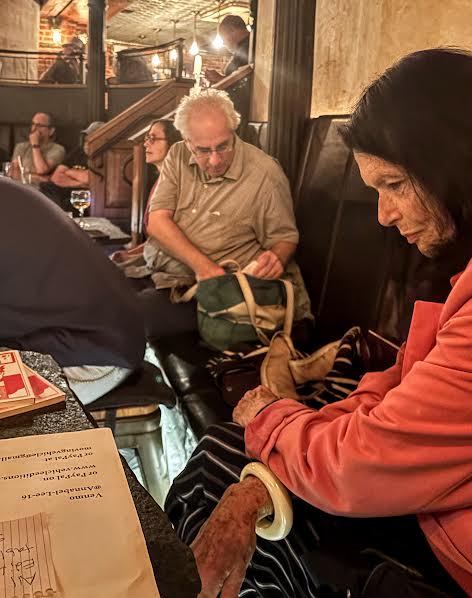
Annabel Lee (yes, her name is spelled the same as in the famous poem by Edgar Allan Poe) was the mistress of ceremonies at Von and read some of her own poetry. Sophie Malleret also read. Victor Bockris gave a powerful and moving talk about the importance of Marcia Resnick. Coco Gordon Moore also read. She’s the daughter of Kim Gordon and Thurston Moore, founding members of Sonic Youth and the songsmiths who wrote the tune Hits of Sunshine (for Allen Ginsberg).
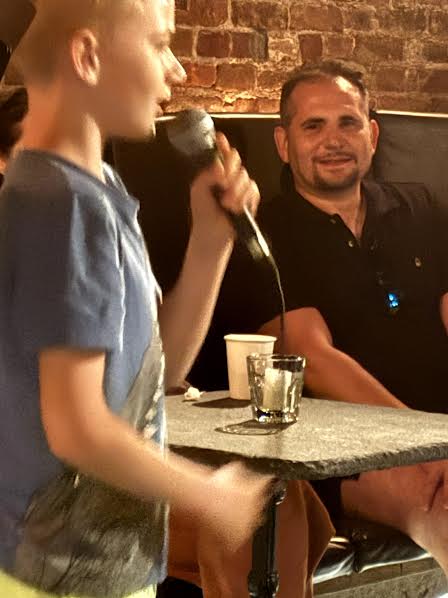
Nine-year-old Jack Rosenthal, son of Aliah and grandson of Bob, designed the cover for his father’s chapbook. He also read twice during the event and displayed a fantastic aptitude for performing. He oughta be in pictures.
Atanasio DiFelice read as Tom D’Egidio. When I asked him what that was all about, he said it was his “Mafia name, because the Mafia guys all used to call me Thomas Crowne.” I have no idea and did not have a follow-up question.
Aliah and his family were in from Europe where, it’s my understanding, he works with the Chinese artist and activist Ai Weiwei, whose father was a poet and good friend of Allen Ginsberg. Atanasio DiFelice – I’m sticking with that name – wasn’t kidding when he said that Ginsberg’s spirit was in the room. It was an authentic and worthwhile experience being there.
So, what is the state of poetry in downtown Manhattan? It’s full of artistic politics and jockeying for position. Despite such inclinations, overall, the scene is healthy and vibrant. The consummate example of that healthiness is Bowery Poetry Club, which has poetry events every night of the week. Bob Holman, shortly after opening Bowery Poetry Club, told a New York Times reporter, “They say no one has ever gone broke running a bar in New York, but we’re going to give it a shot.”
He, the club, and poetry are still going strong.
-30-
Stephen DiLauro is a playwright, poet and arts journalist. His most recent chapbook, a suite of six somewhat salty sestinas, is titled The Flowers of Eros California.