
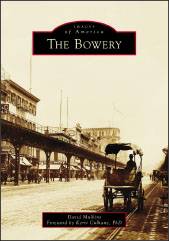
Before there was a city, there was a crooked path. Today, we call it the Bowery—one of New York’s oldest streets and most fiercely contested strips of cultural real estate. Winding from Chatham Square to Cooper Square, it predates the city’s grid and bears the weight of centuries: from Lenape footpath to Dutch wagon trail to the stomping ground of soldiers, artists, drunks, poets, and punks.
In his compact and absorbing new book, “The Bowery,” David Mulkins traces this history with the zeal of a preservationist and the flair of a born storyteller. Mulkins, president of the Bowery Alliance of Neighbors, cofounded the group in 2017 to protect the street’s remaining historical buildings, preserve the character of the neighborhood and fight overdevelopment. His book is both a meticulous chronicle and a pointed reminder: in a city where real estate often trumps memory, history still has its defenders.
Slumming it downtown
The Bowery was home to the city’s first theater district—an affordable one. It drew people from all walks of life across its many immigrant communities: Chinese, Irish, Italian, German, and Jewish.
Two of America’s greatest songwriters—Stephen Foster (“Oh! Susanna”) and Irving Berlin (“White Christmas”)—hummed a few bars here. Poet Walt Whitman (“the Bowery Boy of literature”) and writer Stephen Crane found inspiration in its streets.
Businesses sprang up to meet the demand of its growing crowds: saloons, gambling dens and brothels soon earned the Bowery its notorious reputation. “Slumming tours” for the upper crust became fashionable. When that trend passed, the hoity-toity lifted their skirts, stepped over the streams of urine and sashayed uptown.
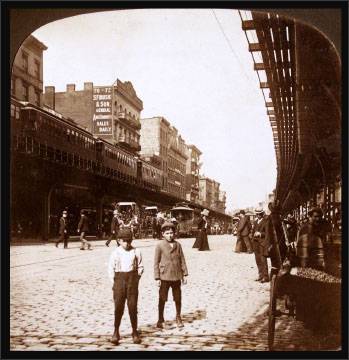
“This bustling Bowery street scene, looking north from Canal Street, shows the Third Avenue Elevated train, horsedrawn carriages and streetcars, and an ad for an auction house at 70-72 Bowery.” Photo courtesy of David Mulkins.
Eating the rich
From the 1920s on, the Bowery housed businesses like restaurants and lighting supply shops, but the neighborhood grew steadily seedier, filling with transients in cheap lodging houses. The Great Depression deepened its decline, cementing its reputation as “America’s skid row.”
By the 1950s and ’60s, artists moved into abandoned commercial lofts — cheap spaces with good light. Mark Rothko painted his Four Seasons murals at 222 Bowery, confessing he hoped they would “ruin the appetite of every son of a bitch who ever eats in the room.” (Mulkins has a bloodhound’s nose for zingers like these.) One of my favorite Beat poets, Diane di Prima, shacked up with LeRoi Jones (aka Amiri Baraka) at 27 Cooper Square, where they co-edited their influential literary journal Floating Bear.
Ellen Stewart founded La MaMa Experimental Theatre Club, and the Amato Opera House, with its 107 seats, made a home at 319 Bowery as “the world’s smallest opera house.” CBGB (RIP) helped launch punk rock — the Ramones, Television, Talking Heads, Blondie and Patti Smith — before becoming a John Varvatos retail store, a transformation many saw as a tone-deaf symbol of the corrupting influence of money on the city’s cultural legacy.
Walking tour highlights
Don’t be deceived by the slim size of “The Bowery.” Part of the “Images of America” historical series, this little paperback is jam-packed with insight. Mulkins organizes his material both chronologically and thematically. He covers topics like architecture, the arts and the Bowery’s place in literature, film and song.
The images are rich, but it’s the captions that steal the show. They are consistently lively, detailed and surprising.
This is a book that begs to be taken out on foot. Mulkins points to the Beaux Arts–style Citizens Savings Bank at 58 Bowery, which he contrasts with today’s “fly-by-night storefront bank branches.” He draws attention to the New York Marble Cemetery —a block-long green space tucked behind Bowery, Second Avenue and Second Street — calling it “one of the Bowery’s best-kept secrets.” And then there’s the Liz Christy Garden on the corner of Houston Street, once a garbage-strewn lot and now the city’s first community garden, brought to life by dedicated volunteers.
“The Bowery” is more than a neighborhood guide. It’s a preservation effort in paperback form: a defense of memory, place, and the ragged dignity of lives lived outside the spotlight. Mulkins doesn’t sanitize the Bowery’s history, and he doesn’t let us look away. Instead, he invites us to see. A community garden where a vacant lot once rotted. A neighborhood built not just on bricks and bones, but on stories.
In these pages, the Bowery isn’t just a street. It’s a battleground over what matters to a city’s people. An unruly, outsider past confronts a conformist, profit-driven future.
Tenderness on skid row
Mulkins is deeply interested in the people who have kept the Bowery’s history alive. Their no-nonsense spirit is invigorating. When photographer Berenice Abbott was warned in the ’30s that “nice girls” don’t go to the Bowery, she replied, “I’m not a nice girl. I’m a photographer.”
If you’re a history buff, this book is a treasure trove. If you’re not, I challenge you to flip through it and not be drawn in by the faces and footnotes: Buffalo Bill with his rifle, Houdini with his handcuffs, and JoJo “the Dog-Faced Boy” in his military jacket (real name: Fedor Jeftichew, who, Mulkins tells us, “spoke three languages, commanded a high salary and was nobody’s fool”).
Mulkins doesn’t flinch from the darker chapters of the city’s history: the slave trade, minstrel shows and breadlines are all here. One of the book’s most moving images, by Joseph C.A. Mercurio, shows two men sleeping on a stoop, one resting his hand gently on the other’s head, as if to keep watch through the night. It’s a quiet reminder that even in suffering, what sustains us is the compassion we show one another. With or without a roof over their heads, the Bowery was home.


“The Bowery” book review by Michael Quinn was powerful and brough to life the living story of this street illustrated in the book. Although the book chronicles the history of the Bowery, it also underscores its contemporary relevance.